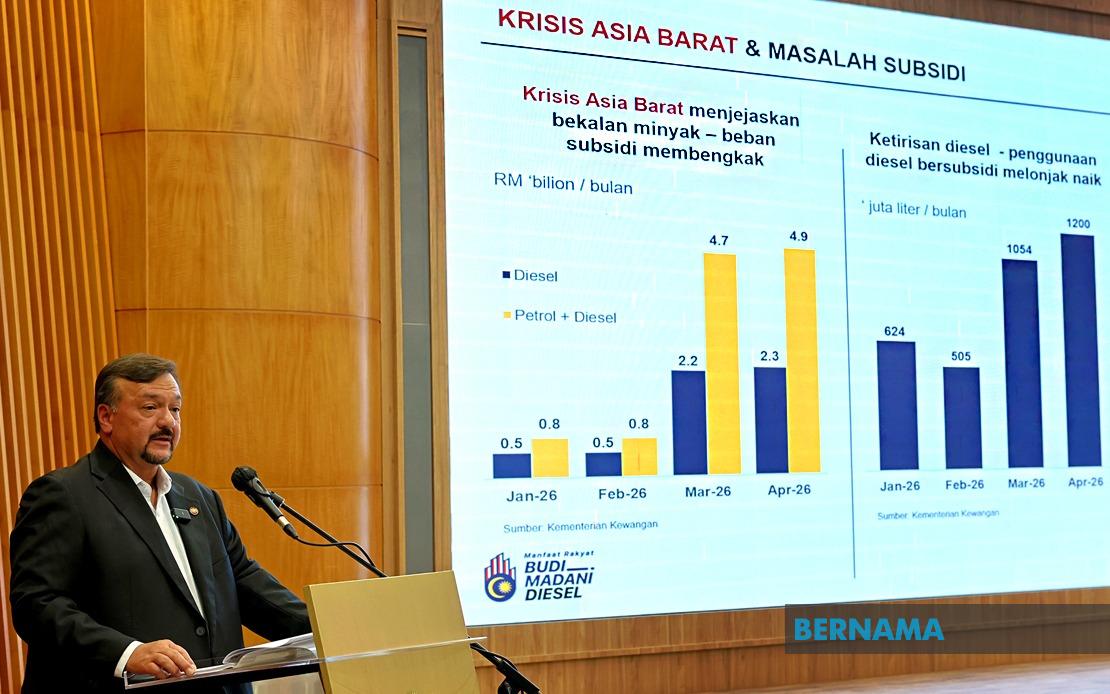
Malaysia's government will maintain the BUDI95 petrol subsidy quota at 200 litres monthly for now, pending a fuller assessment of how ongoing Middle Eastern geopolitical developments influence global oil pricing. Finance Minister II Datuk Seri Amir Hamzah Azizan announced the decision here today, signalling that policymakers remain cautious about committing to any increase in fuel entitlements until the regional situation stabilises and its market implications become clearer.
The reduction of the monthly BUDI MADANI RON95 quota from 300 litres to 200 litres earlier this year reflected concerns about petroleum price volatility and fiscal strain on the subsidy programme. Now, officials are adopting a wait-and-see posture following preliminary peace negotiations between the United States and Iran, which concluded with a 14-point memorandum of understanding last Friday. Amir Hamzah acknowledged that determining whether these diplomatic efforts will succeed and what lasting peace in West Asia might mean for oil supply remains highly uncertain at this stage.
The 60-day negotiation window outlined in the US-Iran accord creates a natural assessment period for Malaysian policymakers. Amir Hamzah stressed that rushing to restore the higher 300-litre allocation would be premature when the ceasefire's durability and broader market consequences are still unknown. This cautious approach reflects the delicate balancing act between providing relief to subsidy-dependent motorists and protecting government finances from unpredictable commodity shocks. The minister indicated that any decision on restoration would hinge on demonstrated improvements in regional stability and corresponding oil price behaviour.
Prime Minister Datuk Seri Anwar Ibrahim expressed qualified optimism earlier this week about the diplomatic breakthrough, though he too acknowledged that a final comprehensive agreement remains subject to completion within the 60-day period. His remarks suggested the cabinet is monitoring these negotiations closely and views them as a potential turning point. However, the Malaysian government's fiscal position means that oil price movements remain a critical variable in subsidy planning, and officials cannot afford to make commitments based on optimism alone.
Data released by Amir Hamzah provides insight into how the current 200-litre quota has functioned in practice. Approximately 80 per cent of BUDI95 subsidy recipients use less than 200 litres monthly, indicating that the reduced ceiling captures the genuine consumption patterns of most participants. This suggests that while the headline reduction from 300 litres sounds significant, the actual impact on typical qualifying motorists has been modest. The minister's observation that most users fall below the threshold implies the subsidy scheme is now better targeted toward those with genuine transport needs rather than those exploiting higher quotas.
The government is simultaneously encouraging voluntary fuel conservation measures to relieve pressure on the subsidy budget. Amir Hamzah highlighted initiatives promoting remote working arrangements, which directly reduce commuting and petrol consumption among eligible employees. Such complementary policies aim to lower overall demand without further tightening the quota ceiling. By framing conservation as a shared responsibility, officials are attempting to build public acceptance of the more restrictive allocation while maintaining programme viability.
For Malaysian motorists and the broader economy, the government's holding pattern means planning around the 200-litre monthly benchmark for the foreseeable future. Those accustomed to the 300-litre allowance have had months to adjust their budgeting and consumption habits, and the government's reluctance to restore that level suggests it is unlikely to do so without dramatic improvements in fiscal conditions or oil market dynamics. This stability in policy, even if disappointing to subsidy recipients hoping for an increase, provides clarity for household financial planning and reduces uncertainty.
The regional geopolitical dimension carries particular significance for Southeast Asia. West Asian instability directly threatens maritime routes through which substantial volumes of global oil transit, including supplies destined for Malaysian refineries and regional consumers. Any protracted conflict or disruption in the Strait of Hormuz would reverberate through energy markets across the region, affecting not only crude prices but also refined product costs. Malaysian policymakers are therefore justified in treating the US-Iran ceasefire as potentially consequential for broader economic stability, not merely as a bilateral issue.
International crude prices have remained volatile this year, and Malaysia's refining sector and domestic fuel consumers bear direct exposure to those fluctuations. The government's fiscal capacity to sustain fuel subsidies depends fundamentally on maintaining reasonable oil price levels. If West Asian tensions reignite or the ceasefire collapses, crude could spike sharply, rendering any restoration of the 300-litre quota unsustainable without massive budgetary strain. Conversely, if the ceasefire holds and leads to a genuine thaw in relations, sustained lower oil prices could eventually create room for more generous subsidy allocations.
The BUDI95 scheme itself has evolved significantly over recent years as successive administrations sought to target subsidies more efficiently while managing fiscal pressures. The current 200-litre quota represents a middle ground between fully removing the fuel subsidy, which would impose severe hardship on lower-income motorists, and maintaining unlimited access, which fuels fiscal deficits and encourages wasteful consumption. This design reflects hard-won lessons about subsidy reform in developing economies. Malaysia's approach differs notably from some neighbours that have attempted more aggressive liberalisation with mixed social and political consequences.
Looking forward, the Malaysian government faces competing pressures: constituent demand for affordable fuel, fiscal constraints limiting subsidy budgets, environmental concerns about encouraging petrol consumption, and macroeconomic exposure to oil price swings. The decision to hold the BUDI95 quota steady while monitoring West Asia demonstrates an effort to manage these tensions pragmatically. By explicitly linking any quota restoration to observable improvements in regional stability and oil market conditions, officials are setting measurable criteria rather than making arbitrary policy reversals.
For the subsidy programme's long-term sustainability, Malaysia ultimately needs either significantly lower global oil prices sustained over many years or a gradual shift toward more targeted, time-limited subsidies combined with broader transport and energy efficiency investments. The current equilibrium at 200 litres, if it proves durable, may represent a useful resting point while policymakers work on deeper structural reforms in fuel pricing and transport policy. However, such reforms require sustained political will and must navigate complex social acceptability questions, particularly among those most dependent on affordable petrol.
The government's decision reflects pragmatic incrementalism rather than a definitive long-term strategy. By explicitly tying the 300-litre restoration to observable West Asian developments, Malaysia's leadership is maintaining policy flexibility while avoiding premature commitments that could prove fiscally ruinous if international conditions deteriorate. This approach grants the government time to monitor ceasefire implementation, assess oil market responses, and develop more comprehensive subsidy and energy policies that address both immediate affordability concerns and longer-term fiscal and environmental sustainability.

