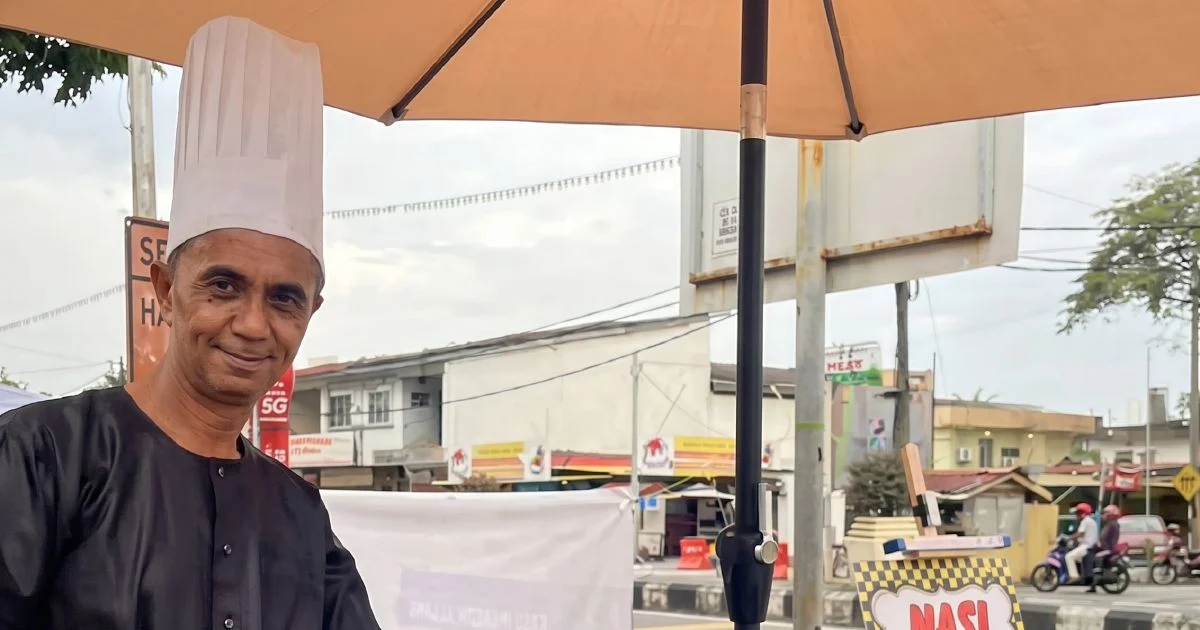
When fire consumed his residence on Jalan Atas Paloh in Kota Baru during 2021, one local entrepreneur refused to surrender to misfortune. Instead of allowing the catastrophe to define his future, he channelled his resolve into establishing a street food business, where he now hawks nasi lemak packets priced at just RM1 each—a determination that has resonated deeply with his community and offers a striking lesson in resilience amid adversity.
The loss of his dwelling represented far more than property damage; it threatened to erase the financial security he had painstakingly built. Many would have sought extended assistance from relief programmes or relocated to pursue other opportunities. Yet this vendor chose a path that demanded ingenuity and grit. Rather than waiting for comprehensive support or rebooting his life elsewhere, he identified a genuine gap in the local market—the demand for authentic, affordable comfort food that speaks to the everyday needs of working-class Kelantan residents.
Nasi lemak, Malaysia's unofficial national breakfast, carries cultural weight across the nation. The dish represents accessibility and shared identity, transcending socioeconomic boundaries through its simplicity and flavour. By pricing his packets at RM1, the vendor has positioned himself not as a profit maximiser but as a community provider. This pricing strategy reflects both pragmatism and a philosophical stance: that small margins sustained by high volume could sustain his household while maintaining his standing among neighbours and regular patrons.
The economics of street vending in Kota Baru demand careful calibration. Input costs for rice, sambal, coconut milk, and accompaniments have risen steadily, squeezing margins that were already thin at RM1 per packet. The vendor's ability to operate profitably at this price point suggests either exceptional sourcing skills, operational efficiency, or a willingness to absorb modest losses as an investment in community goodwill. Such generosity, intentional or circumstantial, creates customer loyalty that transcends transactional relationships.
His story carries particular resonance in Kelantan, where economic opportunities remain constrained relative to more industrialised states. The state's economy relies substantially on agriculture, small-scale commerce, and tourism, limiting stable employment prospects for residents without advanced qualifications. Street vending and informal food businesses remain vital survival mechanisms and entrepreneurial outlets for thousands. This vendor's success, modest as it may appear to outsiders, represents genuine achievement within this context—he has created sustainable income without formal capital, bank loans, or government contracts.
The decision to document his journey through video content reflects evolving attitudes toward informal economies and grassroots entrepreneurship in Malaysia. Social media platforms increasingly celebrate street vendors and small business operators, shifting cultural narratives away from viewing hawker trades as fallback occupations toward recognising them as legitimate, often innovative business models. This visibility can amplify customer bases, attract sympathetic attention from journalists and social platforms, and occasionally generate opportunities for expansion or partnership.
For Malaysian policymakers and urban planners, vendors like this illustrate why informal economies demand protection rather than suppression. Regulations that criminalise or burden street food sellers undermine resilience mechanisms that ordinary residents depend upon during hardship. Licensing frameworks, safety standards, and operational guidelines should balance public health with economic accessibility. The vendor's emergence following catastrophic loss demonstrates how economic flexibility and low barriers to entry enable rapid recovery and adaptation.
His competitive advantage extends beyond pricing. Operating in Kota Baru, he serves a demographic largely composed of wage labourers, students, and tradespeople for whom RM1 nasi lemak represents genuine value. Market saturation with competing food stalls proves inevitable in any town, yet differentiation through reliability, quality, and reasonable pricing creates sustainable positioning. Regular customers form the backbone of street food businesses; they become repeat patrons who recommend vendors to friends and family, creating organic growth.
The broader narrative here transcends individual success. It encompasses themes of adaptive capacity, community interdependence, and the resourcefulness that characterises Malaysian street culture. The 2021 fire could have ended this man's economic participation entirely; instead, it catalysed a transition that arguably strengthened his connection to his neighbourhood. His nasi lemak stall now functions as both livelihood and social institution—a gathering point where residents refuel before work and share daily concerns.
For Southeast Asian readers navigating economic uncertainty and underemployment, this vendor exemplifies possibilities within informal sectors. While street vending demands long hours, exposes operators to weather and regulatory scrutiny, and offers limited job security, it remains accessible to individuals with minimal capital. Building clientele through consistency and fair dealing produces sustainable income without requiring formal credentials or institutional support.
Moving forward, the vendor's trajectory raises questions about scaling and sustainability. Could his model expand to multiple stalls or train family members? Would growth compromise the authenticity and personal touch that drew initial customers? These considerations become relevant as his story attracts wider attention. Whatever direction emerges, his demonstrated ability to rebuild after devastation and contribute meaningfully to his community represents the kind of grassroots resilience that underpins everyday Malaysia—often invisible, consistently undervalued, yet absolutely essential.

