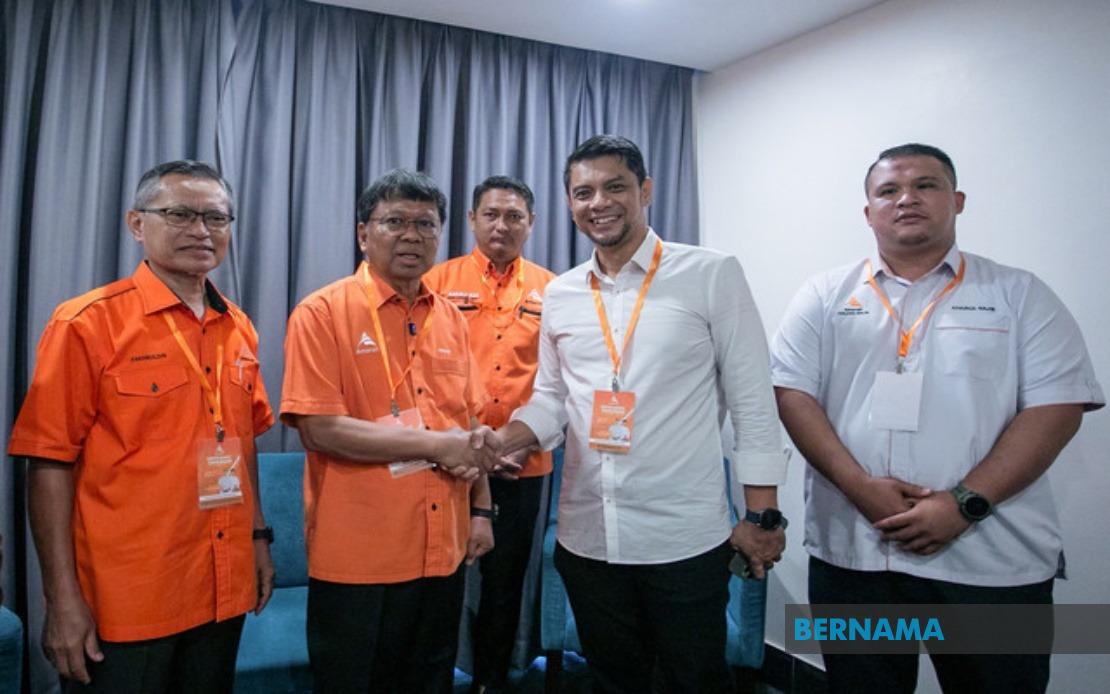
Former Titi Serong state assemblyman Hasnul Zulkarnain Abd Munaim has returned to Parti Amanah Negara following nearly six years outside the party, a move that reflects shifting dynamics within Perak's political landscape and Amanah's evolving membership strategy. The readmission, approved during the party's National Management and Leadership meetings on June 18, comes as Amanah seeks to consolidate support in the state ahead of the 2026 general election cycle.
Perak Amanah chairman Datuk Asmuni Awi announced the decision at the Tambun branch's annual gathering, emphasising that the party leadership had determined the timing was now appropriate to consider applications from former members wishing to rejoin. This represents a notable shift in approach, as Asmuni acknowledged that while Hasnul Zulkarnain had expressed interest in returning previously, party circumstances had not permitted formal discussion until now. The chairman framed the policy change within the broader context of strategies adopted by competing parties, suggesting Amanah recognises the strategic value of reabsorbing experienced former cadres who retain ideological alignment with the party's principles.
Hasnul Zulkarnain's political journey over the past six years illustrates the volatile nature of Malaysian state politics, particularly in Perak where coalitions have shifted dramatically. In March 2020, during the turbulent period following the collapse of the Pakatan Harapan federal government, Hasnul Zulkarnain resigned from Amanah alongside two other Perak assemblymen—Yong Choo Kiong of Tronoh and A. Sivasubramaniam of Buntong, both from DAP. The three declared themselves independents in response to the formation of the Perikatan Nasional administration in Perak, a move that reflected both personal political calculations and dissatisfaction with existing coalitional arrangements at the state level.
His subsequent pivot toward Bersatu in July 2020 further underscored the opportunistic nature of political alignments during that transitional period. However, the intervening years have seen significant recalibrations in Malaysian politics, including the eventual fracturing of Perikatan Nasional and the return of Pakatan Harapan to federal power in 2022. These broader shifts appear to have created space for Hasnul Zulkarnain to reconsider his position and seek readmission to Amanah, where he had previously served as the party's youth chief in Perak.
Asmuni's characterisation of the readmission as evidence of retained loyalty among former members suggests Amanah is banking on the notion that departures, while politically disruptive, did not necessarily reflect ideological abandonment. By framing the policy as recognising shared values and commitment to the party's struggle, the chairman attempts to present Hasnul Zulkarnain's return not as a contradiction of his earlier exit but as a natural reunion based on enduring principles. This messaging is particularly important for Amanah's internal cohesion, as it reassures current members that past leavers can be welcomed without undermining party discipline.
For Perak specifically, Hasnul Zulkarnain's return to Amanah carries practical implications. As a former assemblyman with territorial knowledge and established networks in Titi Serong, his reinstatement provides the party with experienced ground-level operatives capable of mobilising voters in what remains a contested state. Perak has been a battleground between Pakatan Harapan and opposition forces, with assembly seats frequently changing hands. In this context, every experienced campaigner and former elected representative potentially contributes to electoral calculus.
The broader pattern of party movements in Perak during 2020 reflected not merely individual ambition but genuine upheaval in state governance. The collapse of the Harapan state government in February and March 2020 created a vacuum that Perikatan Nasional exploited. Within this chaos, assemblymen defected to independency and subsequently chose between Bersatu, Umno, and PAS, each offering different political futures. That Hasnul Zulkarnain has now chosen to reverse course and return to Amanah suggests either that his interim political experiences proved unsatisfactory or that the current configuration of Perak politics appears more conducive to Amanah's prospects than it did when he departed.
Amanah's explicit acknowledgment that other parties have pursued similar readmission policies indicates this is not an isolated initiative but part of a broader Malaysian political trend. As coalition structures solidify and parties consolidate support, welcoming back departing members can serve multiple strategic purposes: it signals flexibility and pragmatism to wavering supporters, it recovers experienced cadres without requiring extensive recruitment and training, and it can provide psychological momentum by framing returns as vindication of the party's trajectory. However, such policies also carry risks, as readmitted members may retain residual loyalties or grievances that could destabilise party unity if not carefully managed.
Hasnul Zulkarnain's public expression of gratitude to the party leadership, combined with his framing of readmission as a vote of confidence in his contributions, suggests a careful choreography designed to present the move as mutually beneficial. Neither party nor individual is portrayed as making concessions; rather, both are depicted as recognising optimal timing and mutual advantage. This narrative construction is significant because it avoids the appearance that Amanah is desperately seeking members or that Hasnul Zulkarnain is returning out of necessity rather than conviction.
Looking ahead, the success of this readmission will be measured not merely by Hasnul Zulkarnain's individual performance but by whether it catalyses a broader recalibration of Amanah's position in Perak politics. If the party can successfully integrate former members while maintaining internal coherence, it may strengthen its electoral standing. Conversely, if readmissions generate perception of inconsistency or if tensions arise between those who remained and those who departed, the strategy could backfire. For Malaysian observers, this development illustrates how political realignments at the state level remain fluid, and how parties continuously adjust tactics to maximise organisational capacity and electoral viability.

