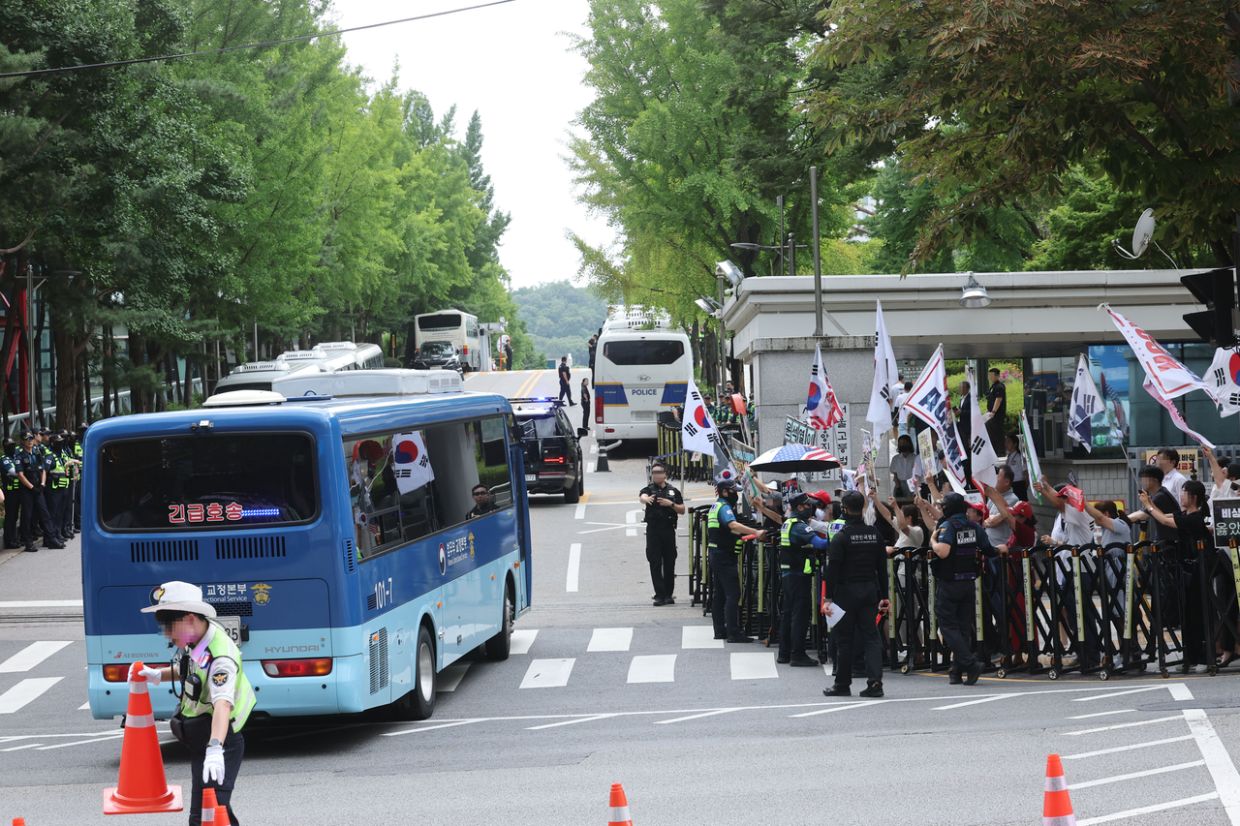
Former President Yoon Suk Yeol of South Korea received a two-year prison sentence on Monday after the Seoul Central District Court found him guilty of breaching campaign finance regulations by accepting free polling services. The conviction centered on 14 surveys valued at 27.92 million won (approximately $18,600) that were provided by political operative Myung Tae-kyun during Yoon's presidential campaign period. The ruling represents a pivotal development in South Korea's continuing efforts to enforce stricter standards around campaign financing and political conduct among its highest office holders.
The court's decision rested on establishing that Yoon had violated the Political Funds Act by receiving in-kind contributions outside the framework prescribed by law. Presiding Judge Lee Jin-gwan emphasized the foundational importance of opinion polling to democratic processes, noting that when surveys are supplied in exchange for political favours rather than through legitimate commercial channels, the integrity of elections becomes compromised. The judiciary's reasoning highlighted how unreported polling assistance can distort public perception and create unfair advantages for particular candidates, thereby undermining the competitive balance that free elections demand.
While prosecutors had originally charged Yoon with conspiring with his wife, former first lady Kim Keon Hee, to receive a substantially larger number of surveys totalling more than 270 million won across the June 2021 to March 2022 timeframe, the court ultimately convicted him only on the 14 surveys for which it found sufficient evidence. The distinction between the prosecutors' original charges and the court's findings underscores the rigorous evidentiary standards applied in high-profile political cases, where judges must weigh competing claims about the scope and nature of alleged misconduct.
The arrangement between Yoon, his wife, and Myung operated through an implicit understanding rather than explicit written agreements. The court determined that Kim Keon Hee had effectively delegated to Myung the authority to control when polls would be conducted, what questions they would contain, how they would be administered, and whether their results would be made public. Critically, the judges found that Yoon was aware of this arrangement and tacitly consented to it, thereby establishing his knowledge and participation in the scheme. This tacit agreement framework proved legally sufficient to establish culpability despite the absence of direct written evidence of explicit conspiracy.
The court also identified a quid pro quo element to the arrangement, finding that Yoon had promised Myung the ruling party's presidential nomination would go to former lawmaker Kim Young-sun in exchange for the polling services. The judges determined that Yoon subsequently used his influence through Chang Je-won, his then-chief of staff, to exert pressure on the People Power Party's internal nomination process to ensure Kim Young-sun's selection. However, the court emphasized that establishing this explicit exchange of favours was not legally necessary to prove a Political Funds Act violation, suggesting that the improper receipt of in-kind contributions alone constituted sufficient grounds for conviction.
Myung Tae-kyun, the political broker who supplied the polling services, received an 18-month prison sentence and was immediately taken into custody in the courtroom. His conviction and imprisonment alongside Yoon's demonstrates the court's determination to hold all participants in illegal campaign finance arrangements accountable, not merely the political figures who benefit from such arrangements. The parallel sentencing reflects a judicial philosophy that views political operatives and brokers as essential links in corrupt schemes who bear significant responsibility for enabling misconduct.
The conviction of Yoon stands in notable contrast to the treatment of his wife in related proceedings involving the same polling services. Kim Keon Hee faced separate charges under the Political Funds Act and was acquitted at both the trial and appellate court levels. Judge Lee explained that the court could not treat the allegations in Yoon's case and Kim's case as identical, a distinction that reflects how courts assess individual culpability even within interconnected schemes. In Kim's case, lower courts found that prosecutors failed to demonstrate she received a quantifiable financial benefit equivalent to the survey costs or that the polling was provided specifically in exchange for political favours toward Kim Young-sun.
This divergence in outcomes between husband and wife, despite their involvement in the same underlying arrangement, may seem puzzling to observers unfamiliar with South Korean jurisprudence. The distinction ultimately turned on whether prosecutors met their burden of proving direct personal benefit and explicit quid pro quo in each individual's case. The different standards applied suggest the courts viewed Kim's role as more peripheral or indirect compared to Yoon's more central role in directing the arrangement and leveraging it for political advantage through party nomination processes.
The Supreme Court is scheduled to deliver its final verdict in Kim Keon Hee's case on Thursday, which may clarify or further refine the legal standards being applied to campaign finance violations among high-level political figures. For Malaysia and other Southeast Asian democracies facing their own challenges with campaign finance transparency and political accountability, the South Korean proceedings offer instructive lessons about how courts can enforce campaign finance laws even against sitting or former leaders. The case demonstrates both the possibilities and complications of prosecuting complex political misconduct where multiple actors participate in arrangements that may operate through implicit understandings rather than explicit written evidence.
Yoon's conviction and imprisonment represent a significant moment in South Korea's ongoing reckoning with political ethics at the highest levels. The country has witnessed multiple former presidents face legal consequences in recent decades, suggesting an institutional commitment to applying the rule of law without regard to political status. Whether this precedent will deter future campaign finance violations or establish clearer boundaries around permissible political conduct remains to be seen, but the decision signals the judiciary's willingness to intervene decisively when democratic processes are compromised by undisclosed financial arrangements and promised political favours.

