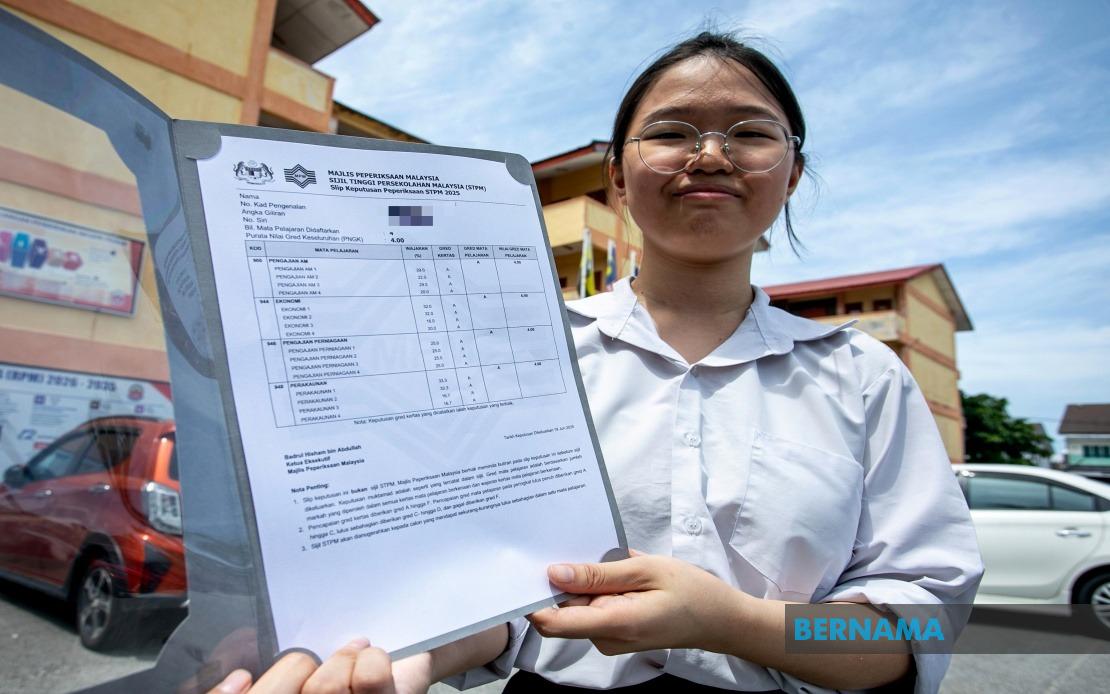
Yong Xin Yi, a final-year student at Sekolah Menengah Kebangsaan Jalan Tasek in Ipoh, has emerged as a standout performer in the 2025 Sijil Tinggi Persekolahan Malaysia examination with an exceptional achievement of four A grades across all subjects. The 20-year-old's accomplishment reflects a deliberate, methodical approach to academic preparation that combines classroom engagement with structured independent study, demonstrating that excellence in Malaysia's most rigorous pre-university qualification requires both consistency and strategic planning.
Central to Xin Yi's success was an unwavering commitment to a disciplined revision schedule that she maintained throughout her final years of secondary education. Each day after school hours, she devoted five hours to consolidating her understanding of course material, setting aside the period between 5:00 pm and 10:00 pm for focused study. This consistency proved crucial in maintaining momentum across multiple demanding subjects simultaneously, allowing her to retain complex concepts while progressing through new material. For Malaysian students preparing for STPM, such structured scheduling offers a practical framework that balances the demands of four subjects without sacrificing depth of understanding.
Equally significant to her revision schedule was Xin Yi's deliberate prioritisation of attentive participation during classroom instruction. Rather than relying heavily on after-school study to compensate for inattention in lessons, she recognised that comprehending concepts directly from teachers significantly reduced confusion and time spent deciphering material independently. This approach aligns with educational research suggesting that active classroom engagement creates stronger foundational knowledge, enabling more efficient revision periods. Her philosophy challenges the common misconception among students that lengthy study hours can overcome insufficient classroom focus.
Xin Yi achieved A grades in General Studies, Principles of Accounting, and Economics—subjects that collectively demand distinct skill sets spanning analytical thinking, numerical competency, and policy understanding. Her cumulative grade point average of 4.00 places her among the most accomplished STPM candidates nationally. Remarkably, she was one of five students from her school to achieve this four-A benchmark in 2025, suggesting that SMK Jalan Tasek's academic environment and teaching quality contributed meaningfully to her preparation.
Among her subjects, General Studies presented the greatest academic challenge, as it demands not merely content mastery but refined writing technique, format awareness, and insight into assessment criteria. Rather than treating this difficulty as an insurmountable obstacle, Xin Yi responded by allocating disproportionate attention to that subject, systematically addressing her perceived weakness before it could compound during examinations. This proactive problem-solving mindset—identifying gaps and addressing them directly—represents a valuable lesson for Malaysian students navigating subjects outside their comfort zone.
Completion of all assigned homework formed another cornerstone of her strategy. While homework might appear routine, Xin Yi recognised its pedagogical value in reinforcing understanding and identifying weak areas requiring additional focus. For Malaysian secondary students, homework completion transforms from mere compliance into a diagnostic tool revealing which topics require deeper engagement during independent revision. Her approach demonstrates how utilising every available learning opportunity, rather than viewing coursework as an obligation to minimise, contributes substantially to examination success.
Beyond personal discipline, Xin Yi's achievement reflects the foundational role of family support in academic success. Her parents, working as a clerk and phone salesman respectively, provided consistent encouragement throughout her studies despite their own demanding work schedules. She explicitly acknowledged that her success was not purely individual but resulted from their emotional and practical backing. This recognition carries particular significance in the Malaysian context, where family dynamics and parental investment heavily influence student outcomes, yet often receive less emphasis than individual effort in achievement narratives.
Xin Yi's motivation extended beyond personal achievement toward familial obligation and gratitude. As an only child from a working-class family, she articulated a clear intention to leverage her academic success to improve her family's circumstances and repay her parents' sacrifices. This perspective reflects values deeply embedded in Malaysian society, where educational advancement functions not merely as personal advancement but as a pathway toward family prosperity and intergenerational mobility. Her determination to pursue further study stems partly from this familial responsibility alongside genuine intellectual interest.
Looking forward, Xin Yi intends to pursue university studies in economics at Universiti Putra Malaysia, a choice grounded in careful assessment of personal aptitude and career prospects rather than external pressure or convenience. Economics as a discipline aligns with her demonstrated analytical capabilities and offers substantial employment opportunities in Malaysia's expanding financial and policy sectors. Her decision-making process illustrates how STPM performance should catalyse informed choices about university and career directions rather than serving as merely a numerical endpoint.
The economics field itself holds particular relevance for Malaysia, where growing sophistication in financial planning, development policy, and international trade demands graduates with rigorous quantitative and analytical training. Xin Yi's pathway into this field contributes to building human capital in a sector crucial for sustaining Malaysia's economic competitiveness. Her example may inspire other students, particularly from modest economic backgrounds, to consider demanding fields like economics where genuine intellectual engagement and strong foundational knowledge create genuine competitive advantages.
Xin Yi's journey offers several replicable insights for Malaysian students pursuing STPM. Her success demonstrates that exceptional results emerge not from extraordinary talent or exceptional circumstances, but from consistent application of proven strategies: focused classroom participation, structured revision schedules, systematic problem-solving, completion of assigned work, and family support. The discipline required—maintaining five hours of daily study across two years—is considerable but achievable for motivated students, making her achievement attainable rather than exceptional in the sense of being uniquely talented.
For educators and parents, her trajectory suggests that investing in classroom quality and encouraging students to engage meaningfully during instruction may yield superior outcomes compared to emphasising extra tuition and supplementary classes. The Malaysian education system increasingly recognises that STPM success depends on genuine understanding rather than rote memorisation or test-taking tricks. Students like Xin Yi, who prioritise comprehension and systematic skill-building, are better positioned to succeed not merely in examinations but in university studies and professional practice thereafter.