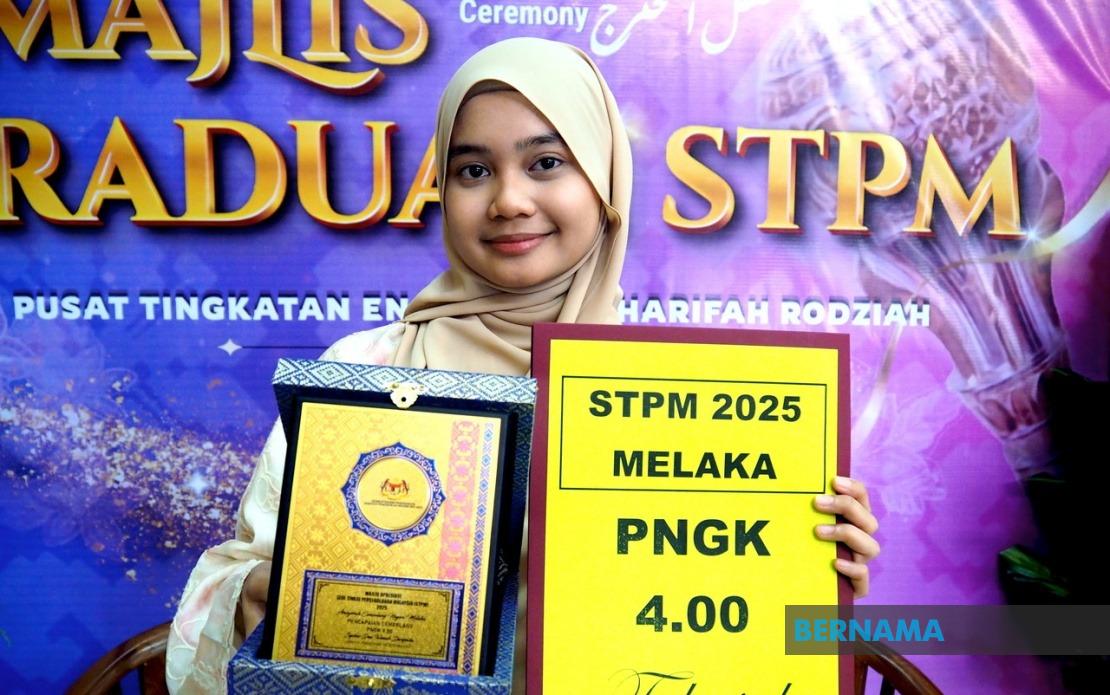
Nurfariesya Nasywa Hamedee's path to academic excellence was forged not in privilege or straightforward circumstance, but through the crucible of grief and unwavering determination. The 21-year-old student from Sekolah Menengah Kebangsaan Agama Sharifah Rodziah in Melaka has achieved a perfect Cumulative Grade Point Average of 4.00 in the 2025 Sijil Tinggi Persekolahan Malaysia examination, a milestone that carries profound personal significance beyond the statistical achievement. Her success is intricately tied to a moment of profound family tragedy that occurred several years earlier, when her father Hamedee Asri, then 43 years old, suffered a fatal heart attack just days before she was scheduled to sit for her SPM trial examinations.
The circumstances surrounding her academic breakthrough reveal a story of resilience that resonates deeply with Malaysian families navigating both educational aspiration and unexpected hardship. When her father passed away, Nurfariesya found herself grappling not only with grief but with a sudden shift in family circumstances. The loss was sufficiently disorienting that she seriously contemplated abandoning her education entirely, having concluded that her most pragmatic contribution to her household would be to enter the workforce and supplement the family income. This represented a critical juncture where her academic trajectory might have been fundamentally altered by circumstance rather than choice. Instead, what proved transformative was her late father's parting counsel, delivered through her mother Yusnita Ruslan, urging her not to squander her potential and to continue pursuing her studies with determination.
This final message became the philosophical anchor that stabilised her during turbulent months of grief and uncertainty. Rather than serving as a temporary consolation, her father's words evolved into a sustained motivational framework that guided her through the years of secondary schooling that followed. She recognised that honouring his memory meant honouring his faith in her capabilities, transforming what could have been a moment of permanent disruption into a catalyst for deeper commitment to academic excellence. The psychological dimension of this journey—converting loss into motivation—illustrates why her eventual achievement resonates beyond the numerical score itself.
When Nurfariesya received her STPM results during the state-level announcement ceremony in Telok Mas, presided over by Datuk Rosli Abdullah, the State Deputy Exco for Education, Higher Education, and Religious Affairs, she acknowledged her own surprise at attaining the perfect 4.00 score. Her preliminary expectations, based on trial examinations and her own calculations, had centred on a CGPA of approximately 3.92. This variance between expected and actual outcomes underscores a phenomenon often observed among high-achieving students: conservative self-assessment combined with thorough preparation yields outcomes that exceed even one's own projections. Her academic trajectory had already demonstrated considerable promise, with seven distinctions in her SPM examinations providing a strong foundational performance.
Beyond the numerical achievement, Nurfariesya's subject selection and career aspirations illuminate her intellectual interests and provide context for her sustained academic commitment. She elected to pursue General Studies, Arabic, Usuluddin, History, and Shariah—a combination reflecting a deep engagement with Islamic jurisprudence and theological study. This specialisation is not arbitrary; she has harboured aspirations toward a career in Shariah law since her school years, representing a confluence of personal conviction and intellectual direction. Such clarity of purpose distinguishes her from many students whose academic performance, while strong, may lack comparable thematic coherence. Her intention to pursue a Bachelor's Degree programme at Universiti Malaya, combined with her recent interview completion for admission, demonstrates that her STPM achievement functions as a platform for advancing toward concrete professional objectives rather than serving as an end in itself.
When discussing the mechanics of her academic success, Nurfariesya articulated a philosophy notably free from claims of exceptional methodology or secret formulae. Instead, she attributed her achievements to disciplined study habits, psychological resilience in the face of difficulty, and spiritual faith. This straightforward assessment carries considerable pedagogical value for younger Malaysian students contemplating their own examination trajectories. She emphasises that excellence emerges from consistent application rather than innate brilliance, from persistence through setbacks rather than natural ease, and from maintaining emotional equilibrium under pressure. Her willingness to attribute success partly to faith in Allah also reflects the worldview of many Malaysian students for whom religious conviction provides both psychological resilience and moral framework.
Nurfariesya's deliberate choice of STPM over the International Baccalaureate or other post-secondary pathways merits examination, as it reveals strategic thinking about educational pathways within the Malaysian system. She recognised STPM as offering a more compressed timeline relative to some alternative qualifications while simultaneously maintaining robust recognition within Malaysian higher education institutions. This pragmatic assessment of institutional structures demonstrates that her achievement is not merely a function of intellectual capability but also of informed decision-making about educational architecture. Her understanding that qualification choice shapes trajectory speaks to a maturity of educational perspective that extends beyond classroom performance.
The broader context of Melaka's 2025 STPM results also featured another remarkable achievement: Ng Zhen Hong from Kolej Tingkatan Enam Tun Fatimah received the National-Level Best Student Award for the Science Stream. Ng's accomplishment, built upon ten SPM distinctions and aspirations toward Chemical or Electrical Engineering at Universiti Malaya, represents the complementary pathway of scientific rather than humanities excellence. His approach—dedicating one to two hours daily to revision, viewing scientific challenges as stimulating rather than overwhelming—parallels Nurfariesya's disciplined framework while operating within different subject domains. Together, these achievements illustrate that Malaysian secondary education is producing students capable of world-class performance across diverse intellectual domains.
For Malaysian families navigating educational pressure combined with economic or personal hardship, Nurfariesya's trajectory offers both inspiration and practical insight. Her experience demonstrates that profound grief need not derail educational ambition, that parental guidance can reverberate powerfully across years, and that institutional structures like STPM can facilitate rapid progression toward degree-level study. Her articulation that success requires not exceptional talent but rather consistency, determination, and faith provides demystifying perspective on academic excellence that may counter narratives of innate gifting or privilege. She represents the category of Malaysian student whose achievement emerges from character and commitment rather than circumstantial advantage.
Looking forward, Nurfariesya's pathway toward Universiti Malaya and a potential career in Shariah law represents the contribution that Malaysia's secondary education system facilitates within professional and intellectual domains. Her perfect STPM score functions as credential, certainly, but more importantly as validation of sustained commitment to meaningful intellectual and professional direction. The perfect 4.00 CGPA becomes not merely a statistical achievement but a chapter in an ongoing narrative of honouring her late father's faith in her potential, channelling personal loss into purposeful academic and professional contribution.

