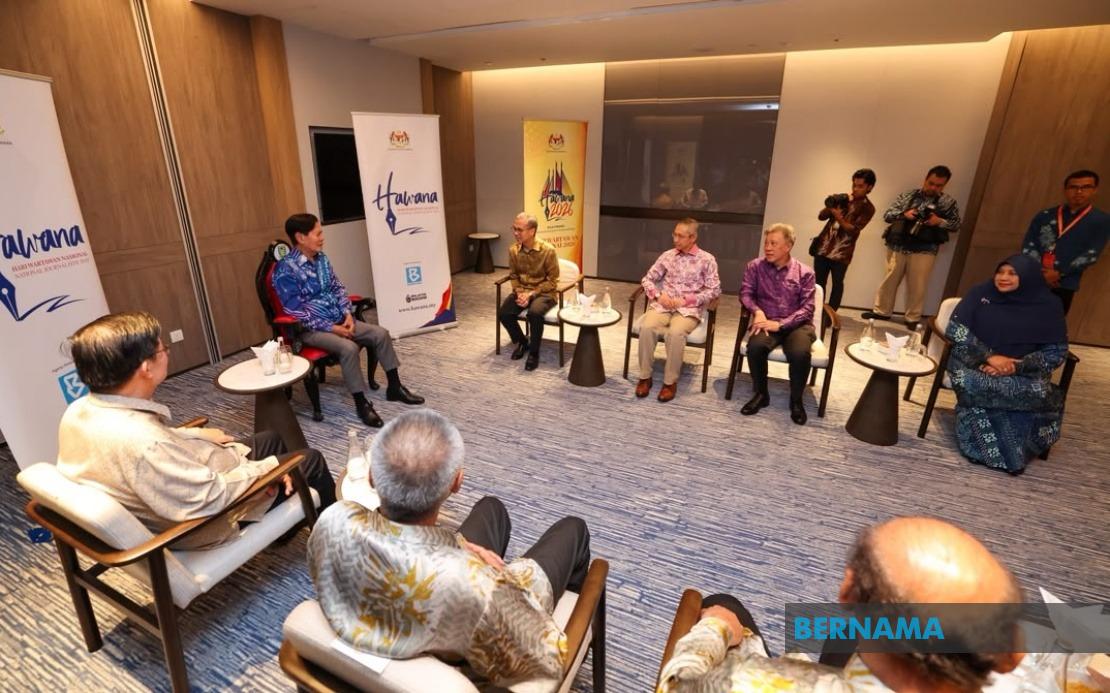
Malaysia's Communications Minister Datuk Fahmi Fadzil has urged journalists and media organisations across Southeast Asia to deepen their collaborative efforts in tackling the escalating challenge of misinformation, emphasising that coordinated action is essential to preserving public trust in news and information. Speaking at a state government dinner in Butterworth honouring National Journalists' Day (HAWANA) 2026, alongside Penang Governor Tun Ramli Ngah Talib and Chief Minister Chow Kon Yeow, Fahmi stressed that the region's media community must prioritise knowledge-sharing and adopt unified standards to ensure reporting remains grounded in verifiable facts rather than speculation or deliberate falsehoods.
The minister articulated a vision of journalism as a vital connective tissue within society, one that translates complex policy decisions into understandable narratives while simultaneously holding institutions accountable to public scrutiny. In an environment where information travels instantaneously across borders and competing narratives proliferate with unprecedented speed, Fahmi argued that media outlets cannot operate in isolation but must instead function as partners in a shared endeavour to protect democratic discourse. His remarks reflect growing concern within the region that unchecked misinformation undermines not only individual news outlets but the broader social fabric, potentially destabilising communities and eroding faith in legitimate institutions.
The HAWANA 2026 celebration, which Penang is hosting, serves a dual purpose in this context. Beyond honouring the contributions of journalists to national development, the event functions as a rallying point for the media profession to reaffirm its commitment to rigorous standards and ethical conduct during an era marked by unprecedented disruption to traditional news models. Fahmi's message resonated with attendees including Penang State Secretary Datuk Seri Zulkifli Long, Communications Ministry secretary-general Datuk Abdul Halim Hamzah, and representatives from ASEAN Communications Ministers, underscoring that combating misinformation is not a matter confined to any single nation but rather a collective regional challenge.
The emphasis on cross-border collaboration carries particular significance for Malaysia and the broader Southeast Asian context. The region has experienced documented instances of coordinated disinformation campaigns targeting elections, religious communities, and public health initiatives. By fostering deeper connections among journalists, editors, and media organisations across ASEAN member states, the region can develop early-warning systems for identifying false narratives before they gain traction, share resources for fact-checking, and establish common protocols for verification that transcend political boundaries. Such coordination could prove especially valuable in detecting campaigns that exploit linguistic and cultural nuances specific to individual countries but form part of larger coordinated efforts.
Fahmi's call for stronger partnerships also implicitly acknowledges that traditional gatekeeping functions of mainstream media have weakened considerably. Social media platforms, messaging applications, and alternative news channels now compete with established outlets for audience attention, creating an information ecosystem where speed often trumps accuracy. By emphasising the irreplaceable value of journalism rooted in truth, integrity, and responsibility, the minister signalled that professional media remain essential counterweights to this fragmentation. The challenge lies not merely in producing accurate stories but in persuading audiences that professional standards matter, a task that becomes easier when regional media institutions present a united front against falsehoods.
Penang's role as host of the HAWANA 2026 celebration underscores the state's positioning as a hub for progressive governance and public discourse within Malaysia. The attendance of prominent figures from state and federal government, combined with representation from ASEAN Communications Ministers, elevates the event beyond a domestic recognition ceremony into a platform for articulating shared regional values regarding media freedom and responsibility. This symbolic importance matters because it demonstrates that concerns about misinformation and the need for media collaboration command high-level political attention throughout the region.
Fahmi's remarks also implicitly address the tension between media freedom and the imperative to combat harmful misinformation. Rather than advocating for state censorship or heavy-handed regulation, his approach privileges collaboration, knowledge exchange, and professional standards as the primary mechanisms through which the media sector can police itself and maintain public trust. This represents a sophisticated understanding that draconian controls on media often backfire by creating suspicion of official narratives, whereas voluntary adoption of rigorous verification standards builds credibility organically. By positioning ASEAN's media professionals as active partners in safeguarding information integrity, Fahmi's vision offers an alternative to increasingly polarised debates elsewhere about who should regulate speech and how.
The involvement of Bernama, Malaysia's national news agency, alongside other major regional media companies illustrates the breadth of institutional support for strengthened collaboration. Bernama's role as chairman through Datuk Seri Wong Chun Wai and the oversight of chief executive officer Datin Paduka Nur-ul Afida Kamaludin, who also chairs the HAWANA 2026 Working Committee, demonstrates that Malaysia's media establishment recognises the urgency of the misinformation challenge. National news agencies throughout ASEAN possess particular leverage to promote collaborative standards because they serve as foundational information sources for smaller outlets and regional journalists who may lack resources for independent fact-checking.
The timing of these remarks, with HAWANA 2026 providing the occasion, suggests that Malaysia intends to position itself as a thoughtful voice within regional media governance conversations. Rather than simply warning about the dangers of misinformation, Fahmi offered a constructive framework emphasising mutual support, capacity-building, and shared professional values. This approach aligns with Malaysia's broader diplomatic efforts to strengthen ASEAN cohesion and presents an opportunity for the country to exert soft power through leadership on an issue affecting all member states equally.
Moving forward, translating Fahmi's vision into concrete mechanisms will require sustained commitment from multiple stakeholders. Potential initiatives might include establishing ASEAN-wide fact-checking networks, creating shared databases of debunked narratives, organising regular training exchanges for journalists, and developing common standards for source verification that respect local contexts while maintaining rigorous universal principles. The challenge will be ensuring that such collaboration remains genuinely voluntary and reflects the profession's own values rather than becoming a vehicle for government agenda-setting, a distinction that journalists and media organisations must vigilantly maintain.
For Malaysian readers, the minister's emphasis on regional media collaboration holds particular relevance given Malaysia's position as a significant media producer and consumer within Southeast Asia. The country's diverse population and complex media landscape—spanning multiple languages, communities, and political perspectives—make it both a potential flashpoint for misinformation and a laboratory for testing collaborative responses to false narratives. By embracing the partnership model Fahmi articulated, Malaysian media can contribute meaningfully to regional stability while simultaneously strengthening the domestic profession's capacity to serve the public interest effectively.

