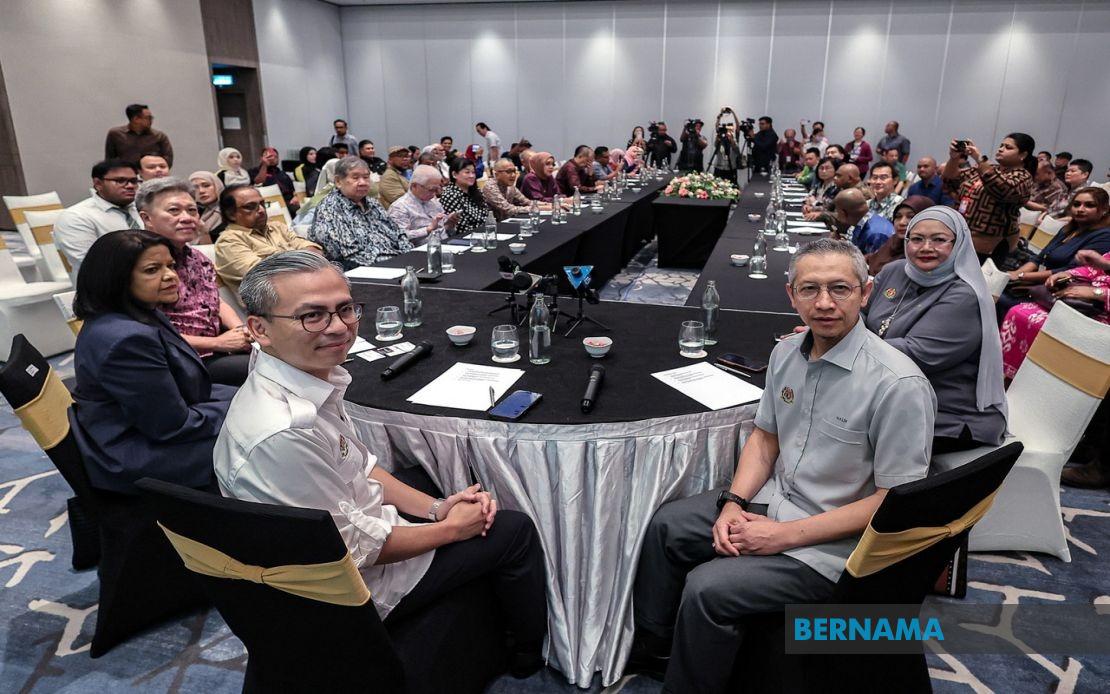
Communications Minister Datuk Fahmi Fadzil has unveiled a new framework for deepening government engagement with Malaysia's journalism sector, proposing that annual retreats featuring media practitioners become a permanent fixture of the National Journalists' Day (HAWANA) celebrations. The proposal emerged from a substantive two-hour dialogue held in Butterworth during HAWANA 2026, signalling the government's intent to formalize what has traditionally been periodic contact with media organisations into a systematic channel for policy consultation. The initiative reflects growing recognition that sustainable solutions to industry challenges require sustained dialogue rather than ad-hoc responses to emerging problems.
Fahmi announced that his ministry would work with the Malaysian Media Council (MMC) to oversee the organization and logistics of these annual retreat sessions. By delegating coordination responsibilities to the MMC, the government hopes to ensure that future gatherings maintain credibility and independence while remaining aligned with broader national communications objectives. This collaborative approach suggests an effort to position the retreats as industry-led initiatives rather than top-down government exercises, potentially increasing participation and candour from media practitioners who might otherwise view such forums with suspicion. The structural choice to involve the MMC also reflects confidence in the council's standing and convening power within Malaysia's media landscape.
The retreat framework is designed to function as a formal mechanism for collecting structured feedback from journalists and media organisations on matters spanning policy development, legislative reform, and industry sustainability. Rather than relying on scattered comments or reactive consultations, the government would use these sessions to systematically gather proposals addressing specific challenges. Fahmi explicitly mentioned that submissions could relate to policy concerns or recommended amendments to existing legislation, acknowledging that media practitioners often identify regulatory obstacles or unintended consequences of laws that government planners may overlook. By institutionalizing this feedback mechanism, the government signals willingness to treat the media industry as a stakeholder group capable of providing technical insight into governance challenges affecting their own sector.
A particularly pressing concern elevated during the dialogue was the economic sustainability of mainstream media operations in an increasingly digital environment. Fahmi identified a critical vulnerability facing traditional news organisations: the massive mismatch between journalistic labour and resources invested in producing content for social media platforms, set against the complete absence of financial returns from those distribution channels. This is an acute problem across Southeast Asia, where advertising dollars have migrated to platforms while news organisations continue bearing editorial costs. The minister's acknowledgment of this structural problem suggests the government recognizes that content piracy on social networks—where publishers' material circulates without compensation—represents an existential threat to the business models supporting professional journalism.
In response to this economic challenge, Fahmi proposed a proactive government role in facilitating negotiations between Malaysian media organisations and major social media platforms. By positioning the government as a potential intermediary or convening force, he implied that regulatory leverage or diplomatic engagement might convince platforms to establish revenue-sharing mechanisms or licensing agreements with local publishers. This approach parallels recent global developments, including Australia's media bargaining code and the European Union's Digital Services Act framework, which have created legal obligations for platforms to negotiate with news publishers. For Malaysian media, government support in such negotiations could prove decisive, given the asymmetry in market power between domestic news organisations and global technology companies.
The dialogue session drew participation from senior officials and media industry leaders, underscoring the initiative's institutional significance. Communications Ministry secretary-general Datuk Abdul Halim Hamzah and deputy secretary-general Datuk Bahria Mohd Tamil attended alongside Malaysian National News Agency (Bernama) chairman Datuk Seri Wong Chun Wai and Bernama chief executive officer Datin Paduka Nur-ul Afida Kamaludin. The presence of MMC chairman Tan Sri Nallini Pathmanathan and representatives from major local media organisations indicated broad industry commitment to the proposed framework. This high-level attendance transformed the event from a routine minister's appearance into a substantive working session with credibility across government and media sectors.
The proposal arrives amid broader regional uncertainty about the future of journalism. Across Southeast Asia, media organisations face intensifying commercial pressures alongside concerns about editorial independence and regulatory environment stability. By establishing recurring, structured dialogue forums, Malaysia's government is attempting to position itself as part of the solution rather than merely a source of regulatory burden. This reframing carries diplomatic significance too—it distinguishes Malaysia's approach from authoritarian models characterised by one-way pressure, while distinguishing it equally from purely laissez-faire approaches that abandon media sustainability concerns to market forces.
The emphasis on long-term industry viability also reflects practical understanding that healthy journalism requires economically sustainable newsrooms. News organisations operating under existential financial pressure inevitably compromise editorial ambition, cutting investigative capacity and foreign coverage while depending increasingly on government handouts or advertising from state-linked companies. Neither scenario serves government interests in a functional fourth estate. By helping address the structural economic problems facing media organisations, the government simultaneously strengthens the institutional capacity of journalism to serve as an effective check on power, a relationship that economists and governance scholars increasingly recognize as symbiotic rather than adversarial.
Looking forward, the HAWANA retreat initiative will likely establish patterns for how Malaysian government and media sectors negotiate their relationship in coming years. If retreats generate genuine policy changes or regulatory reforms addressing industry concerns, they will establish credibility and encourage fuller participation from media organisations. Conversely, if they become ceremonial exercises without substantive follow-through, their utility will diminish. The success of this framework will partly depend on government willingness to implement recommendations emerging from the retreats, demonstrating that consultation yields results worth investing time and political capital in. For Malaysian journalism at a critical juncture, the establishment of these institutional channels represents a meaningful, if preliminary, commitment to recognizing the industry's essential role in democratic governance.

