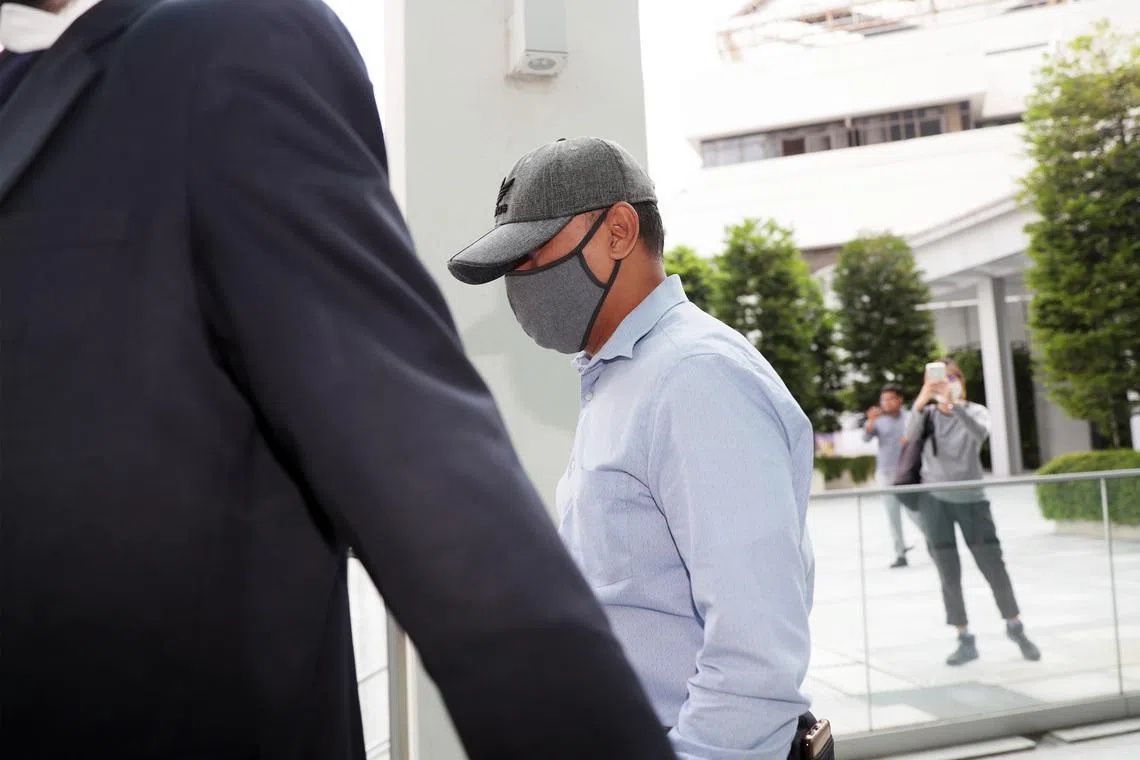
Singapore's courts have handed down a 14-month jail sentence to Abdul Rahim Mawasi, the former executive chairman of Darul Aman Mosque and Sallim Mattar Mosque, following his conviction on corruption charges centred on construction contracts that benefited his associate. The June 26 sentence closes a significant chapter in a public sector graft case that exposed how personal relationships and privileged access to institutional decision-making can corrupt government-linked religious bodies in ways that compromise public trust.
At the time of the offences, Abdul Rahim held a dual role as a senior officer seconded by the Islamic Religious Council of Singapore (MUIS) to oversee the management boards of both mosques. His position gave him substantial influence over procurement decisions for maintenance and construction work. The 59-year-old, who joined MUIS in 2005, exploited this access to advantage his long-time friend Mohd Mustaqim Kam, a director at construction firm Zeal-Con Engineering. The arrangement demonstrated a troubling pattern where institutional authority was weaponised for personal financial gain, a concern that resonates across Singapore and the broader region where religious organisations manage significant budgets.
The corrupt scheme emerged from a seemingly innocent business proposal. In July 2018, Abdul Rahim suggested to Kam that they establish a travel company focused on pilgrimage trips. Kam agreed to the venture, but the partners devised an arrangement where Abdul Rahim would contribute no initial capital. Instead, he would leverage his position to secure construction contracts for Zeal-Con from the two mosques, with the company's profits funnelled as paid-up capital into their joint travel enterprise. This arrangement epitomised a conflict of interest built into the transaction itself, where institutional resources were converted into private business capital.
The manipulation of Zeal-Con's bids revealed the calculated nature of Abdul Rahim's corruption. When Darul Aman Mosque called for construction quotes in 2018, Zeal-Con initially submitted a figure of S$128,600 on August 20. Abdul Rahim then conducted extensive discussions with Kam regarding pricing strategy, providing what prosecutors termed crucial price indications. Armed with this intelligence, Kam revised the quote downward to S$118,000 on September 12, undercutting the next-closest bid of S$125,500 from a competing firm. The mosque's management board remained ignorant of these behind-the-scenes negotiations, and Zeal-Con won the contract on September 26 at the lower price.
A parallel scheme unfolded at Sallim Mattar Mosque. In September 2018, Zeal-Con submitted an initial quote of S$115,700 for works including roof repairs and reception area improvements. Months later, in July 2019, the company lowered its quote to S$105,000 for the identical scope of work. Court evidence established that Abdul Rahim had directly advised Kam to reduce the bid to secure the contract. The following month, Sallim Mattar Mosque issued formal contract awards linked to this revised amount. Together, the two contracts totalled approximately S$223,000, representing the material scale of the diverted institutional resources.
To obscure his involvement, Abdul Rahim employed sophisticated concealment tactics that underscored his understanding of wrongdoing. He and Kam converted an existing shell company into Amal Travel and Tour (ATT) in or before November 2019, initially capitalising it at S$37,500 but increasing paid-up capital to S$100,000. Rather than hold shares directly, Abdul Rahim arranged for his son to hold 25,000 shares valued at S$1 each in November 2019, with the shares registered in the son's name. This deliberate interposition of a family member served as a buffer against detection. During trial proceedings, Abdul Rahim denied any involvement with ATT and claimed to hold no shares, though the evidence proved otherwise. Critically, he failed to disclose his financial interest in the joint venture company to MUIS, a material breach of institutional governance protocols.
The prosecution's case, presented by Deputy Public Prosecutor Bryan Wong, characterised Abdul Rahim's conduct as a serious breach of public sector trust. Although the works performed by Zeal-Con were completed satisfactorily and the two mosques sustained no substantial financial losses, the prosecutor stressed that the offence represented corruption undertaken for personal financial gain within a government-linked body. This distinction—between financial harm and corruption itself—matters considerably in public sector integrity frameworks. The mere act of steering institutional resources to benefit connected parties, irrespective of whether work quality remained acceptable, constitutes a fundamental violation of the public trust and fairness principles that underpin governance.
Abdul Rahim's associate, Mohd Mustaqim Kam, received a six-month jail sentence in February 2025, reflecting his subordinate role in the scheme despite his active participation. Kam's lighter sentence acknowledged that Abdul Rahim, as the institutional insider with discretionary procurement power, bore greater responsibility for initiating and executing the corruption. The sentencing differential sent a clear message about culpability hierarchies: those holding official positions who abuse them face steeper penalties than private-sector actors who exploit those abuses, a principle consistent with Singapore's public sector corruption framework.
The case carries implications for Southeast Asia's broader governance landscape. Singapore's religious institutions, including mosques, temples, and churches, manage substantial budgets derived from donations and community contributions. The Abdul Rahim case illustrates vulnerabilities in oversight mechanisms where individual officers possess significant discretionary authority over procurement with limited institutional checks. Religious organisations across the region, many of which operate with substantial autonomy from state supervision, would benefit from examining their own conflict-of-interest policies, procurement transparency standards, and rotation practices to prevent similar abuses.
Abdul Rahim's defence counsel, Satwant Singh Sarban Singh, sought leniency by highlighting his client's previously unblemished record and requesting a sentence of no more than six months. The court rejected this plea, instead imposing a term more than double that amount. The 14-month sentence reflects judicial assessment that public sector officers in trusted positions warrant stringent deterrence. Abdul Rahim's bail was set at S$30,000, and he was scheduled to commence his sentence on July 10, allowing time for legal formalities. His conviction, following trial rather than guilty plea, indicates that he contested the charges fully, and the court's rejection of his denials underscored the strength of prosecution evidence.
This case underscores the persistent vulnerability of Southeast Asian institutions to insider corruption, particularly where individuals occupy roles combining procurement authority with limited institutional oversight. The apparent respectability of Abdul Rahim's position—a senior officer in a well-established religious council—alongside his long tenure since 2005 suggests that corruption can flourish within established structures if procedural safeguards remain inadequate. For Malaysian readers, the Singapore precedent serves as a cautionary framework: institutions managing public or quasi-public resources require robust conflict-of-interest declarations, competitive bidding oversight, mandatory rotation of procurement officers, and surprise audit mechanisms. The Abdul Rahim case demonstrates that corruption investigations can successfully penetrate even trusted institutional hierarchies, provided enforcement agencies maintain investigative rigour and courts apply proportionate sentencing that reflects the severity of public sector betrayal.

