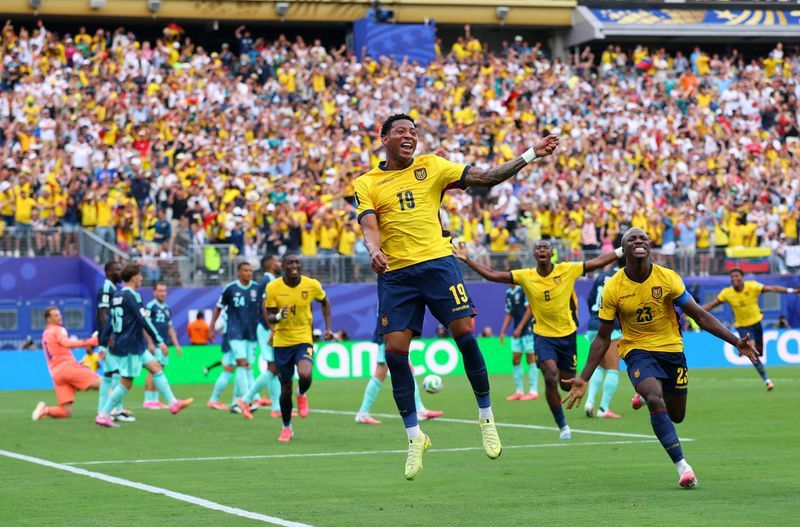
Ecuador delivered one of the tournament's most unlikely comebacks on Thursday, overturning an early German goal to secure a 2-1 triumph at the sold-out East Rutherford stadium in New Jersey. The result proved decisive for the South American nation's World Cup survival, catapulting them into the last 32 after their campaign had teetered on the brink of elimination following disappointing results against Ivory Coast and Curacao. For a squad under immense pressure heading into their final group assignment, the victory represented vindication of their fighting spirit and a dramatic reversal of fortune that had seemed improbable just minutes into the encounter.
Germany's lightning-quick start appeared to have sealed Ecuador's fate when Leroy Sane converted in the second minute, capitalising on Florian Wirtz's astute find following a throw-in to fire past goalkeeper Manuel Neuer. The finish marked a significant milestone for Sane at the international stage, delivering his first goal in a major tournament appearance despite this being his 15th outing in such competition. The early breakthrough suggested Germany, already assured of progression as group winners, would coast through their remaining assignment while Ecuador faced an uphill struggle to salvage their tournament participation.
yet the Ecuadorian response came with impressive urgency, and their equaliser arrived within minutes of Sane's strike. Nilson Angulo curled a finish from the edge of the penalty area beyond Neuer in the ninth minute, breaking a frustrating streak that had seen Ecuador fail to register a single goal across their opening two matches despite 39 previous attempts. The breakthrough sparked jubilant scenes among Ecuador's supporters occupying the stadium's yellow-filled sections, signalling that their team possessed the capacity to trouble even an established European powerhouse. This moment would prove psychologically vital, transforming what had appeared to be a resignation from their tournament to a genuine competitive opportunity.
Controversy punctuated the match's opening exchanges, with Ecuadorian protests about a raised foot incident during Germany's opening goal going unheeded by referee Tori Penso. The official's decision-making would again feature prominently in the second half when he initially awarded a penalty against Ecuador following what appeared to be contact between Kai Havertz and defender Joel Ordonez. However, upon VAR consultation, Penso reversed the determination, identifying a preceding foul committed by Germany's Felix Nmecha that invalidated the original penalty award. These refereeing interventions proved crucial in maintaining competitive balance during a match that hinged on marginal incidents.
Gonzalo Plata sealed Ecuador's remarkable turnaround in the 78th minute when he reacted quickest to a near-post flick-on from substitute Kevin Rodriguez following a corner delivery, stabbing his finish past Neuer to send the stadium into pandemonium. This decisive intervention capped a second-half performance in which Ecuador demonstrated superior intensity and clinical finishing compared to a German outfit whose defensive vulnerabilities—evident throughout their group campaign—had been thoroughly exposed. The closing stages saw Ecuador manage the game effectively, preventing Germany from mounting a meaningful riposte despite their numerical and pedigree advantages.
Germany's progression as group leaders proves only partially satisfying given their inability to secure consecutive victories or maintain defensive solidity. Although they accumulated six points to finish ahead of Ivory Coast on goal difference, having allowed goals in all three group matches represents a concerning pattern ahead of knockout competition. Their 12-match unbeaten streak ended without the anticipated third consecutive group triumph, suggesting vulnerabilities that more formidable opponents may prove capable of exploiting. The result demonstrates that even established European heavyweights cannot afford complacency once progression is mathematically assured.
Ecuador's qualification as one of the eight best third-placed teams reflects both their resilience and the unpredictable nature of group-stage football. Their journey from the verge of elimination to knockout participation underscores how tournament momentum and psychological confidence can shift dramatically through single performances. For Malaysian followers of the competition, Ecuador's pathway offers instructive lessons regarding competitive spirit and the capacity for tactical adjustment under pressure—qualities that transcend geographical or developmental boundaries within international football.
The victory carries particular significance for Ecuadorian football on a global stage, demonstrating their capability to compete against elite opposition and secure results through determined, organised play rather than superior individual talent. Coach Gustavo Alfaro's side showed tactical discipline in their approach play and clinical efficiency in converting limited opportunities, attributes that may serve them well in forthcoming knockout encounters. Their capacity to recover from early adversity and psychological setbacks suggests a squad capable of punching above their apparent weight classification.
Southeast Asian observers may draw parallels with their own regional teams' occasional upsets against more fancied opponents, recognising how tournament football permits surprises when preparation meets opportunity and psychological factors align favourably. Ecuador's performance illustrates that European pedigree and early advantages provide no guarantees in the sport's most demanding arena, where execution and collective commitment often prove decisive beyond pure individual quality. As the knockout stage approaches, Ecuador's dramatic progression offers compelling evidence that tournament narratives remain unpredictable and that no team—regardless of world ranking or historical prestige—commands immunity from shock elimination.

