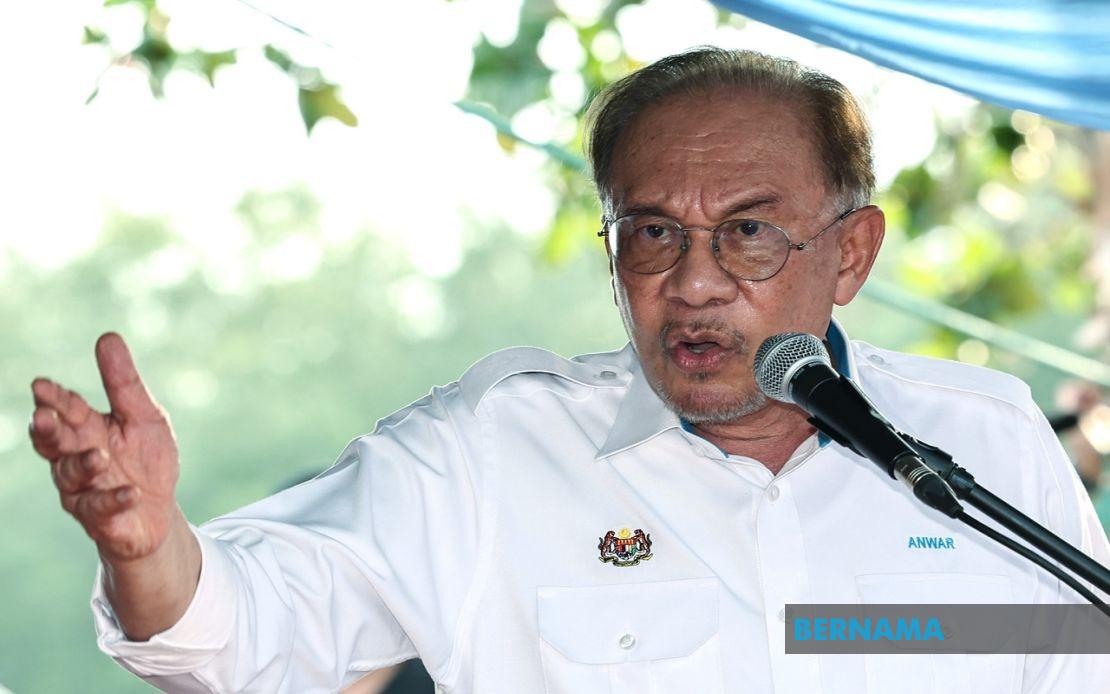
Prime Minister Datuk Seri Anwar Ibrahim has called for Malaysia's development agenda to be genuinely inclusive, warning that the nation's economic progress risks remaining confined to urban centres and large-scale projects unless deliberate efforts are made to extend benefits to rural and grassroots populations. Speaking at a gathering with fishing communities, farmers, and local residents at Pantai Leka Food Court in Muar on June 15, the Prime Minister underscored that economic advancement cannot be measured solely by headline-grabbing infrastructure or technological milestones, but by tangible improvements in the lives of ordinary Malaysians working in agriculture, fishing, and small-scale enterprises.
Anwar's comments reflect growing recognition within government circles that Malaysia's development trajectory has historically created winners and losers, with rural communities often lagging substantially behind urban counterparts in income levels, infrastructure quality, and access to services. The Prime Minister's emphasis on ensuring that development "must be enjoyed by all" suggests an acknowledgement that previous economic models, while delivering aggregate growth figures, have failed to address persistent disparities between different regions and socioeconomic groups. This inclusive growth agenda forms a cornerstone of the MADANI Government's stated priorities, though implementation gaps remain significant across various sectors and regions.
The scope of Anwar's vision extends beyond simply channelling financial assistance to disadvantaged groups. He articulated a need for Malaysia to pursue high-technology initiatives such as artificial intelligence and digital transformation while simultaneously prioritising the welfare and livelihoods of rural communities. This dual-track approach acknowledges that modern economies require investment in cutting-edge sectors to remain competitive globally, yet cannot sacrifice the basic economic security and dignity of citizens dependent on traditional industries. For Malaysian farmers facing volatile commodity prices and changing climate patterns, and for fishing communities confronting depleted stocks and international competition, these are not abstract economic concepts but immediate survival concerns.
Implicitly, the Prime Minister's remarks at Pantai Leka also constituted a message to his Cabinet and political leadership across the country. Anwar stressed that responsible governance demands that elected officials and appointed administrators move beyond capital cities and ministerial offices to engage directly with communities experiencing economic hardship. This directive carries particular weight in Malaysia's political context, where perceptions of disconnect between government and grassroots populations have historically fuelled discontent and electoral volatility. By explicitly calling for leaders to "go down to the ground" and "personally listen to the people's grievances," Anwar was signalling that rhetorical commitment to inclusive growth would be measured against observable engagement patterns.
The infrastructure of inclusion that Anwar referenced centres on social safety nets and targeted assistance programmes. The government, through various agencies and authorities, maintains systems ostensibly designed to channel support effectively to vulnerable populations. Yet the Prime Minister's felt need to reiterate this commitment during a public engagement suggests awareness that implementation challenges persist. Whether due to bureaucratic inefficiency, inadequate resource allocation, or mismatches between policy design and actual community needs, delivery gaps remain evident in many Malaysian constituencies. Addressing these gaps requires not merely funding increases but genuine reform of how assistance programmes are designed, delivered, and monitored.
For Malaysia's estimated 1.7 million fishing households and several million farmers and smallholders, Anwar's message offered qualified hope coupled with implied acknowledgement of historical neglect. Rural Malaysia has long experienced slower income growth, higher poverty rates, and less reliable access to quality education and healthcare compared to urban areas. Agricultural mechanisation, while productivity-enhancing, has displaced rural workers without consistently creating alternative employment. Climate change threatens traditional farming and fishing patterns. In this context, the Prime Minister's insistence that development benefits must reach these communities represents more than symbolic gesture politics—it addresses constituencies whose economic vulnerability could translate into political instability if unaddressed.
The emphasis on preventing any group from being "marginalised from the country's modernisation" carries specific implications for Malaysia's plural society. Different ethnic communities have historically concentrated in different economic sectors and regions, meaning that regionally unequal development often correlates with communal disparities. When the Prime Minister articulates concern about inclusivity, he is simultaneously addressing concerns about whether modernisation benefits will be equitably distributed across Malaysia's Malay, Chinese, Indian, and indigenous populations. The legitimacy of economic policy increasingly depends on demonstrated capacity to improve circumstances for all major demographic groups, not simply national aggregates.
Translating Anwar's vision into sustained policy outcomes faces substantial obstacles. Rural development requires long-term investment in infrastructure, skills training, and market access—commitments that compete with other budgetary priorities in a fiscally constrained environment. High-tech sectors and large-scale urban projects generate visible, quantifiable returns that appeal to planners and international investors in ways that incremental rural improvements do not. Moreover, political economy dynamics mean that concentrated interests benefiting from current arrangements may resist redistributive policies. The Prime Minister's articulation of inclusive growth principles therefore represents necessary but insufficient foundation for transformation.
Regional variations within Malaysia further complicate inclusive development efforts. East Malaysia's Sabah and Sarawak states, despite significant resource wealth, continue experiencing poverty rates exceeding peninsular averages. Remoteness, infrastructure deficits, and dependence on primary industries create distinct challenges requiring tailored approaches rather than uniform national prescriptions. Similarly, peninsular states show wide variation in development outcomes, with several northern and east-coast states lagging significantly behind central and southern regions. Genuine inclusion requires recognising these sub-national variations and resourcing appropriate interventions.
For Malaysia's Southeast Asian neighbours, Anwar's emphasis on inclusive growth resonates with broader regional conversations about equitable development. Vietnam, Indonesia, and Thailand have all grappled with similar tensions between rapid GDP growth and persistent rural poverty. The region's development experience demonstrates that aggregate growth, while necessary, proves insufficient without deliberate inclusive mechanisms. Malaysia's particular challenge involves maintaining competitive advantage in technologically demanding sectors while ensuring that rural and traditionally-dependent populations are not simply left behind in pursuit of higher-order economic objectives.
Moving forward, the credibility of Malaysia's inclusive growth agenda will be measured through specific metrics: rural incomes relative to urban counterparts, poverty reduction rates in farming and fishing communities, school completion rates in rural areas, and healthcare access disparities. These indicators will determine whether Anwar's Pantai Leka pronouncements translate into material improvements for the communities he addressed. The political stakes are considerable—failure to deliver on inclusivity promises risks validating longstanding critiques that Malaysian economic policy perpetually privileges concentrated urban interests over dispersed rural populations, ultimately undermining both economic resilience and social cohesion.
%22%2F%3E%3C%2Fpattern%3E%3C%2Fdefs%3E%3Crect%20width%3D%22100%25%22%20height%3D%22100%25%22%20fill%3D%22url(%23ph1g9tbg)%22%2F%3E%3Crect%20width%3D%22100%25%22%20height%3D%22100%25%22%20fill%3D%22url(%23ph1g9tbp)%22%2F%3E%3Ctext%20x%3D%2250%25%22%20y%3D%2250%25%22%20text-anchor%3D%22middle%22%20dominant-baseline%3D%22central%22%20fill%3D%22rgba(255%2C255%2C255%2C0.95)%22%20font-family%3D%22Georgia%2C%20'Times%20New%20Roman'%2C%20serif%22%20font-weight%3D%22700%22%20font-size%3D%22226%22%20letter-spacing%3D%22-0.02em%22%3EPolice%3C%2Ftext%3E%3C%2Fsvg%3E)
%22%2F%3E%3C%2Fpattern%3E%3C%2Fdefs%3E%3Crect%20width%3D%22100%25%22%20height%3D%22100%25%22%20fill%3D%22url(%23ph4z3nag)%22%2F%3E%3Crect%20width%3D%22100%25%22%20height%3D%22100%25%22%20fill%3D%22url(%23ph4z3nap)%22%2F%3E%3Ctext%20x%3D%2250%25%22%20y%3D%2250%25%22%20text-anchor%3D%22middle%22%20dominant-baseline%3D%22central%22%20fill%3D%22rgba(255%2C255%2C255%2C0.95)%22%20font-family%3D%22Georgia%2C%20'Times%20New%20Roman'%2C%20serif%22%20font-weight%3D%22700%22%20font-size%3D%22136%22%20letter-spacing%3D%22-0.02em%22%3EPAS-Bersa%E2%80%A6%3C%2Ftext%3E%3C%2Fsvg%3E)