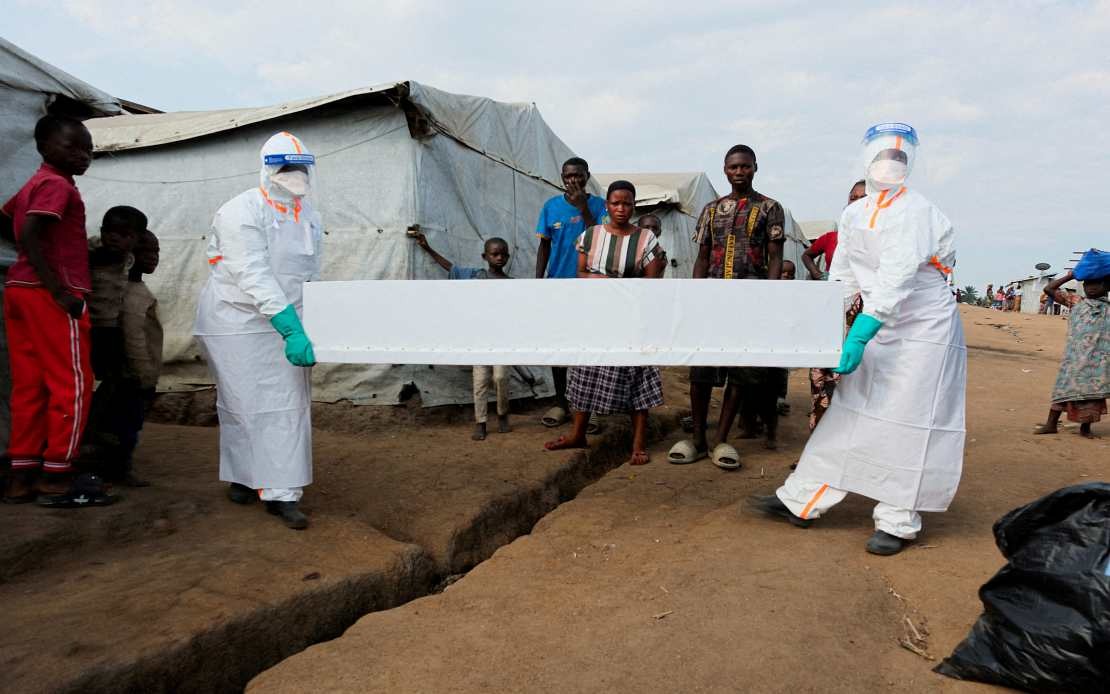
The Ebola virus outbreak in the Democratic Republic of Congo has crossed a critical threshold, with confirmed cases now exceeding 1,000 as health authorities report continued transmission in affected regions. As of Sunday, June 22, the Democratic Republic of Congo's Health Ministry documented 1,003 confirmed cases accompanied by 254 deaths since the outbreak was first declared on May 15. The mortality rate currently stands at 25.3 per cent, underscoring the severity of the epidemic that continues to spread despite intensive containment efforts.
Health Minister Roger Kamba indicated that response operations remain focused on three key provinces—Ituri, North Kivu, and South Kivu—where the virus has established its foothold. While recovery numbers have shown some improvement, with at least 100 patients successfully discharged, the overall situation reflects a rapidly evolving health crisis. Currently, 365 patients remain under medical supervision either in isolation facilities or hospital wards, representing the active caseload requiring immediate treatment and monitoring. The distribution of cases across multiple provinces complicates response efforts, as each region presents distinct challenges in terms of infrastructure, population density, and access to healthcare resources.
The international health community has sounded alarm bells regarding the outbreak's potential trajectory. The Africa Centres for Disease Control and Prevention issued a warning last week that the current epidemic could potentially surpass the devastating 2014-2016 West African Ebola outbreak, which claimed more than 11,000 lives across Guinea, Liberia, and Sierra Leone. That catastrophic event fundamentally reshaped global understanding of the virus's capacity to spread through interconnected populations and overwhelm healthcare systems in resource-constrained settings. The Africa CDC's caution reflects genuine concern that without rapid and effective intervention, the Democratic Republic of Congo outbreak could follow a similarly tragic trajectory, particularly given ongoing insecurity and limited healthcare infrastructure in affected areas.
Despite these grim projections, the Health Ministry has emphasised that response operations continue unabated across all affected zones. Epidemiological surveillance teams remain active in conducting investigations to trace new infections and understand transmission patterns. Prevention initiatives focused on community education and behavioral modification are being intensified to interrupt disease spread. However, Health Minister Kamba acknowledged a troubling decline in the contact follow-up rate—a critical metric indicating how effectively authorities can identify and monitor individuals who have been exposed to confirmed cases. This deterioration in contact tracing capability represents a significant vulnerability in the outbreak response, as breaking chains of transmission fundamentally depends on identifying and isolating exposed individuals before they develop symptoms.
Community engagement has emerged as central to containment strategy. The Health Ministry is prioritising efforts to improve communication with local populations, working to overcome mistrust and encourage reporting of suspected cases. Simultaneously, diagnostic capacity and case management protocols are being expanded to ensure rapid identification and treatment of infected individuals. These parallel tracks—engagement and clinical response—represent the dual challenge facing health authorities: building community trust while simultaneously scaling up medical infrastructure to accommodate rising patient numbers. In regions where healthcare facilities are already stretched thin, this dual burden creates significant operational challenges.
A critical scientific finding emerged from collaboration between Ugandan and Congolese research institutions regarding the outbreak's origins. Scientists from the Ugandan Health Ministry's Department of National Health Laboratory and Diagnostic Services and Congo's Institute of National Biomedical Research determined that the causative agent is the Ebola Bundibugyo strain, which appears to have emerged through a new wildlife spillover event. This determination rules out the possibility that the outbreak represents a residual continuation of a previous epidemic that had persisted undetected in the human population. The identification of a novel spillover event carries significant implications for future prevention efforts, as it indicates that animal reservoirs continue to pose transmission risks and that multiple independent introductions of Ebola to human populations remain possible.
The Ebola Bundibugyo strain itself warrants careful consideration from regional health perspectives. While less frequently observed compared to the Zaire subtype responsible for the 2014-2016 West African outbreak, Bundibugyo possesses independent epidemiological characteristics that merit study. The emergence of this strain through fresh wildlife contact suggests that ecological changes, deforestation, or increased human-animal interface may be facilitating spillover events. For Malaysia and Southeast Asian nations monitoring global disease trends, the identification of novel strain emergence underscores the unpredictable nature of zoonotic disease dynamics and the importance of maintaining vigilant surveillance systems.
The geographical concentration of cases in Ituri, North Kivu, and South Kivu reflects the complex operating environment across eastern Democratic Republic of Congo. These regions have experienced prolonged conflict, displacement of populations, and deterioration of public health infrastructure—conditions that historically facilitate rather than contain epidemic spread. The movement of displaced persons, fragmented healthcare delivery systems, and limited governmental authority in some areas create an ecosystem where the virus can circulate with minimal interruption. Additionally, cultural practices, burial rituals, and healthcare-seeking behaviors in these communities may inadvertently facilitate transmission if not carefully addressed through culturally sensitive communication strategies.
From a regional perspective, the Democratic Republic of Congo outbreak carries implications for neighbouring countries and the broader African continent. Land borders with Uganda, Rwanda, Burundi, Tanzania, Zambia, and Angola create potential pathways for international spread if outbreak control falters. Rwanda's hosting of the regional reporting centre reflects broader African Union commitment to coordinated disease surveillance, yet the capacity to implement effective border health measures remains variable across the region. Southeast Asian nations, while geographically distant, maintain awareness of such developments given the increasing connectivity between African and Asian populations through migration and trade networks.
The challenge of sustaining response operations over an extended period represents another critical concern. Ebola containment campaigns are resource-intensive, requiring sustained funding, personnel deployment, and logistical support. Health systems already fragmented by conflict and resource constraints face mounting pressure as cases accumulate and treatment facilities reach capacity. International support through bilateral partnerships and multilateral health organisations becomes essential to preventing response fatigue and ensuring that epidemiological surveillance, treatment capacity, and community engagement efforts remain adequately resourced throughout the outbreak's duration.
Looking forward, the Democratic Republic of Congo's experience underscores persistent vulnerabilities in global disease surveillance and response architecture. While scientific identification of the Ebola Bundibugyo strain occurred relatively rapidly, translating that knowledge into effective field interventions remains challenging in conflict-affected environments. The declining contact follow-up rate, despite official statements of continued intensity, suggests that operational realities in affected zones may diverge from public health directives. Success will ultimately depend on sustained international cooperation, adequate resource allocation, and meaningful engagement with affected communities whose cooperation remains essential to breaking transmission chains.

