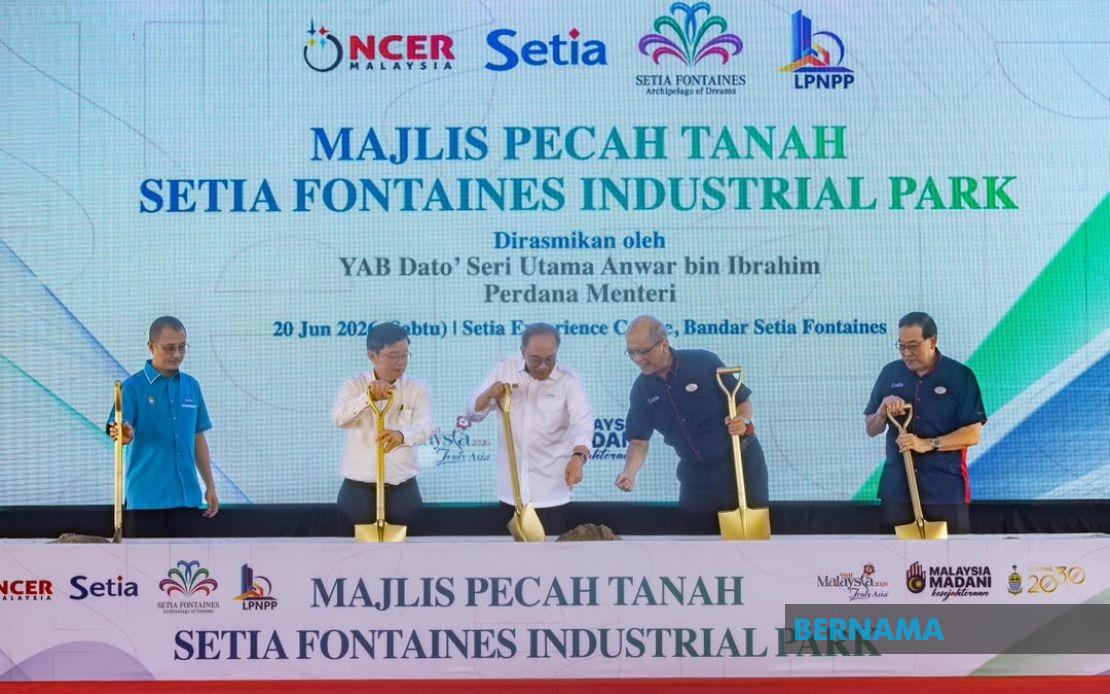
Prime Minister Datuk Seri Anwar Ibrahim has issued a stark warning that Malaysia's rapid economic development risks deepening social divisions unless policymakers deliberately structure opportunities to reach middle- and lower-income Malaysians. Speaking at the groundbreaking ceremony for the Setia Fontaines Industrial Park in Bandar Setia Fontaines on June 20, Anwar emphasised that government-linked corporations and private developers must embed inclusive growth into every significant project they undertake.
The Prime Minister's remarks underscore a growing concern within government circles that investment surges, while economically beneficial on aggregate measures, risk bypassing ordinary workers and small entrepreneurs. Anwar specifically named major institutional investors including Khazanah Nasional Berhad, Permodalan Nasional Berhad, and the Employees Provident Fund, signalling that these heavyweight players bear particular responsibility for ensuring their capital deployment creates wealth distribution pathways rather than concentrating benefits among already-privileged segments. He contended that every regulatory approval granted to these entities carries an implicit obligation to generate tangible gains for lower-income households.
The central tension Anwar articulated reflects a fundamental challenge facing middle-income Southeast Asian economies: how to sustain growth momentum while preventing the emergence of dual-track development where prosperity clusters in specific sectors or geographic zones. Without deliberate intervention, he warned, Malaysia faces a scenario where opportunities for disadvantaged groups become progressively narrower even as headline economic indicators improve. This framing resets the debate around development from purely quantitative metrics to qualitative outcomes—whether growth actually translates into improved living standards across socioeconomic tiers.
The Setia Fontaines Industrial Park project itself exemplifies the type of initiative Anwar believes should model inclusive development principles. Located in the Seberang Perai region, the facility represents an effort to balance Penang's uneven growth patterns, where the island and southern districts have attracted disproportionate investment while the mainland area lagged. By strategically locating industrial capacity on the Seberang Perai side, planners aim to distribute economic activity more evenly across the state and generate employment closer to populations that have historically faced limited local job prospects.
Anwar identified advanced manufacturing and technology-driven sectors as the employment frontier where Malaysia's industrial base must migrate. Rather than continuing reliance on back-end assembly operations, he envisions the nation capturing value-added roles in sophisticated technology production. The Setia Fontaines facility could exemplify this transition, potentially creating higher-wage positions that demand technical sophistication. However, realising this vision hinges on whether local workers possess the requisite skills—a precondition that Anwar stressed remains unmet without coordinated institutional effort.
This skills gap represents perhaps the most critical obstacle to inclusive growth in Anwar's framework. Manufacturing plants may proliferate and investment capital may flow abundantly, but without aligned workforce development, employers will simply recruit foreign talent or relocate to regions with deeper technical labour pools. Anwar therefore called for intensive collaboration between industry practitioners, technical and vocational institutions, and universities including Universiti Sains Malaysia. This coordination must ensure educational curricula remain synchronized with rapidly evolving sector requirements rather than lagging behind technological change.
The technological acceleration Anwar highlighted—where sector capabilities transform within one or two years—poses particularly acute challenges for Malaysian policymakers. Traditional education cycles move slowly; by the time vocational graduates enter labour markets, the skills they learned may already face obsolescence. Bridging this temporal mismatch demands agile partnerships where universities and training providers maintain continuous dialogue with employers, adjusting course content and teaching methodologies in near-real time. This represents a significant departure from conventional education management and requires institutional flexibility many Malaysian institutions currently lack.
For regional Southeast Asian observers, Anwar's emphasis on inclusive development carries broader significance. The Association of Southeast Asian Nations comprises nations at varying development stages, many facing similar pressures to accelerate growth while managing inequality concerns. Malaysia's experience navigating these tensions influences regional development discourse; Anwar's positioning of inclusive growth as a prerequisite for sustainable development rather than an optional add-on potentially influences how peer nations approach their own investment frameworks. Thailand, Indonesia, and the Philippines all grapple with similar challenges of ensuring investment booms benefit beyond metropolitan and industrial zones.
The political dimensions of Anwar's message also warrant attention. His government has staked considerable legitimacy on delivering improved living standards for ordinary Malaysians, particularly those experiencing cost-of-living pressures. By publicly insisting that major corporations and sovereign wealth funds prioritise inclusive outcomes, Anwar signals commitment to this agenda while establishing benchmarks against which his administration's performance can be measured. Future development project announcements will inevitably be scrutinised through the lens of whether they genuinely create pathways for lower-income participation or merely pay rhetorical homage to inclusivity while concentrating benefits among existing elites.
Implementing Anwar's vision, however, requires translating rhetoric into binding mechanisms. Regulatory frameworks must incentivise or mandate inclusive employment practises; financing terms for major projects could be structured to reward companies demonstrating genuine community benefit; and transparent metrics must track whether purported inclusive growth actually materialises. Without such institutional architecture, corporate statements about commitment to broad-based opportunity often remain aspirational rather than operationalised.
The Setia Fontaines project thus becomes a testing ground for whether Malaysia can authentically embed inclusive principles into industrial development. Its performance—measured not just by capital invested or facilities constructed but by the quality and distribution of employment opportunities actually created—will inform whether Anwar's approach gains genuine traction or remains constrained by the structural forces that historically concentrate development benefits. For Malaysian workers and entrepreneurs in middle- and lower-income categories, the coming years will reveal whether such statements translate into material improvement in economic opportunity or represent merely updated versions of familiar promises.

