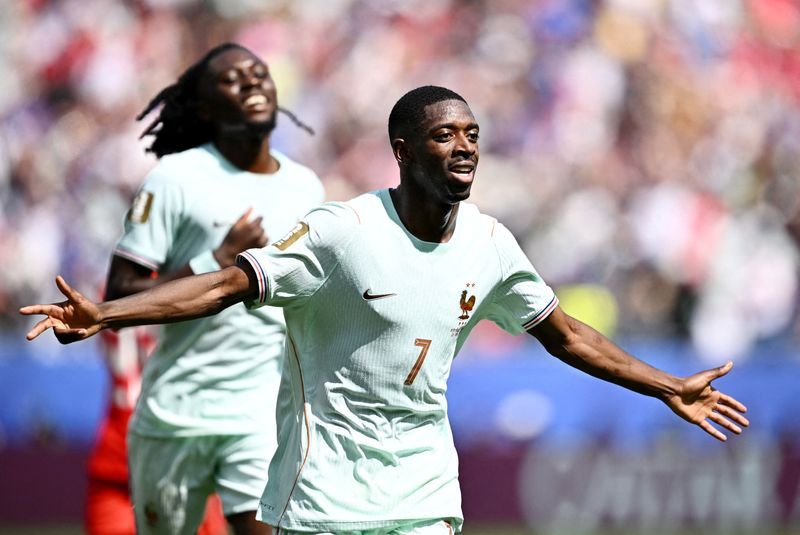
France showcased their championship credentials by dismantling a severely weakened Norway side 4-1 in Foxborough, Massachusetts, on Friday, with Ousmane Dembele's devastating three-goal burst in the first half defining a performance that underscored the gap between the tournament's elite and emerging nations. The winger's remarkable efficiency, completing his hat-trick in just 25 minutes, demonstrated the clinical finishing that has characterised France's path through the competition and validated their status as serious contenders for the trophy.
Dembele's achievement places him in rarified company within French football history. Only Just Fontaine and Kylian Mbappe had previously scored hat-tricks for France at World Cup tournaments, making the Paris Saint-Germain forward's accomplishment a significant milestone. More impressively, the speed at which he accumulated his three goals ranks as the second-fastest hat-trick in World Cup history, surpassed only by Austria's Erich Probst, who netted three against Czechoslovakia in 1954 after 24 minutes—a record that stood virtually unchallenged for seven decades.
The match outcome carried particular significance given that both teams had already secured progression to the knockout round before kickoff. However, France's determination to claim top position in Group I reflected astute tournament strategy. The fixture scheduling and geographic layout of World Cup matches across North America offers teams higher in their group a considerably lighter travel burden during the Round of 32, a competitive advantage that European sides particularly value when managing player fatigue and logistics across multiple time zones.
Norway coach Stale Solbakken's decision to rest virtually his entire starting lineup—excepting a single player—proved decisive in shaping the contest's trajectory. The absence of talismanic striker Erling Haaland and captain Martin Odegaard significantly diminished the Scandinavian team's attacking threat and defensive organisation. This wholesale rotation, made possible by their already-confirmed advancement, essentially gifted France an opportunity to fine-tune their preparations against nominal opposition rather than genuine competition.
France's own preparations were unconventional, with head coach Didier Deschamps absent from the technical area due to a family bereavement. The squad channelled their emotions into an attacking display as a tribute to their leader, who had returned home to the United States temporarily to attend his mother's funeral. This departure from typical matchday protocols created an unusual dynamic, yet the players' commitment to delivering a dominant performance suggested strong internal cohesion and respect for their manager.
From the opening moments, France's intent was unmistakable. Kylian Mbappe, the young superstar already engaged in an implicit competition with Haaland for the tournament's Golden Boot award, nearly opened the scoring within 20 seconds when his angled attempt struck the crossbar. The Paris Saint-Germain forward's presence alone dictated Norway's defensive positioning, but it was his creative contributions that truly distinguished his performance. A sweeping cross-field pass in the sixth minute set Dembele free down the flank, allowing the winger to orchestrate a clinical finish past goalkeeper Egil Selvik.
Dembele's second arrived 14 minutes later through similar patterns of play. The service from Mbappe again found space, and Dembele's composure in executing a dipping shot over the goalkeeper demonstrated technical excellence under minimal defensive pressure. The third goal, arriving in the 32nd minute, showcased different qualities—a precisely weighted low curl into the bottom corner that reflected the winger's complete attacking repertoire. In the space of 25 minutes, Dembele had fundamentally determined the match's outcome and shifted momentum decisively in France's favour.
Norway's sole moment of threat came through Thelo Aasgaard, whose goal pulling one back provided temporary respite but proved merely a consolation against the hosts' momentum. More significantly, Joergen Strand Larsen's tame penalty save in the second half represented a genuine opportunity squandered that could have galvanised the visitors. Oscar Bobb's subsequent efforts further exposed France's occasional defensive vulnerabilities, suggesting that Les Bleus' preparations against more motivated opponents would require greater defensive discipline.
The final scoreline was completed by Desire Doue, whose header from a Bradley Barcola cross in closing stages cemented France's dominance. Crucially, finishing atop Group I ensures France will face Sweden in the Round of 32, a more favourable prospect than Norway's assignment against Ivory Coast. For tournament organisers balancing competitive integrity against logistical realities, such matches raise enduring questions about whether simultaneous group-stage conclusions serve the sport's fundamental principles.
France's performance, while superficially impressive in its scoreline, must be contextualised against opposition that represented the competition's weakest available opponent at that moment. The defending 2018 champions and 2022 runners-up have demonstrated sufficient technical quality and tactical discipline to justify favouritism, but genuine examinations of their credentials will arrive against nations refusing to concede strategic advantages through wholesale rotation policies.

