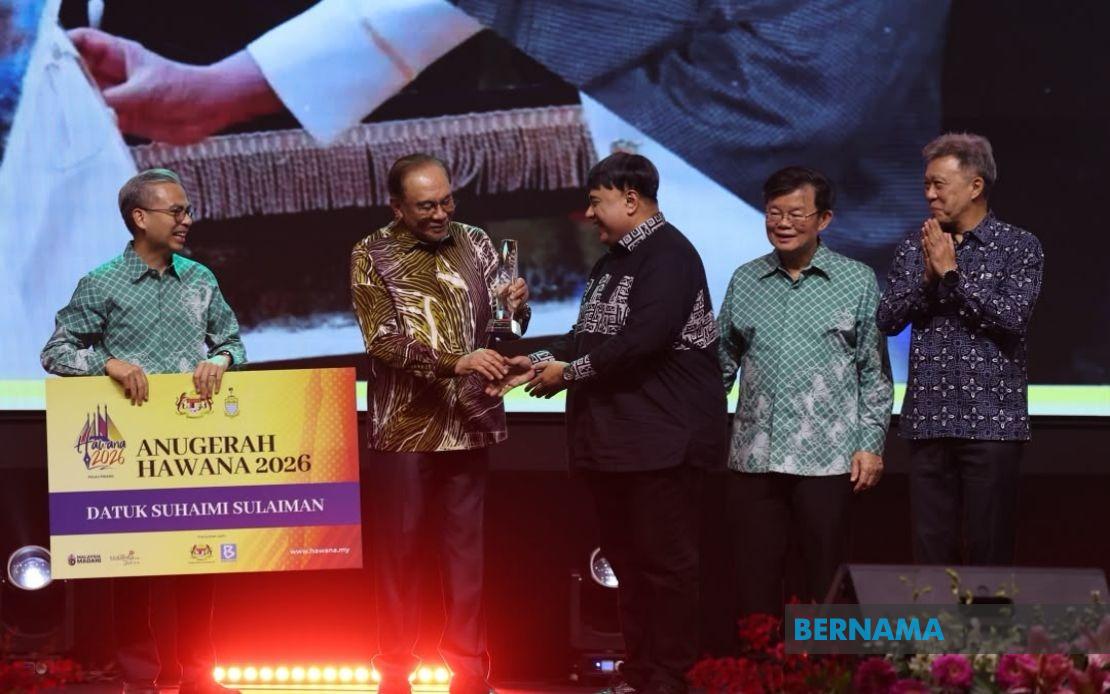
Datuk Suhaimi Sulaiman, who spent more than thirty years shaping Malaysia's broadcasting and journalism landscape, received the National Journalists' Day (HAWANA) 2026 Award at a ceremony in Butterworth on June 20, marking a significant milestone in recognising his contributions to the country's media sector. Prime Minister Datuk Seri Anwar Ibrahim presented the honour at the HAWANA 2026 Grand Finale held at PICCA @ Arena Butterworth Convention Centre, underscoring the national significance attached to the award and Suhaimi's career achievements.
The ceremony drew prominent figures from Malaysia's media and political establishment, with Penang Chief Minister Chow Kon Yeow, Communications Minister Datuk Fahmi Fadzil, and Malaysian National News Agency (Bernama) chairman Datuk Seri Wong Chun Wai all in attendance to witness the recognition. The presence of such high-ranking officials reflects the esteem in which Suhaimi is held across government and media circles. Bernama chief executive officer Datin Paduka Nur-ul Afida Kamaludin and editor-in-chief Arul Rajoo Durar Raj also participated in the event, highlighting the media industry's collective appreciation for his decades of service.
Suhaimi's career trajectory positions him as a witness to and architect of significant transformations within Malaysia's broadcasting ecosystem. His tenure as director-general of Broadcasting Malaysia (RTM), the country's national broadcaster, gave him considerable influence over editorial direction and strategic vision during formative periods of Malaysian broadcasting. This leadership role ensured he was instrumental in shaping how state media evolved, particularly during periods when technological advancement and changing audience preferences demanded industry-wide adaptation.
In his response to receiving the award, Suhaimi characterised the honour as both a validation of past efforts and a charge to continue contributing meaningfully to the profession. He emphasised that the recognition carries profound responsibility, framing it as a motivational force to persist in learning and transmitting accumulated knowledge to the next generation of media practitioners. This reflection demonstrates a thoughtful approach to career legacy, viewing professional achievement not as an endpoint but as a platform for ongoing contribution and mentorship.
The timing of the award is particularly significant given the massive structural shifts confronting global and regional media industries. Suhaimi's comments specifically highlighted artificial intelligence as a transformative force that demands renewed learning and adaptation from experienced practitioners. The emergence of AI-driven newsrooms, algorithmic content curation, and automated reporting capabilities represents a fundamental challenge to traditional journalism pedagogy and practice, making Suhaimi's emphasis on continuous learning especially resonant.
For Malaysian media practitioners, Suhaimi's recognition serves as tacit endorsement of the value that veteran journalists and broadcasters bring to an industry undergoing profound technological and economic disruption. In Southeast Asia, where broadcast and print media continue to grapple with declining advertising revenues and audience fragmentation, the acknowledgment of long-serving professionals like Suhaimi affirms the importance of institutional knowledge and editorial integrity. His perspective on navigating the AI transition carries particular weight given his decades-long immersion in evolving media ecosystems.
The HAWANA Awards programme itself represents Malaysia's formal recognition of excellence and contribution within journalism and broadcasting sectors. By honouring Suhaimi at the 2026 iteration of these awards, the Malaysian government and media industry underscore their commitment to celebrating professional achievement and encouraging sustained excellence in an increasingly competitive and technologically complex environment. The National Journalists' Day framework provides occasions for the profession to collectively reflect on standards, values, and future direction.
Suhaimi's emphasis on the AI era as a defining challenge for contemporary journalism aligns with broader conversations across Southeast Asian newsrooms about digital transformation, skills upgrading, and maintaining editorial credibility amid information abundance. Malaysian media organisations, like their counterparts throughout the region, increasingly grapple with questions about how to integrate AI tools while preserving journalistic integrity and maintaining sufficient human editorial oversight. Veterans like Suhaimi offer valuable perspective on bridging traditional journalistic values with emerging technological possibilities.
The award ceremony also functioned as recognition of RTM's role in Malaysian media history and its ongoing significance despite competition from private broadcasters and digital platforms. As the institution Suhaimi led, RTM remains the official voice of Malaysian broadcasting, responsible for important public service programming and emergency communications. By honouring him, the government indirectly reaffirmed the national broadcaster's continued relevance and the expertise of those who have steered its development across multiple technological generations.
Moving forward, Suhaimi's award serves as both a capstone to a distinguished career and a potential platform for ongoing influence on Malaysian media discourse. His stated intention to continue learning and sharing experience suggests he remains an engaged voice within industry conversations, particularly regarding how traditional media values navigate transition into artificial intelligence-augmented environments. For younger Malaysian journalists and broadcasters, his example illustrates that sustained commitment to professional standards, continuous adaptation, and willingness to mentor subsequent generations constitute paths to meaningful recognition within the field.

