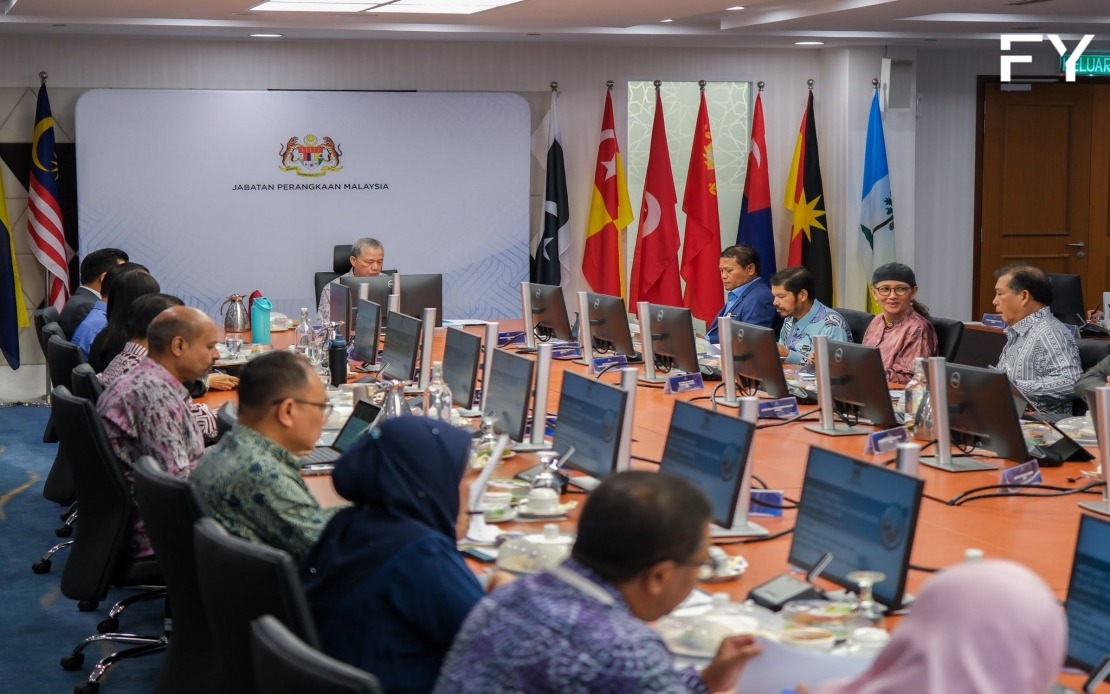
The government intends to position data analytics and artificial intelligence as foundational elements in its approach to governance, with Deputy Prime Minister Datuk Seri Fadillah Yusof declaring these tools essential for navigating the complexities that will define the 13th Malaysia Plan (13MP) spanning 2026 to 2030. Speaking after chairing a high-level meeting of the National Statistics and Data Council (MSDN), Fadillah articulated a vision in which evidence-based decision-making replaces intuition, and statistical rigour becomes inseparable from ministerial action across all portfolios.
The deputy prime minister's emphasis reflects a broader recognition within Putrajaya that Malaysia faces an environment of unprecedented volatility. Economic uncertainties stemming from global trade friction, geopolitical realignments that threaten supply chains, the accelerating pace of digital transformation, and the existential challenge of climate change demand that policymakers possess real-time, granular understanding of conditions on the ground. Fadillah noted that artificial intelligence, coupled with robust statistical infrastructure, enables government to absorb and process vastly more information than traditional methods allow, compressing decision cycles and improving targeting of resources to where they matter most for citizens.
Critically, Fadillah reframed statistics and data not as administrative niceties but as strategic national assets comparable in importance to mineral reserves or human capital. This recharacterisation signals a shift in how Putrajaya values and allocates investment toward its statistical agencies. When data becomes classified as strategic infrastructure, budgets follow, talent flows toward institutions holding that data, and coordination mechanisms prioritise information-sharing. For Malaysia, a developing nation competing for foreign investment and seeking to improve its global rankings on innovation and governance indices, this positioning carries tangible consequences.
The government's economic performance provides one concrete example of this philosophy's application. Malaysia recorded gross domestic product expansion of 5.4 per cent in the first quarter of 2026, a showing Fadillah attributed directly to development policies formulated on a foundation of solid data analysis. Whether measured purely by growth rates or by deeper metrics such as employment quality, income distribution, and sectoral productivity, the claim invites scrutiny—yet it underscores why ministries now view statistical capability as a competitive advantage rather than a compliance burden.
Integration across government represents another dimension of the envisioned transformation. The meeting brought together representatives spanning Works, Health, Communications, Digital Affairs, and Economy portfolios, alongside permanent council members and chief statistician Datuk Seri Dr Mohd Uzir Mahidin. This assembly reflected recognition that data siloes—where each ministry maintains separate databases using inconsistent standards—undermine the comprehensive picture necessary for coordinated policymaking. Fadillah emphasised the need for strategic collaboration among federal ministries, state administrations, private enterprises, universities, and research institutions, a sprawling ecosystem that must somehow function as a unified system.
The practical challenge of achieving such integration should not be minimised. Integrating administrative data from separate agencies requires resolving technical incompatibilities, establishing data governance protocols that protect privacy while enabling access, and often overcoming institutional resistance from entities reluctant to share information that might reveal inefficiencies or limitations. Fadillah acknowledged this complexity by singling out data governance, big data analytics capability, and secure, ethical data integration as specific areas requiring ongoing enhancement. These phrases appear anodyne but mask deep organisational and technical work.
Fadillah's portfolio as Minister of Energy Transition and Water Transformation adds weight to his advocacy for data-driven governance in strategic sectors. Energy policy, water management, and climate adaptation all demand precisely the kind of predictive capability that AI systems coupled with comprehensive datasets can provide. A smart electrical grid requires real-time data on consumption patterns, renewable generation capacity, and grid stability; water security in a tropical nation prone to both droughts and floods depends on hydrological modelling informed by decades of precipitation and runoff records; climate policies that commit Malaysia to international targets while protecting economic growth hinge on accurate carbon accounting and sectoral emissions data. Without this infrastructure, Fadillah's own ministerial agenda becomes significantly harder to execute.
The initiatives reviewed at the meeting—standardising official statistical definitions, strengthening data governance frameworks, integrating administrative records, developing talent databases in science and technology sectors, supporting youth development through data insights, and managing national road asset information—collectively constitute a modernisation agenda that extends beyond the statistical system proper. Each reflects a specific governmental pain point or opportunity. Road asset data, for instance, enables predictive maintenance scheduling that reduces infrastructure downtime and extends asset lifespan; talent databases in emerging fields help match available human resources to skills gaps identified through data analysis; standardised definitions eliminate the confusion that arises when different agencies measure the same phenomenon differently.
For Malaysian readers and Southeast Asian observers, Fadillah's emphasis on artificial intelligence carries particular significance given regional anxieties about technological dependence. The deputy prime minister's framing positions AI not as something Malaysia passively receives from foreign vendors but as a tool Malaysia actively deploys within its own governance infrastructure. This distinction matters for national sovereignty and strategic autonomy. It also reflects competition among Southeast Asian nations—Thailand, Singapore, Vietnam, and Indonesia all pursue comparable data governance and AI integration agendas—to avoid falling behind in the technological capabilities that increasingly determine which nations can implement effective social, economic, and environmental policies.
The integrity and timeliness of statistics take on heightened importance when coupled with AI systems. Machine learning models trained on poor-quality, outdated, or biased data will simply scale those flaws, potentially locking governments into incorrect policy directions across many jurisdictions simultaneously. Fadillah's insistence on quality, integrity, and timeliness reflects awareness that Malaysia's transition toward data-driven governance creates new vulnerabilities. The statistical system becomes not merely a source of information but a critical infrastructure whose failures carry systemic consequences.
Planning under the 13MP will increasingly depend on this strengthened apparatus. Policy evaluation, which currently often relies on anecdotal evidence or delayed administrative reports, could become more rigorous and continuous when built on real-time data feeds and sophisticated analytics. Monitoring implementation of vast development initiatives across multiple states and sectors becomes more feasible when integrated databases provide visibility into progress against targets. Resource allocation decisions that currently involve considerable negotiation and political calculation could be informed by evidence about which interventions deliver greatest returns in specific contexts.
Yet Fadillah's vision also contains implicit tensions worth acknowledging. Expanded data collection and AI analysis raise legitimate privacy concerns among citizens wary of surveillance. The emphasis on integration creates dependencies—if central databases fail, many agencies lose access to critical information. Overreliance on historical data for training AI systems may entrench existing inequalities if those datasets reflect historical biases. These challenges do not invalidate the case for data-driven governance; rather, they underscore why the institutional frameworks Fadillah identified—data governance protocols, ethical standards, secure integration mechanisms—must themselves be robust and subject to oversight.
The 13MP's success ultimately depends less on any single policy tool than on sustained political commitment to evidence-based administration, backed by adequate funding and protected from short-term electoral pressures. Fadillah's positioning of data and AI as central to that success suggests the government recognises this reality, at least in principle. Whether that recognition translates into consistent practice across diverse ministries with competing priorities remains the test ahead.

