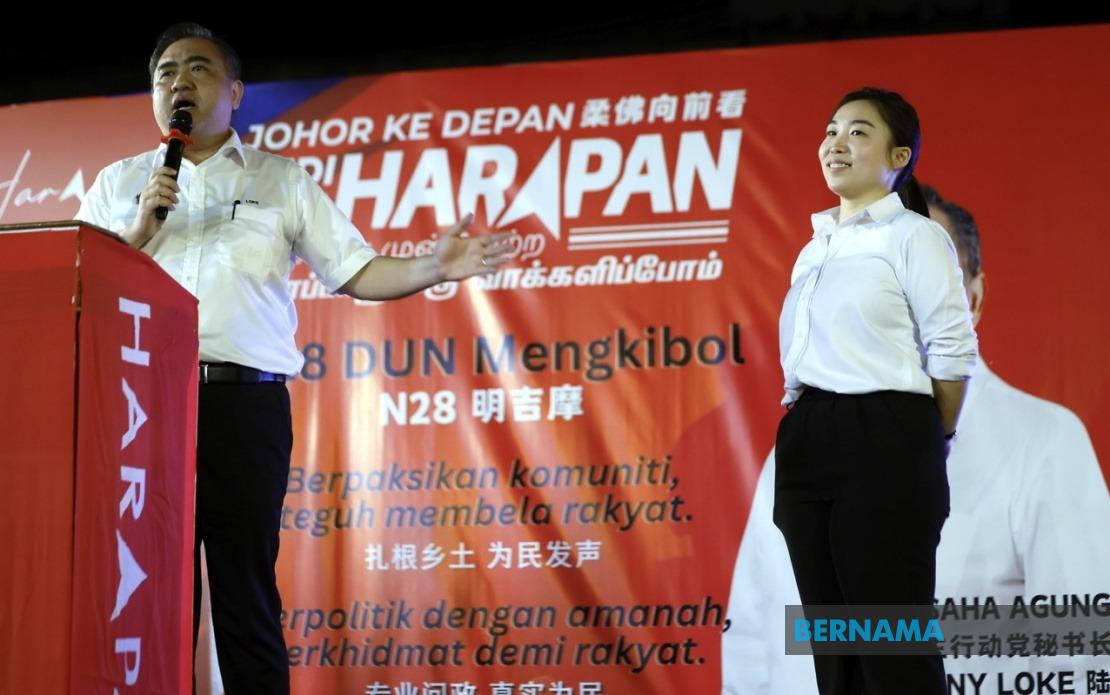
The Democratic Action Party has announced 33-year-old lawyer Chu Poh Yee as its candidate for the Mengkibol state seat in the forthcoming Johor state election, marking a strategic shift in the party's representation for the constituency and signalling a broader commitment to advancing female candidates in electoral contests across the state.
Party secretary-general Anthony Loke unveiled Chu's candidacy at a ceremony in Kluang on June 18, confirming that she will assume the seat vacated by the incumbent assemblyman Chew Chong Sin. Chew has completed two terms representing Mengkibol and will now pivot toward a higher political platform, having been identified by party leadership as a suitable prospect for the Labis parliamentary constituency in the next federal election.
The succession arrangement reflects calculated succession planning within the DAP's state apparatus. Chew's transition materialises following indications from the current Labis Member of Parliament, Pang Hok Liong, that he intends to step aside from contesting the seat again. By positioning Chew as Labis's next standard-bearer, the party aims to retain parliamentary representation in the area while simultaneously refreshing its state-level candidates with new talent and perspectives.
Chu brings formidable credentials to the Mengkibol nomination. At 33 years old, the lawyer has cultivated considerable experience assisting elected representatives with legal aid matters affecting constituents, providing her with intimate familiarity with community concerns and established networks within the constituency. Her multilingual capabilities and robust educational background distinguish her as what party leadership characterises as a competitive candidate capable of commanding voter confidence across diverse demographic segments.
Loke emphasised that Chu's selection reflects a deliberate institutional effort to expand opportunities for female representation within DAP's electoral strategy. The decision aligns with broader aspirations within the party to challenge gender imbalances in political candidatures and demonstrate commitment to inclusive democratic participation. This positioning carries particular resonance in Malaysian politics, where female candidacies remain disproportionately underrepresented, especially in constituencies with strong electoral prospects.
The Mengkibol announcement represents merely the opening salvo in DAP's candidate unveiling process for the Johor contest. The party's selection committee has finalised its complete roster across 17 state seats that the DAP intends to contest. This portfolio comprises ten constituencies currently held by the party, four seats previously lost that the DAP seeks to reclaim, and three additional contests representing new territorial expansion for the party.
The phased announcement strategy distributes candidate reveals across multiple occasions designed to generate sustained media engagement and public interest. Loke indicated that four additional candidates will be presented on Saturday for the constituencies of Tiram, Johor Jaya, Senai and Bukit Permai, with the remaining nominees disclosed collectively alongside the broader Pakatan Harapan slate during a Monday announcement orchestrated by the Prime Minister.
This sequencing reflects the coordinated approach characteristic of PH's coalition dynamics, whereby component parties announce their respective candidate selections within a unified framework managed by the coalition's leadership. The arrangement ensures coherent messaging and prevents individual party announcements from dominating coverage to the exclusion of coalition-wide strategic positioning. It also affords the Prime Minister's office opportunity to frame the overall electoral challenge within the government's broader policy agenda and developmental priorities.
For Malaysian observers monitoring opposition and government positioning, the Johor contest assumes heightened significance given the state's substantial parliamentary representation and its historical role as a political bellwether. DAP's willingness to field new candidates in retained seats suggests confidence in its electoral machinery and suggests the party believes generational renewal does not necessarily compromise electoral competitiveness. The insertion of Chu Poh Yee into this calculus represents a calculated wager that fresh faces and diverse candidate profiles can sustain party dominance in constituencies where DAP maintains organisational strength.
The broader implications extend beyond Johor's boundaries, signalling to other regional constituencies and upcoming electoral contests that established opposition coalitions are adapting their candidature strategies to incorporate fresh talent whilst maintaining institutional continuity. In a Malaysian political environment where voter sentiment demonstrates increasing volatility and traditional patterns prove increasingly unreliable, the willingness of experienced parties to refresh their candidate profiles may represent an astute recognition that established political actors must themselves evolve to retain relevance and electoral viability.
Chu's background in legal aid work carries particular relevance for the Mengkibol constituency and broader state politics, as legal matters affecting ordinary citizens frequently translate into electoral concerns and constituent service demands. Her demonstrated commitment to this domain positions her to engage effectively with constituents on practical governance issues, potentially distinguishing her approach from purely party-political messaging and establishment politics.