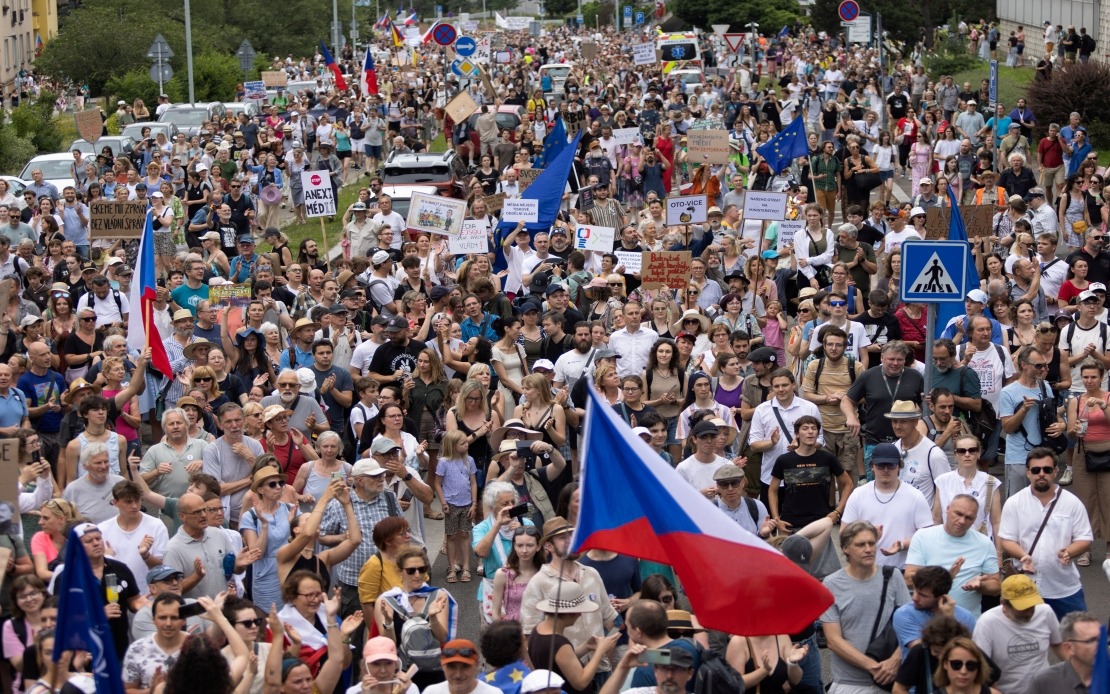
Several thousand Czechs gathered outside the Prague headquarters of Czech Television (ČT) on Sunday in a major show of support for media independence, responding to mounting concerns that the government's proposed financing changes could fundamentally compromise the editorial autonomy of the nation's public broadcasters. The demonstration, reported by Czech news agencies and the German Press Agency, underscored growing anxiety among journalists, media professionals, and citizens about the direction of public broadcasting under the current administration.
The catalyst for the protest was the recent decision by Prime Minister Andrej Babiš's government to eliminate the traditional licence fee system that has long sustained Czech Television and Czech Radio (ČRo). Under the new arrangement set to take effect next year, both broadcasters would depend entirely on direct state budget allocations. This structural shift represents a departure from the European model that has insulated public media from political pressure through dedicated revenue streams independent of government appropriations.
Beyond the funding mechanism itself, observers and protest organisers have flagged a troubling financial dimension to the reform. The government's plans would supply the public broadcasters with less funding than they currently receive through licence fees, a reduction that Babiš has justified by claiming operational efficiencies exist at the organisations. While the Prime Minister has offered assurances that there would be no political interference in editorial matters, the combination of budget cuts and direct state financing has alarmed independent media advocates and staff members who see the formula as potentially coercive.
The demonstrators, many carrying placards reading "A free society needs free media," articulated a broader concern that resonates across Central Europe: that direct government financing, particularly coupled with reduced budgets, creates subtle but powerful incentives for broadcasters to avoid antagonising their paymaster. The civic movement "A Million Moments for Democracy", which organised Sunday's rally, had previously mobilised similar protests across Czech cities in May, indicating sustained public engagement on the issue.
Culture Minister Oto Klempíř, himself a member of the right-wing populist Motorists party, became a focal point for demonstrators' demands. Speakers and organisers called explicitly for his resignation and for the government to shelve its broadcasting reforms entirely. The intensity of feeling was evident in the turnout and the clarity of messaging, suggesting this is not merely a technical policy dispute but rather a fundamental question about democratic accountability and the role of public institutions.
Remarkably, employees of both Czech Television and Czech Radio signalled their solidarity with the protesters by unfurling banners from the broadcaster's building with the message "Thank you!", a gesture that revealed the deep unease within the organisations themselves. This internal dissent proved consequential: staff members announced plans to strike on Monday, escalating the pressure on the government and demonstrating that concerns about editorial independence were not merely external commentary but reflected authentic anxiety among those working within public broadcasting.
The political context amplifies these concerns. Since December, the Czech Republic has been governed by a coalition led by Babiš's ANO party alongside the far-right Freedom and Direct Democracy (SPD) and the Motorists party. This rightward composition, particularly the inclusion of the far-right SPD, has fuelled fears among media watchdogs and democratic advocates that any consolidation of government control over broadcasting could serve partisan rather than public purposes.
For Malaysian and Southeast Asian observers, the Czech situation illuminates challenges that resonate across democracies navigating the relationship between state power and media freedom. Many regional countries maintain public broadcasting systems, and debates over their funding and governance reflect enduring tensions between fiscal responsibility and editorial independence. The Czech case demonstrates how structural changes—even those framed in technocratic language about efficiency—can reshape political incentives in ways that ultimately threaten the watchdog function of journalism.
The European Union has been attentive to developments in Czech media governance, as press freedom and independent broadcasting are core democratic values within the bloc. The scale of public mobilisation on Sunday suggests that ordinary citizens recognise something fundamental is at stake, not merely the administrative arrangements of two broadcasters but the broader capacity of society to maintain institutions capable of holding power accountable.
The strike announcement and continued street protests indicate this dispute is unlikely to resolve quickly or quietly. The government faces a choice between proceeding with plans that have sparked significant public resistance and striking a compromise that preserves both fiscal discipline and editorial autonomy. How Czech authorities navigate this tension will carry implications not just for Czech media but for how democracies worldwide manage the fraught relationship between public funding, political oversight, and journalistic integrity in an era of polarisation and weakening institutional trust.

