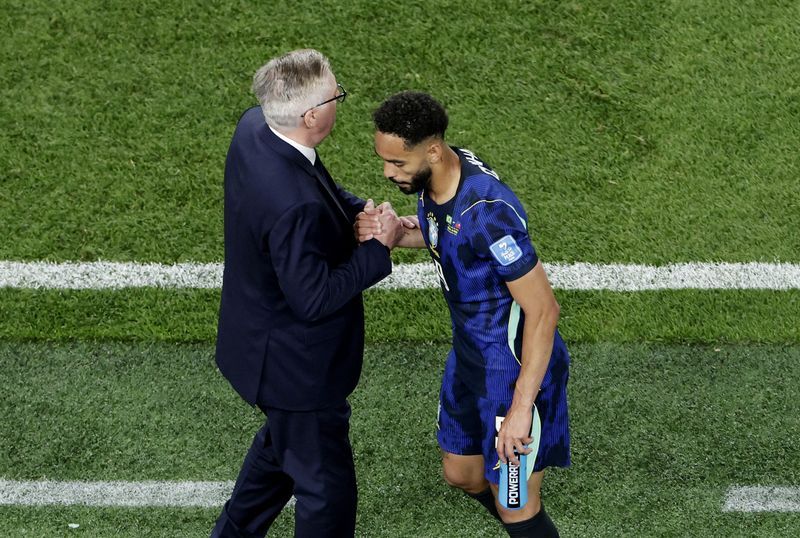
Carlo Ancelotti provided Brazil's supporters with fresh optimism on Wednesday in Philadelphia, even if he did not entirely banish the demons from their Copa America opener. The 3-0 demolition of Haiti offered the first tangible evidence that the Italian maestro's blueprint for this team has substance, coming on the heels of a disappointing 1-1 draw against Morocco that had raised doubts about Brazil's tournament credentials.
Haiti presented a largely accommodating opponent, their attacking intent untempered by any serious defensive discipline, which created opportunities for Brazil to establish rhythm and execute the intricate short-passing sequences essential to their style. Yet measured against the alternatives available, this outcome represented a significant step forward. The transformation hinged primarily on two substitutions Ancelotti introduced, most crucially the deployment of Matheus Cunha in place of Igor Thiago. This single adjustment fundamentally altered how Brazil's attacking unit functioned, introducing the kind of fluidity and positional intelligence that had been absent against the North African side.
Cunha's central contribution lay not merely in his goal tally but in his restless movement across the forward line, particularly his drift towards the left flank. This dynamism created a natural bridge between Brazil's midfield and attacking players, a connection that had grown increasingly tenuous since Neymar's long-term injury altered the team's structural balance. By operating as a roaming forward rather than an orthodox centre-forward, Cunha provided the counterpoint needed to Vinicius Jr's wide running, while simultaneously supporting Lucas Paqueta's forays from midfield. Paqueta, who had been extensively criticised for his subpar showing against Morocco, rediscovered his rhythm in this system, appearing far more purposeful and engaged as the left-sided midfielder.
Ancelotti's diamond formation finally revealed its intended mechanics through this configuration. With Paqueta operating on the left of the diamond and Bruno Guimaraes commanding the right, the structure offered both creative width and defensive stability. The three goals Brazil scored emerged predominantly from the left side, a direct consequence of the understanding developed between Cunha, Paqueta, and Vinicius. This combination possessed the kind of automatic understanding and spatial awareness that elite football demands, suggesting that Ancelotti has identified a template worthy of further development as the tournament progresses.
The concerning shadow across this tactical renaissance centres on Brazil's right flank, where Barcelona's Raphinha has thus far struggled to impose himself. Against Haiti, as previously against Morocco, Raphinha appeared disconnected from the team's rhythm, misfiring passes and misjudging the tempo of possession. The responsibility likely stems partly from his role positioning—asked to operate as a traditional winger rather than the interior role he occupies in club football. Earlier in the week, blisters had restricted his training availability, and his opening performance suggested he had not fully recovered his sharpness. Whether the difficulty proves temporary or symptomatic of a deeper tactical mismatch remains an open question.
Should Raphinha's injury concerns persist beyond Haiti, multiple options exist for Ancelotti's consideration. Luiz Henrique emerged as the most credible alternative, having gained minutes as Raphinha's replacement. Rayan also entered the fray but failed to establish sufficient command to suggest he represents a genuine long-term solution. The flexibility lies within the broader diamond structure—Bruno Guimaraes, who orchestrated Brazil's right-sided play with considerable fluency, could potentially drop deeper to provide additional defensive ballast alongside the ageing Casemiro, whose capacity to withstand the intensity of higher-calibre opponents remains an unresolved question.
Casemiro's positioning at the diamond's base raises legitimate concerns about Brazil's defensive infrastructure against stronger adversaries. The 34-year-old midfielder continues to exhibit the technical proficiency and positioning sense expected of a player of his pedigree, yet the relentless physical demands of a congested Copa America schedule—coupled with stronger opposition than Haiti provides—may expose vulnerabilities. By deploying Guimaraes in a deeper role, Ancelotti could maintain the attacking verve demonstrated on Wednesday while constructing greater defensive resilience ahead of more demanding fixtures.
This match represented progress rather than a dominant statement of intent. Brazil dismantled an opponent lacking any semblance of defensive organisation, which inevitably limits the inferences one might draw about their tournament viability. Nevertheless, the architectural principles underpinning their victory—the utilisation of Cunha's pressing movement, the integration of Paqueta into attacking sequences, and the overall rhythm achieved through the diamond shape—provide a foundation upon which Ancelotti can build. Against Scotland and potentially more formidable opponents in the knockout stages, these foundations will undergo genuine examination. For now, Brazil's supporters possess a clearer sense of direction, a commodity in short supply following the Morocco stalemate.

