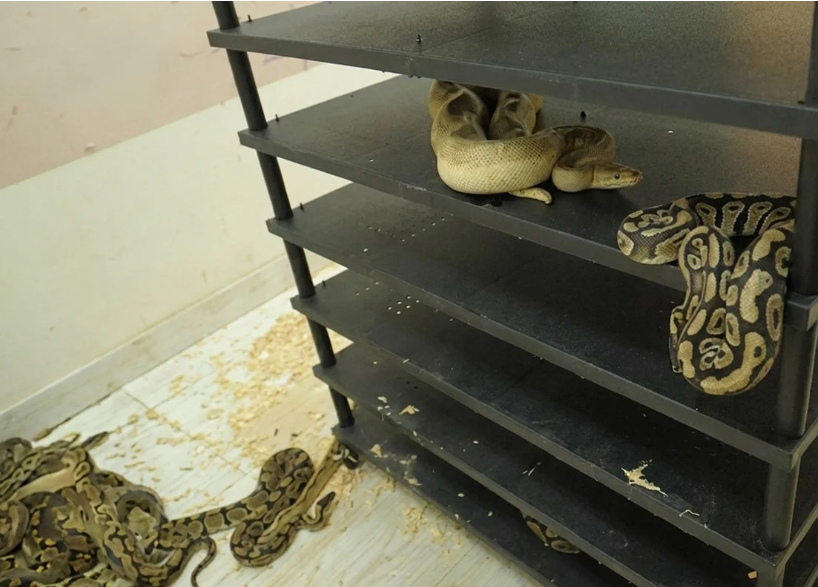
A residential discovery in eastern China has exposed one of the country's largest clandestine wildlife breeding operations, resulting in prison sentences for multiple individuals involved in the unlicensed breeding and sale of hundreds of endangered pythons. The case began innocuously in March 2024 when a senior resident of Taizhou, Zhejiang province, encountered a large snake near a local mountain and reported the unusual find to authorities, setting in motion an investigation that would ultimately uncover a sophisticated operation spanning multiple locations and hundreds of reptiles.
China's strict wildlife protection framework classifies pythons as Grade Two protected animals, the second-highest protection category in the nation's endangered species hierarchy. This designation means that breeding, buying, selling, and transporting pythons without explicit government authorization constitutes a serious criminal offense. The regulatory framework reflects China's broader commitment to wildlife conservation, particularly regarding species that face extinction threats or play critical roles in their ecosystems. However, the ease with which these restrictions can be circumvented through online sales and remote operations demonstrates persistent enforcement challenges in protecting rare animals from determined black market operators.
When police examined the escaped python, they recognized it was not native to the Zhejiang region, and its appearance during early spring—when wild snakes typically remain dormant—suggested artificial origin. A consultation with professional herpaculturists proved revelatory: maintaining viable python populations requires precise environmental conditions, specifically temperatures between 20 and 30 degrees Celsius combined with high humidity levels. These specialized requirements demand sustained electrical power consumption for heating and climate control systems, creating an inadvertent forensic signature that investigators could exploit. The investigators theorized that anyone breeding pythons at commercial scale would generate electricity consumption patterns dramatically exceeding normal household usage.
Leveraging this insight, police began examining electricity consumption records for residents in areas surrounding the discovery site. The methodical screening process identified a man surnamed Guo, who lived alone in an apartment and reportedly maintained no regular employment. What made Guo's profile particularly suspicious was his apparent sole occupation and the demographic pattern of his daily activities. Further investigation revealed that a frequent visitor named Di regularly collected parcels from courier stations, packages that consistently contained small white mice purchased from online vendors. Intelligence gathering showed these rodents were specifically sourced for feeding captive reptiles, establishing a supply chain supporting a breeding operation.
Guo's social media footprint provided additional damning evidence. He had publicly shared photographs of snakes and made veiled references to selling pythons to interested buyers, demonstrating neither caution nor concern about concealing his activities. Transaction records obtained by investigators revealed that Di had facilitated the sale of at least two pythons to an outside buyer for 1,000 yuan (approximately US$150), establishing that the operation extended beyond personal collection into commercial distribution. This evidence sufficiently convinced authorities to execute arrest warrants for both Guo and Di, setting the stage for revelations that would shock even experienced police officers.
When detectives entered Guo's apartment, they encountered a sight that departed dramatically from ordinary residential living. The main bedroom contained only basic furniture, pushed aside to maximize space, while the two additional bedrooms and living room had been completely converted into reptile housing. Plastic boxes of varying sizes were stacked methodically throughout these spaces, creating a labyrinthine arrangement of python enclosures. Police ultimately catalogued 309 pythons occupying Guo's residence, representing one of the largest single-location illegal breeding stocks ever discovered in the region. The seized reptiles were subsequently transferred to a local zoo for proper care and long-term housing, preventing their potential release into ecosystems where they could establish invasive populations.
Guo revealed his long-standing fascination with snakes to investigators, explaining that his interest began years earlier when he acquired four pythons in 2014. Rather than treating this as a casual hobby, Guo had methodically devoted himself to studying reptile genetics and breeding techniques, viewing his enterprise through the lens of scientific cultivation rather than criminal activity. In interviews, he reportedly expressed pride in his ability to selectively breed pythons exhibiting diverse color morphs and patterns, describing himself as a 'creature creator.' This mentality illustrates how individuals can rationalize clearly illegal activities through reframing them as legitimate scientific or artistic pursuits, a psychological pattern that frequently characterizes wildlife trafficking offenders who view themselves as pioneers rather than criminals.
The investigation expanded beyond Guo and Di when authorities identified a third conspirator, a shop owner named Deng who had originally sold four pythons to Guo a decade earlier. Police discovered an additional 47 pythons in Deng's residence, indicating his continued involvement in the operation despite the decade-long interval. The combined investigation revealed that Guo and Di had successfully sold approximately 80 pythons through their distribution network, suggesting their operation had maintained sufficient discretion and customer base to sustain sales over an extended period. The total case tally encompassed 436 pythons valued collectively at over 30 million yuan (approximately US$4.4 million), demonstrating the substantial financial incentives driving illegal wildlife trafficking.
A Taizhou court convicted and imprisoned all three defendants—Guo, Di, and Deng—for violations of China's Criminal Law provisions protecting Grade Two endangered species. While the specific sentence lengths were not disclosed in available reports, the legal framework permits maximum sentences of five years imprisonment for such violations. The prosecutorial effort reflects both the seriousness with which Chinese authorities treat protected species violations and the sophisticated investigative techniques now deployed to combat wildlife trafficking networks. For Southeast Asian readers, the case underscores how illegal wildlife operations in one jurisdiction can threaten regional biodiversity, as snakes and other exotic animals captured in breeding operations sometimes escape or are intentionally released, potentially establishing invasive populations.
The investigation methodology employed by Zhejiang police—cross-referencing specialized environmental requirements with forensic consumption data—offers a model that enforcement agencies throughout Southeast Asia might adapt for their own wildlife protection efforts. Malaysia, Indonesia, and Thailand have witnessed significant wildlife trafficking through similar online channels, yet detection capabilities remain inconsistent across jurisdictions. As the Chinese case demonstrates, even seemingly specialized criminal operations leave measurable traces in utility consumption patterns, shipping records, and digital communications. The broader implication extends beyond mere case closure: successful prosecution of large-scale breeding operations requires cooperation between wildlife experts, utility companies, courier services, and traditional law enforcement, creating an integrated investigative ecosystem that developing nations continue to build.
The incident also highlights tensions between enforcement capacity and wildlife conservation goals in developing Asian economies. While China's Grade Two classification system provides legal tools for protection, the actual breeding of hundreds of pythons proceeded for approximately a decade with apparent impunity. The initial detection depended less on proactive monitoring than on accidental discovery by a civilian. This pattern repeats throughout Southeast Asia, where reactive investigations following escaped animals or public tips often reveal larger operations that have operated undetected for years. Strengthening predictive enforcement—such as monitoring electricity consumption patterns, analyzing online sales of specialized reptile equipment, and tracking courier shipments of live rodents—represents an underutilized approach that could intercept trafficking operations before they reach dangerous scale.
Looking forward, the case raises important questions about legal versus illegal wildlife commerce in East and Southeast Asia. Demand for exotic pythons among collectors, whether in China, Malaysia, or Singapore, drives the economic incentives sustaining these operations. While the convicted individuals clearly violated explicit legal prohibitions, the underlying market demand remains substantial and largely unaddressed through demand-reduction strategies. Public education campaigns emphasizing conservation ethics, regulations strengthening the legal exotic pet trade through licensing and health requirements, and international cooperation on species-specific protection standards all represent longer-term solutions complementing law enforcement approaches. For Malaysia's agricultural and environmental authorities managing their own wildlife protection mandates, the Taizhou case provides both cautionary lessons about sophisticated trafficking operations and tactical insights into detection methodologies that have proven effective in neighboring jurisdictions.

