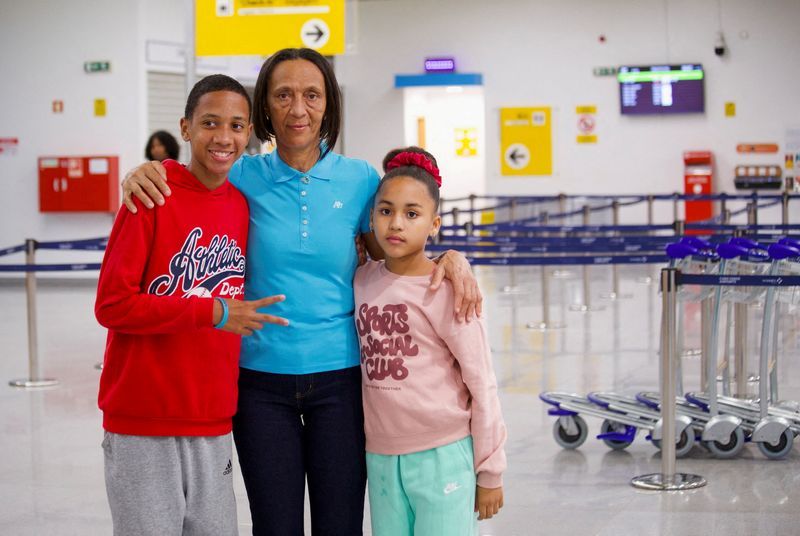
The mother of Cape Verde goalkeeper Vozinha has received approval to travel to the United States for the World Cup after initially being unable to obtain a visa, a development that came after the 40-year-old's public heartbreak over her absence from his standout performance against Spain drew international attention. Ana Candida Evora will now be in the stands when her son faces Uruguay in Miami on Sunday, marking a dramatic reversal of circumstances that had threatened to keep her separated from one of the tournament's most compelling personal stories.
Vozinha delivered a performance that immediately catapulted him into World Cup folklore when Cape Verde, making their maiden appearance in the tournament, held European champions Spain to a goalless draw in Atlanta. The goalkeeper made seven crucial saves to secure the unexpected result, earning the distinction of being named his team's player of the match and providing one of the tournament's early shocks. His reflexes and positioning throughout the contest demonstrated why he remains an integral figure in the Cape Verde squad, despite the advanced age that often signals the twilight of a goalkeeper's career.
What should have been an unambiguous celebration, however, took on a deeply poignant dimension when Vozinha revealed the painful reality waiting for him after the final whistle. His mother, Ana Candida Evora, had been unable to travel from Cape Verde to witness the historic moment, denied entry into the United States due to visa complications. The goalkeeper's emotional response to this absence—kept from his mother despite achieving one of the defining performances of his career—resonated powerfully across social media platforms and international news outlets, humanising the often-sterile world of international football.
The visa obstacles that prevented Evora from joining her son in the United States were rooted in broader immigration policy changes instituted under President Donald Trump's administration. The policy required citizens from numerous countries, including Cape Verde, to post bonds reaching as high as $15,000 to enter American territory—a financial barrier that proved insurmountable for most ordinary families, regardless of their connection to World Cup participants. For someone in Cape Verde's economic circumstances, such a sum would have represented an unfeasible expense, effectively closing off any possibility of attending her son's tournament matches.
However, the initial blanket application of this bond requirement began to unravel as questions mounted about the equity and optics of preventing World Cup attendees from entering the country. The U.S. State Department ultimately made an exception for individuals holding valid World Cup tickets, waiving the bond requirement for this category of travellers. This modification represented a significant softening of the harder-line approach, though by that point, the damage had already been done for many families who had concluded the hurdle was insurmountable and abandoned their plans.
Vozinha's tearful public account of his mother's absence appears to have triggered a more intensive administrative response from the U.S. State Department. After his story circulated widely, State Department officials confirmed that their visa processing office in Praia, Cape Verde's capital, had established direct contact with Evora and was providing expedited support to facilitate her application. The intervention underscored the diplomatic reality that the American government recognised the public relations dimension of the situation and the value in demonstrating responsiveness when high-profile cases emerged.
A State Department spokesperson affirmed the decision to grant Evora's visa application in language that emphasised routine procedure and policy compliance, suggesting that the approval, while expedited, was characterised as a straightforward administrative process. "Consistent with all policies, procedures, and standards, full steam ahead for travel for the game," the official stated, framing the action as entirely standard rather than as an extraordinary exception made in response to the goalkeeper's viral moment.
This episode highlights the tension between rigid immigration enforcement and the practical realities of citizens seeking to exercise ordinary travel rights within their means. Cape Verde, despite its limited economic resources, has produced athletes capable of competing at football's highest level, yet the administrative and financial barriers constructed around US entry had effectively sealed it off for ordinary families supporting their relatives at the World Cup. The case illustrates how immigration policy operates not in abstract, but through concrete impacts on individual lives and family moments.
For Malaysian and Southeast Asian observers, the situation carries particular resonance given ongoing discussions throughout the region about visa accessibility and the barriers that bureaucratic requirements can impose on cross-border travel, even when legitimate purposes exist. The World Cup represents a rare opportunity for citizens of smaller nations to participate in global spectacle, and restrictions that inadvertently exclude family members from witnessing historic achievements strike at something fundamental about why international sport matters beyond the tactical and technical dimensions.
The approval of Evora's visa in time for the Uruguay match represents a rare instance where political and media pressure successfully reversed an administrative outcome that had left a mother unable to watch her son achieve professional triumph at the world's largest sporting stage. Yet it also underscores how access to such moments remains fundamentally unequal, determined by the intersection of nationality, wealth, and administrative machinery rather than by merit or connection to the event itself.