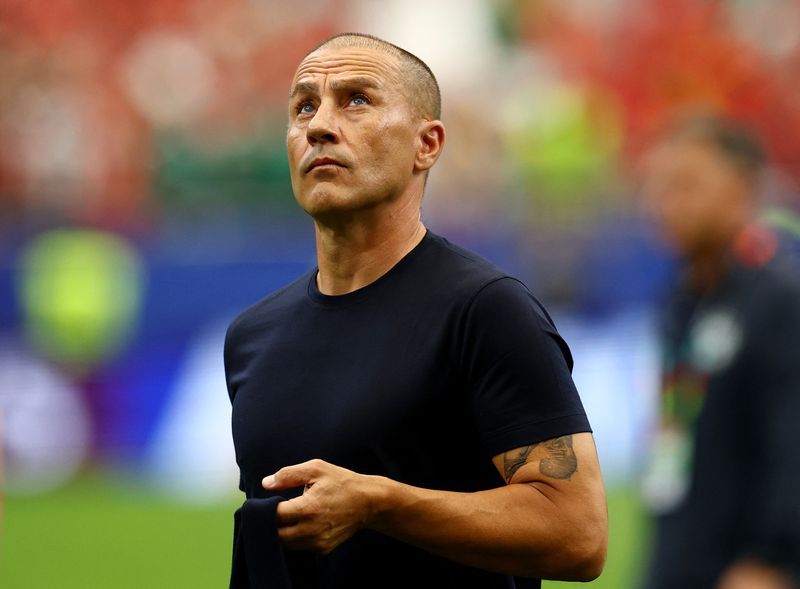
Fabio Cannavaro, the decorated Italian midfielder who lifted the World Cup with his country in 2006, has taken personal ownership of Uzbekistan's catastrophic 5-0 defeat to Portugal in their opening World Cup campaign, though the veteran manager stopped short of accepting that his team's tournament aspirations are finished. Speaking in Houston after Tuesday's Group K encounter, Cannavaro projected a measured tone that balanced accountability with resilience, telling assembled reporters that despite the scale of the loss, Uzbekistan's players had shown commitment and effort throughout the match, and that the experience of their maiden World Cup appearance would ultimately benefit the developing football nation.
Uzbekistan finds itself in a precarious position as the tournament enters its early stages. The Central Asian team has already suffered two significant defeats—the heavy loss to Portugal and an earlier 3-1 setback against Colombia—leaving them with a slim mathematical pathway to the knockout rounds. Their final group encounter against the Democratic Republic of Congo on Saturday has become an absolute must-win fixture if they are to salvage any hope of progressing to the round-of-32, a scenario that currently appears unlikely given the competitive level displayed so far.
Cannavaro's approach to the post-match fallout demonstrated a philosophy shaped by decades in professional football at the highest levels. Rather than deflecting criticism toward his players or making excuses about quality disparities, the former defender and Ballon d'Or winner insisted that the responsibility for tactical decisions and team preparation lay squarely with him. "All my life I have taken responsibility, as a player and as a coach," he stated plainly. "If we lost 5-0, it is because today I made mistakes, and not them." This candid acknowledgment reflects Cannavaro's understanding that while individual errors may occur in any match, the overall game plan and strategic framework are ultimately the coach's domain.
Yet beneath this acceptance of responsibility runs a current of philosophical optimism about Uzbekistan's developmental trajectory. Cannavaro positioned the painful defeat not as evidence of permanent inadequacy but rather as a learning episode for a squad gaining invaluable exposure on sport's grandest stage. He emphasized to his players that mistakes and misplaced passes were inevitable consequences of attempting to compete courageously at World Cup level, and that maintaining confidence despite adversity was crucial to their collective growth. This framing suggests a coach attempting to insulate his team's morale and long-term development from the immediate trauma of the scoreline.
A specific moment during the Portugal match appears to have inflicted disproportionate psychological damage on Uzbekistan's performance. Azizjon Ganiev's disallowed goal at a stage when Portugal led 2-0 proved to be a turning point in the team's momentum and belief. Cannavaro identified this decision as particularly consequential, explaining that the annulment for an infraction in the build-up had visibly deflated his side's collective spirits. "The goal that was disallowed really had an impact on our confidence," he reflected. The incident underscored how in football, subjective refereeing decisions can compound a team's difficulties, especially for less experienced squads navigating the pressure of their first World Cup campaign.
Cannavaro's instructions to his players centered on embracing a fearless approach to the game despite the formidable opposition they faced. He had challenged them to play with boldness, to express themselves through football rather than retreat into defensive caution, recognizing that timid football rarely succeeds against elite opponents. This tactical philosophy—rooted in the belief that aggressive, positive play creates more opportunities than purely reactive football—appeared to have been partially vindicated in the opening phases of both the Colombia and Portugal matches, where Uzbekistan showed ambition in their approach before the results deteriorated.
The coach's determination to maintain hope through remaining fixtures, despite overwhelming mathematical probabilities, reflects both professional duty and strategic messaging. By publicly insisting that Uzbekistan would "keep believing until we mathematically cannot go through," Cannavaro sought to preserve team unity and prevent psychological collapse ahead of the Congo match. Defeatism among players before the contest had been mathematically decided would serve no constructive purpose and might further damage Uzbekistan's long-term football development.
For Malaysian and Southeast Asian observers, Uzbekistan's experience carries particular resonance. Like many developing football nations in the region, Uzbekistan represents a country investing in football infrastructure and international competition to elevate its standing. The Central Asian federation's investment in appointing an elite coach with Cannavaro's pedigree demonstrates ambition to accelerate development, even if early World Cup results have been disappointing. The philosophy Cannavaro espouses—prioritizing experience, courage, and measured growth over immediate results—mirrors the strategic approach that wealthier Southeast Asian federations have adopted when competing at elite levels.
Cannavaro's public statements also reveal the tension inherent in managing a team at a major tournament while simultaneously building for future competitions. The immediate pressure to avoid humiliation competes with the longer-term objective of developing talented young players who might sustain competitiveness beyond this World Cup cycle. By framing the defeats as growth opportunities rather than terminal failures, Cannavaro attempts to navigate this psychological minefield and protect the confidence of players who may represent Uzbekistan at future tournaments.
The broader context of football development in Central Asia suggests that Uzbekistan's World Cup participation, regardless of outcome, represents substantial progress. The nation's first appearance at the tournament came after a competitive qualifying campaign, and the exposure to world-class competition provides invaluable benchmarking for domestic football structures. Cannavaro's willingness to accept accountability while maintaining faith in his team's capacity to improve embodies a coaching philosophy that values integrity and long-term vision alongside short-term competitive results.

