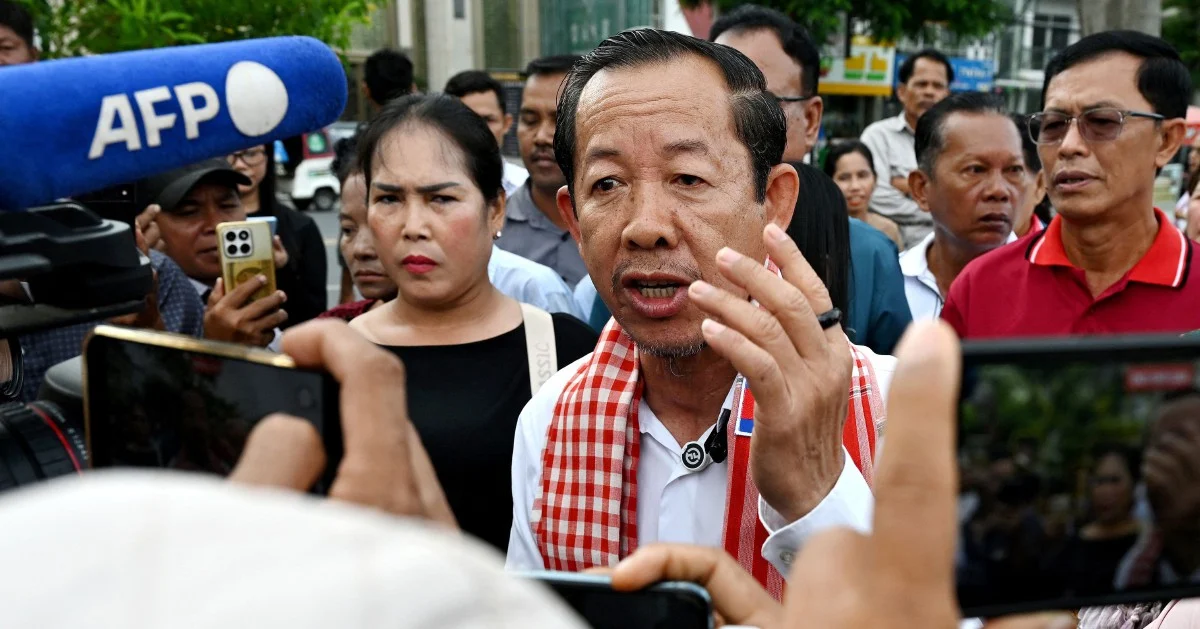
Cambodia's highest judicial authority has suspended the prison sentence imposed on prominent opposition figure Rong Chhun while maintaining a prohibition that bars him from seeking elected office, according to statements from his legal team released on Friday from the capital, Phnom Penh.
The ruling represents a mixed outcome for the embattled politician, whose legal troubles have drawn scrutiny from international observers monitoring political freedoms in the Southeast Asian nation. The suspension of his custodial sentence provides some relief, yet the affirmation of the electoral ban effectively removes him from formal political participation for the foreseeable future—a restriction with significant implications for Cambodia's political landscape and the viability of opposition movements in the country.
Rong Chhun's legal predicament exemplifies broader concerns about the narrowing political space in Cambodia, where opposition figures have faced mounting legal challenges in recent years. The Supreme Court's selective approach—reducing the personal consequences while preserving electoral restrictions—suggests a judicial strategy that neither fully exonerates nor completely incapacitates the politician, effectively sidelining him from the formal democratic process without the finality of imprisonment.
The electoral ban carries substantial weight within Cambodia's political context. Elections serve as the primary avenue through which opposition parties can challenge the ruling establishment and build parliamentary representation. By maintaining this prohibition, the court effectively neutralises Rong Chhun's capacity to mobilise supporters through candidacy or to leverage his political platform during campaign periods, even as he avoids serving a prison sentence.
Regional observers and international human rights organisations have expressed recurring concerns about judicial independence in Cambodia, particularly regarding cases involving political opposition figures. The pattern of suspending sentences while upholding ancillary penalties raises questions about whether such outcomes reflect legal principle or serve broader political objectives. The distinction between these two elements—imprisonment versus electoral eligibility—creates a form of selective justice that warrants careful examination.
For Malaysian observers, Cambodia's political trajectory holds cautionary lessons about how democratic institutions can gradually narrow the scope of legitimate political competition. Malaysia's own experience with electoral contestation and the occasional deployment of legal mechanisms against political opponents provides a basis for understanding the mechanisms through which democratic participation becomes constrained, whether through statute, judicial ruling, or administrative action.
Rong Chhun's case also illuminates the interconnected nature of Southeast Asian political systems. Neighbouring countries maintain active interests in Cambodia's stability and governance frameworks, and restrictions on opposition figures inevitably influence the broader regional calculus regarding democratic representation and political legitimacy. Malaysia, as a nation with substantial economic and diplomatic ties throughout the region, has interests in understanding how political governance operates across its neighbourhood.
The Supreme Court's decision may have practical consequences extending beyond the immediate legal situation. Political parties associated with Rong Chhun must now operate without his formal candidacy or direct electoral participation, potentially affecting their organisational capacity and campaign effectiveness. Supporters face constraints on their ability to mobilise behind a familiar political figure during election cycles, forcing opposition movements to develop alternative leadership structures and messaging approaches.
The suspension of the prison sentence suggests that Cambodia's judicial system maintains some mechanisms for moderating excessive punishment, yet the persistence of electoral restrictions indicates that such moderation operates within defined boundaries. This selective approach creates a legal grey zone where political opponents remain partially active but substantially diminished—they can potentially engage in advocacy and organisational work outside formal electoral contexts, but cannot directly challenge ruling authorities through the ballot box.
International response to such rulings varies considerably, with some observers viewing them as incremental steps toward fairer treatment while others interpret them as insufficient given the underlying questions about judicial independence and political persecution. For Malaysia and other ASEAN members, Cambodia's legal and political developments remain relevant to broader conversations about how constitutional democracies function and where institutional guardrails against abuse effectively operate.
Looking forward, the implications of this ruling extend beyond Rong Chhun's individual circumstances. The decision establishes precedent for how Cambodia's courts might handle similar cases involving opposition figures, potentially shaping the legal terrain within which political contestation occurs. If electoral bans become routine outcomes despite sentence suspensions, this could fundamentally alter Cambodia's electoral dynamics and the competitive conditions available to opposition movements seeking parliamentary representation.
For Malaysia's political and media establishment, Cambodia's experience reinforces the importance of maintaining robust institutions that genuinely protect political freedoms and ensure that judicial decisions remain insulated from political pressure. The Malaysian public benefits from transparency regarding how courts handle cases involving opposition figures, and understanding international examples—both successful and cautionary—helps inform domestic conversations about the proper role of institutions in democratic systems.

