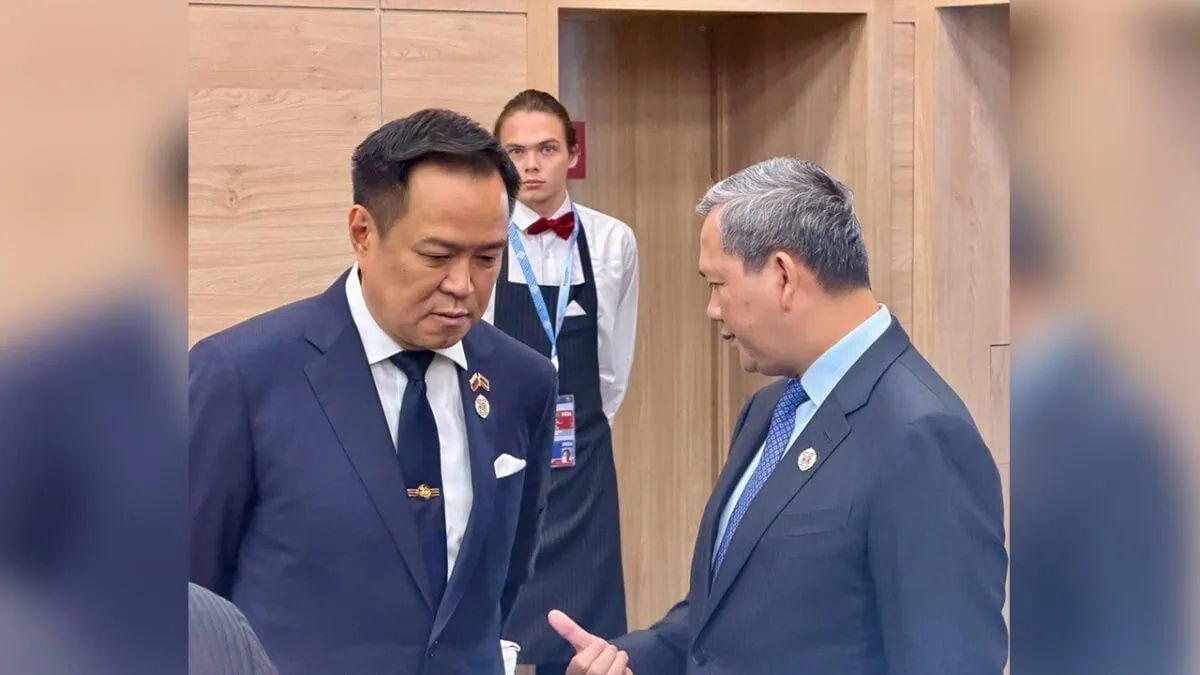
Cambodian Prime Minister Hun Manet has pressed Thailand to move forward with appointing leadership for the Joint Boundary Commission and resuming long-stalled border demarcation efforts, signalling his government's determination to resolve longstanding territorial disagreements through diplomatic channels. The appeal came during an informal encounter between Manet and Thai Prime Minister Anutin Charnvirakul on the margins of an Asean-Russia engagement held in Kazan, Russia, where both regional leaders happened to be attending meetings. Manet's subsequent remarks on social media underscored Cambodia's commitment to settling border matters peacefully and in line with established international legal frameworks, even as he made clear that Bangkok needed to take concrete steps to advance the stalled bilateral process.
The diplomatic exchange highlights the delicate balancing act required to manage territorial tensions in Southeast Asia, where historical boundary disputes between neighbouring states remain sources of friction despite decades of formal relations. Manet characterised the Kazan conversation as merely a brief, casual discussion—the kind that occurs when senior officials find themselves in proximity at international gatherings—yet he used the occasion to formally request that Thailand finally appoint a JBC chief and commence the joint survey and demarcation work that both nations committed to under the terms of a December 27, 2025 Joint Statement. The timing of this public call suggests that Cambodia views the appointment of a Thai JBC chief as a critical next step that should no longer be delayed, and Manet's decision to publicise the request indicates that Phnom Penh wishes to maintain diplomatic pressure on the matter.
Thailand's account of the Kazan encounter, as relayed through Prime Minister Anutin to Thai media outlets, largely corroborated the Cambodian version while offering a slightly different emphasis on tone and scope. Anutin characterised the interaction as merely "pulling each other aside by the elbow"—a colloquial expression suggesting a fleeting, informal chat rather than a substantive negotiation—and he underscored that the brevity of their exchange reflected genuine time constraints imposed by the Kazan schedule. Despite the apparent casualness of the moment, however, both leaders took the opportunity to reaffirm their respective nations' commitment to avoiding conflict and to managing disagreements through established diplomatic and legal mechanisms. Anutin specifically referenced Thailand's continued dedication to international frameworks including the United Nations Convention on the Law of the Sea (UNCLOS), the Joint Boundary Commission, and the General Border Committee (GBC), all of which serve as formal channels for boundary discussions.
The dual-track approach that both nations are pursuing reflects the complexity of their territorial issues, which involve disputes over both maritime boundaries in the Gulf of Thailand and terrestrial boundaries on land. Cambodia and Thailand are currently engaged in a compulsory conciliation process under UNCLOS regarding maritime matters, a mechanism that has already been formally initiated. For land boundaries, however, the two countries have historically preferred bilateral negotiations conducted through the JBC, a framework established through existing bilateral agreements that allows for direct discussion and technical work on demarcation. Manet made clear that Cambodia continues to favour this bilateral approach for land issues and does not intend to escalate matters to multilateral forums, at least for now. Yet his public call for Thailand to appoint a JBC chief suggests that the lack of Thai representation in this commission has become an obstacle that must be resolved to move the process forward.
One notable aspect of Anutin's remarks was his dismissive response when asked whether the two leaders had discussed reopening border checkpoints between their nations. According to reports of the conversation, Anutin reportedly laughed off the question and stated that he had deliberately avoided raising the checkpoint issue because doing so would provoke domestic backlash in Thailand. This comment reveals the domestic political sensitivities that constrain what national leaders can publicly propose regarding Cambodia-Thailand relations. Border checkpoint operations carry symbolic weight in both countries, with citizens holding strong views about cross-border access and regional integration. Anutin's reluctance to discuss the matter publicly, even in an informal setting, indicates that any move toward reopening checkpoints would face significant internal resistance in Thailand and therefore remains off the diplomatic agenda for now.
The divergence in emphasis between the Cambodian and Thai public statements, while subtle, reflects the different strategic priorities of each nation in managing their bilateral relationship. Cambodia, through Manet, sought to emphasize Thai responsibility for accelerating the JBC process by highlighting the specific December 27, 2025 Joint Statement and the outstanding task of appointing a JBC chief. This framing positions Cambodia as the willing party and Thailand as the laggard, potentially building international and domestic pressure on Bangkok to act. Thailand, through Anutin, preferred to underscore both nations' shared commitment to peaceful resolution and mutual rejection of conflict, a more consensual framing that avoids assigning blame or creating perceptions of unequal commitment. Both approaches, however, ultimately converge on a common objective: managing border tensions through established dialogue mechanisms rather than through confrontation or unilateral action.
The border issues between Cambodia and Thailand continue to command significant public attention in both countries, driven partly by nationalist sentiment and partly by genuine concerns about sovereignty and territorial integrity. Each government must carefully calibrate its public messaging to satisfy domestic audiences while maintaining sufficient diplomatic flexibility to negotiate with the other side. Manet's decision to publicly call out Thailand's failure to appoint a JBC chief demonstrates that Phnom Penh is willing to apply gentle pressure through publicity, a technique that falls short of formal complaint but makes clear that progress is expected. Similarly, Anutin's emphasis on Thailand's commitment to peaceful resolution and international frameworks serves to reassure both domestic audiences and international observers that Bangkok has no aggressive intentions and views these disputes as technical matters to be resolved through proper channels.
The Asean-Russia engagement in Kazan, where this conversation occurred, itself reflects the broader geopolitical context in which Southeast Asian border disputes unfold. As major powers compete for influence in the region, Southeast Asian nations must manage their internal disputes while also positioning themselves strategically vis-à-vis major powers. Cambodia and Thailand, as Asean members, have a shared interest in maintaining regional stability and demonstrating that the bloc can manage its internal disagreements peacefully. Both leaders' invocation of UNCLOS, bilateral agreements, and established commissions signals commitment to rules-based approaches to dispute resolution, a positioning that aligns with international norms and may be particularly important given great power competition in regional waters and territories.
Moving forward, the key metric for assessing progress on Cambodia-Thailand border issues will be whether Thailand follows through on appointing a JBC chief and whether the two nations can jointly initiate or accelerate survey and demarcation work. These are concrete, measurable steps that would indicate genuine commitment to resolving long-delayed disputes. The December 27, 2025 Joint Statement that both leaders referenced provides a formal framework and timeline, suggesting that expectations have been set and both sides are aware of what the other expects. Cambodia's public reiteration of these expectations, delivered through informal diplomatic channels yet amplified through social media and media reporting, keeps the matter visible and maintains diplomatic momentum toward resolution. For observers of Southeast Asian regional affairs, the Cambodia-Thailand border dispute remains a test case of whether established diplomatic mechanisms can resolve longstanding territorial disagreements in an era when such disputes carry domestic political weight and when great power attention to regional maritime areas has increased substantially.

