Malaysia's political leadership has launched a nationwide appeal for citizens to internalize the deeper spiritual and practical significance of Hijrah—the Islamic New Year—as the nation transitions into 1448H. The message, delivered through statements from Deputy Prime Ministers and Cabinet ministers, transcends ceremonial observance to anchor discussion around concrete values of personal transformation, collective responsibility and national strength during a period of global economic uncertainty.
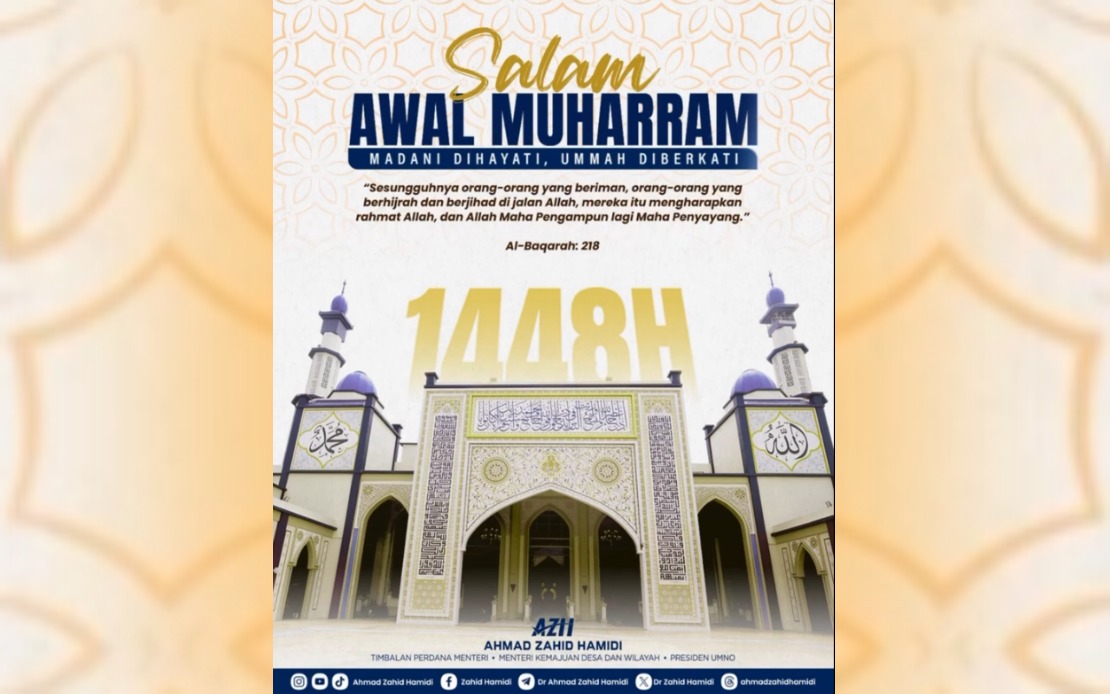
Deputy Prime Minister Datuk Seri Dr Ahmad Zahid Hamidi positioned Hijrah not as mere chronological change but as a philosophical framework demanding tangible commitment. In his statement, he emphasized that meaningful progress cannot emerge from rhetoric alone; instead, it requires sustained effort, self-discipline and the determination to outperform one's previous self. By framing Hijrah within these parameters, Zahid Hamidi has articulated a leadership philosophy that connects Islamic tradition to contemporary governance challenges, signaling to the public that the government views this period as one demanding substantive action rather than passive acceptance.
The invocation of sacrifice and perseverance as core Hijrah values carries particular resonance in Malaysia's current context. These principles, according to Zahid Hamidi, should guide leaders, workers and community members in their respective roles. This framing suggests that government officials are positioning themselves as exemplars of these values—a subtle but important statement in a political environment where integrity and accountability remain contested issues. The emphasis on using these historical lessons to navigate contemporary challenges represents an attempt to legitimize policy decisions through spiritual and cultural reference points.
Deputy Prime Minister Datuk Seri Fadillah Yusof expanded the discussion by addressing Malaysia's vulnerability to external economic pressures. He directly linked the Hijrah spirit to practical responses to global supply chain disruptions, economic uncertainties and resource constraints affecting Malaysian households and businesses. This connection between spiritual reflection and pragmatic economic management is particularly significant for Southeast Asian readers, as it demonstrates how government messaging attempts to bridge religious observance with the material concerns of ordinary citizens grappling with inflation and cost-of-living pressures.
Fadillah's emphasis on moderation and resource conservation—prudent spending, energy efficiency, food waste reduction—reflects an administrative awareness that Hijrah period messaging can reinforce fiscal discipline across society. By encouraging Malaysians to prioritize needs over wants, the government frames economic restraint not as deprivation but as alignment with Islamic teaching. This approach offers a culturally coherent pathway for promoting household savings and reduced consumption without appearing to blame citizens for economic difficulties beyond their control.
The repeated invocation of national unity throughout these statements underscores a consistent government concern: managing social cohesion amid Malaysia's complex multicultural landscape. Fadillah explicitly warned against allowing differences to fracture society, positioning the Hijrah spirit as a corrective against divisive tendencies. For Malaysia specifically, where religious and ethnic sensitivities remain politically charged, such messaging serves multiple functions—reassuring majority Muslim populations while signaling to non-Muslim communities that religious observance need not exclude them from narratives of shared national purpose.
Communications Minister Datuk Fahmi Fadzil's contribution centered on psychological and spiritual renewal, emphasizing courage, patience and sincerity as Hijrah-derived virtues applicable to personal development and public life. This framing suggests that government messaging strategy intentionally targets individual consciousness as a pathway to collective change. By positioning the Islamic New Year as an opportunity for renewed determination, the minister has effectively recast religious observance as a moment for civic and personal recommitment—a subtle but important rhetorical move that connects faith practice to national development goals.
Minister in the Prime Minister's Department Zulkifli Hasan's specific guidance on prayer practices—recitation of end-of-year and beginning-of-year prayers at precise times—demonstrates how government religious affairs messaging bridges abstract principles with concrete devotional acts. By providing practical details about prayer timing and encouraging family participation, Hasan has transformed Hijrah observance into an actionable practice rather than merely symbolic gesture. This approach recognizes that spiritual transformation often requires structured ritual and communal participation, not simply intellectual assent to principles.
The breadth of ministerial participation—spanning portfolios from agriculture to digital infrastructure—reflects a deliberate strategy to embed Hijrah messaging across the entire governmental apparatus. When ministers responsible for trade, health, education and defense all echo similar themes of transformation, unity and resilience, they create a coordinated narrative suggesting that these values should permeate all policy domains and administrative functions. For Malaysian observers and regional analysts, this comprehensive messaging indicates that government leadership has identified the Hijrah period as strategically important for reinforcing administrative messaging around reform and shared national purpose.
The timing of this collective messaging proves particularly significant given Malaysia's ongoing economic challenges and political landscape. By anchoring calls for reform, unity and resilience in Islamic tradition, government leaders attempt to bypass some contentious policy debates by shifting focus toward values that command broad, cross-sectional acceptance within the Muslim-majority population. This strategy proves especially valuable during periods of policy uncertainty or when specific government initiatives face criticism—abstract appeals to Hijrah spirit and national unity can redirect public discourse toward aspirational rather than controversial terrain.
For Southeast Asian readers, these statements illustrate how religious calendars and spiritual observances serve governmental functions beyond ceremonial significance. In Malaysia, Hijrah messaging becomes a vehicle for discussing economic adaptation, national cohesion and individual responsibility during periods of external pressure. This pattern resonates across the region, where many governments similarly invoke cultural and religious frameworks to build consensus around policy directions and reinforce citizen identification with national projects.
The consistent emphasis on personal and collective transformation through the Hijrah framework also reflects implicit acknowledgment that Malaysia faces substantive challenges requiring behavioral and attitudinal shifts. Whether addressing economic uncertainty, social fragmentation or governance deficits, government messaging positions Hijrah observance as potentially catalytic—a moment when citizens might recalibrate priorities, strengthen interpersonal bonds and recommit to national development. Whether this appeals translates into sustained behavioral change across diverse populations remains uncertain, but the coordinated messaging clearly signals that Malaysia's leadership views the Islamic New Year as a critical juncture for reorienting public consciousness toward collective resilience and shared responsibility.