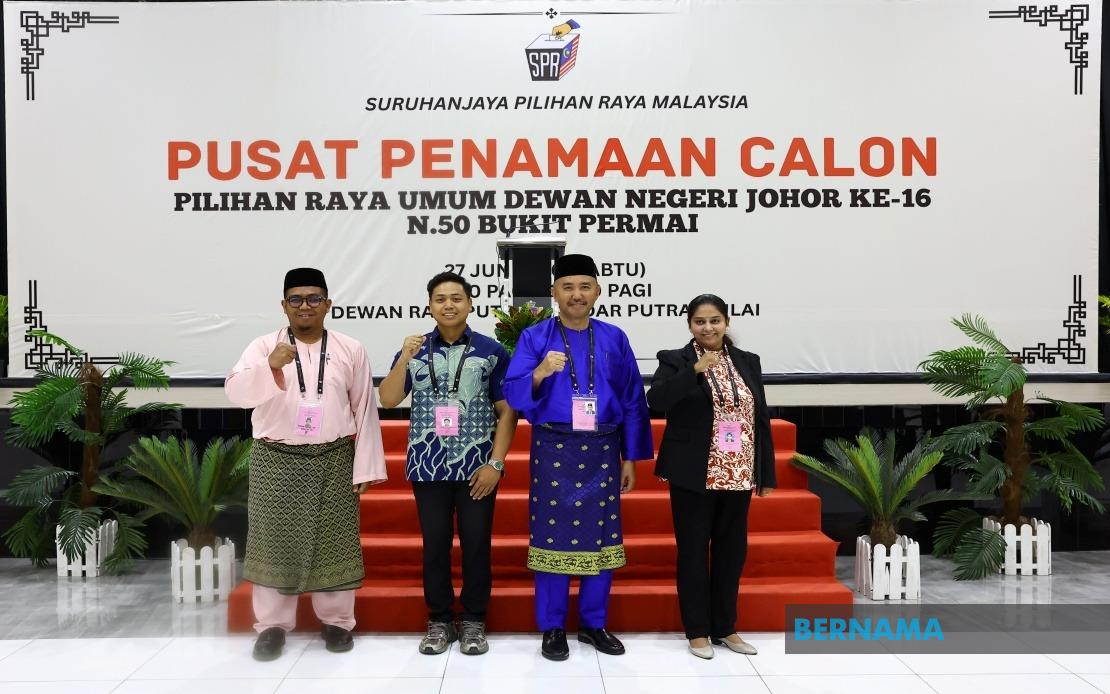
Datuk Mohd Jafni Md Shukor, the incumbent state assemblyman for Bukit Permai, faces a competitive battle to retain his seat as the 16th Johor state election enters its candidate nomination phase. The Barisan Nasional representative finds himself in a four-cornered contest that reflects the increasingly fragmented political landscape in Malaysian state-level contests. Nomination papers were officially closed on June 27 at the Dewan Raya Putra nomination centre in Bandar Putra, Batu Pahat, with returning officer Afzan Azhari confirming the final roster of contenders vying for the constituency.
Mohd Jafni's challengers represent the full spectrum of Malaysia's major political coalitions and newer entrants. Mohamad Shafwan Ani carries the hopes of Pakatan Harapan, the opposition coalition that has made significant inroads in recent years, whilst Perikatan Nasional, which has grown as a formidable political force since 2020, fields M. Lina Manoh. Completing the field is Muhammad Aidil Riduan Mohd Yusof of Parti Bersama Malaysia, a relative newcomer to Malaysian politics that has been gradually building its presence across the peninsula. The presence of Johor DAP chairman Teo Nie Ching at the nomination centre to support Mohamad Shafwan underscores the significance that Pakatan Harapan places on this particular seat.
Mohd Jafni's previous victory in 2022 demonstrated his electoral strength in the constituency. The incumbent secured a commanding majority of 4,755 votes in what was also a four-cornered contest at that time. Such a margin provides a substantial buffer, though it is not insurmountable in an environment where voter sentiment can shift significantly between election cycles. The fact that he faced multiple opponents then and faces them again now suggests that Bukit Permai has become a competitive battleground where no single political force commands overwhelming support.
The timing of the election reflects broader electoral scheduling in Malaysia. The Election Commission has structured the campaign to allow for early voting on July 7, providing flexibility for those unable to vote on the main polling day. The principal election date of July 11 will determine not only the fate of Bukit Permai but the overall composition of the Johor state assembly, making individual constituencies like this one crucial building blocks in determining which coalition can claim the right to form government in one of Malaysia's largest and most economically significant states.
The four-way nature of this contest has implications beyond Bukit Permai itself. With multiple candidates splitting votes across competing coalitions, the outcome will likely depend on which party can maintain the strongest ground organisation and voter mobilisation efforts. For Barisan Nasional, defending incumbents in fragmented constituencies presents a particular challenge, as the coalition's base vote can become diluted when multiple opposition and alternative parties contest. Conversely, Pakatan Harapan and Perikatan Nasional will each seek to consolidate their respective support bases whilst potentially benefiting from splits in the Barisan Nasional coalition vote.
The emergence of Parti Bersama Malaysia as a contesting force in Bukit Permai signals the diversification of Malaysia's political marketplace. Rather than politics being dominated by a bipolar or even tripolar contest, voters in constituencies like this one now have genuinely distinct ideological and organizational choices. This multiplicity reflects deeper changes in how Malaysian voters are engaging with politics, particularly younger demographics seeking alternatives to the traditional major coalitions. For Bersama Malaysia, each seat contested represents an opportunity to build credibility and electoral experience.
From a Johor perspective, the state has historically served as a crucial testing ground for national political trends. Elections here often provide early indicators of shifting voter sentiment across the broader peninsula. The Bukit Permai contest, therefore, offers valuable insights into how different voter cohorts in this southern state region are assessing their political options heading into the campaign period. The presence of competition from multiple directions suggests that voters in this constituency are actively evaluating their alternatives rather than automatically supporting incumbent or traditional aligned parties.
The campaign period between nomination closure and July 11 will be decisive. Each candidate will need to articulate distinct positions on state-level governance issues whilst also resonating with voters' concerns about national developments. For Mohd Jafni, the challenge involves mobilising his existing base whilst demonstrating continued relevance to constituencies that may be attracted to opposition alternatives or newer political options. His opponents, meanwhile, must each carve out distinct campaign messages that differentiate themselves not just from the incumbent but from each other.
The electoral mechanics of a four-cornered contest mean that victory may not require securing an absolute majority of votes. In such scenarios, effective vote consolidation and superior ground operations often prove decisive. Barisan Nasional's organisational machinery and established structures in traditional strongholds may serve Mohd Jafni well, but these advantages cannot be taken for granted against well-resourced opposition parties and increasingly sophisticated newer entrants. The 4,755-vote margin from 2022 suggests the seat is competitive rather than safely held, particularly if opposition and alternative parties can effectively coordinate messaging around specific local issues.

