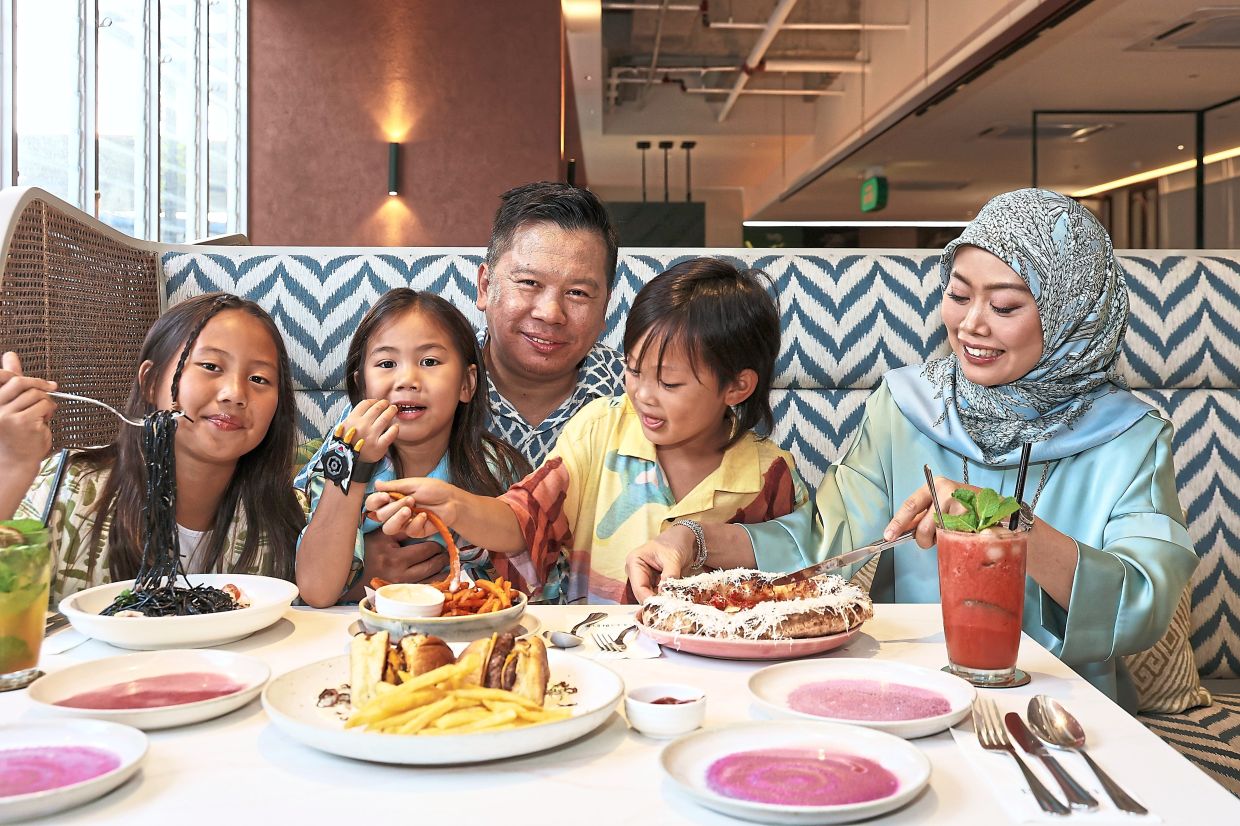
At the stylish Super Blonde restaurant within Kuala Lumpur's KLGCC Mall, a scene of domestic contentment unfolds on an ordinary afternoon. Arya Iman, aged ten, confidently works behind the counter at Taffy, her aunt's adjacent gelato establishment, while her younger brothers Arman Noah, eight, and Arif Azeez, five, occupy themselves nearby. The children move through these dining spaces with the ease of those who have spent their formative years surrounded by culinary operations—a tangible reminder of how deeply the restaurant industry has woven itself into their family fabric. Their comfort in these environments speaks to something beyond mere familiarity; it reflects a deliberate parenting philosophy that has grown from the lived experiences of their parents.
Their father, Datuk Mohd Najib Abdul Hamid, and mother, Datin Qistina Taff, have transformed what might appear to be a professional liability—the all-consuming demands of the food and beverage sector—into something resembling an advantage for family bonding. Both serve as directors of the Serai Group, a portfolio of restaurant concepts that now encompasses over 30 outlets across Malaysia and the United Kingdom. The group's architectural diversity is notable: the original Serai brand, along with Super Blonde, Jibby & Co, and Jibby Chow represent homegrown concepts, while international partnerships such as Meet Bros, the London-based steakhouse operated in conjunction with Menate Steak Hub, demonstrate ambition beyond Malaysia's borders. This expansion represents not merely business growth but the manifestation of a vision to elevate regional dining culture onto a broader stage.
When asked whether she takes pride in her parents' accomplishments, young Arya responds with refreshing candour: "Yes, because the restaurants make us money!" Her pragmatism, tinged with humour, hints at a child who has absorbed fundamental economic truths simply through proximity and observation. Yet beneath this quip lies a more profound reality about how entrepreneurial families function differently when children grow up within the business itself. The three siblings have witnessed firsthand the mechanics of expansion, the demands of operational excellence, and the tangible rewards of sustained effort—lessons that formal education alone rarely delivers.
The roots of this restaurant-centric family narrative run deep into both parents' personal histories. Datin Qistina's mother, Rina Abdullah, established the pioneering Serai Thai restaurant in Shah Alam, Selangor in 1990, creating the foundational concept that would eventually evolve into today's diversified group. Datuk Najib, meanwhile, grew up in Sabah in a household where culinary enterprise was equally embedded. His father, recognizing market potential, began by preparing dishes such as nasi lemak and mee goreng at their home before systematically testing demand by distributing baskets of food to government offices. Young Najib participated in these early ventures, carrying heavy baskets during school holidays and absorbing lessons about risk-taking, market responsiveness, and the grinding work prerequisite to business success. Both parents thus arrived at their partnership already steeped in food industry culture, creating a shared language and mutual understanding that would prove invaluable during the establishment years.
The couple's meeting in Melbourne, Australia, where they initially orbited within the same circles without genuine connection, preceded a period of long-distance courtship after Qistina's return to Malaysia. Datuk Najib had accumulated more than a decade of restaurant experience in the Australian city, frequently working 16-hour days and building the operational resilience that would define his approach to business building. When he relocated to Malaysia in 2009 and married Qistina the following year, the couple possessed complementary skills, aligned values, and an understanding that their partnership would necessarily blur boundaries between domestic and professional spheres. Their first five years together were characterized by relentless effort, with both founders handling fundamental tasks—purchasing from markets at dawn, managing cash registers, overseeing kitchen operations—that established the work ethic underpinning everything that followed.
The strategic pivot toward expansion occurred when the couple recognized that maintaining the historic Serai brand while simultaneously innovating risked constraints. "I said, 'Let's bring Serai to a different level, like Serai 2.0. The original brand was started 37 years ago and we decided to maintain the name and set up the restaurant group so we could do different concepts," Datuk Najib explains. This conceptual framework—preserving legacy while enabling evolution—allowed them to launch Super Blonde and other ventures without diluting the original concept's integrity. The approach reflects mature business thinking, acknowledging that growth sometimes requires portfolio differentiation rather than monolithic expansion of a single brand.
Arya's infancy coincided with this period of deliberate expansion, and from the beginning she inhabited restaurant spaces as her natural environment. Datuk Najib recalls her colouring books spread across tables while her parents worked, and her remarkable ease in conversing with staff members despite her tender age—mimicking managerial authority in the unselfconscious manner of young children. When her brothers arrived, the restaurant environment continued to serve as extended family space, and all three children absorbed food knowledge organically, engaging in conversations about culinary matters and dining experiences that occupy the family's attention during meals and excursions. This immersion has produced children who, despite their youth, demonstrate genuine comprehension of food culture and business operations—an advantage that extends far beyond the hospitality industry into their general cognitive development.
The international dimension of the Serai Group represents a significant achievement within Malaysia's competitive F&B landscape, yet the expansion into London via Meet Bros has also served as a crucible for testing Datuk Najib's priorities. When the family moved to London for four months during the restaurant's establishment phase, the decision to relocate rather than proceed with frequent business trips reflected a deliberate choice to protect family cohesion against the centrifugal forces that business building typically exerts. This choice carries particular resonance because it contradicts prevailing cultural narratives within entrepreneurial circles, where separation and sacrifice are often lionized. Instead, Datuk Najib privileged presence, a stance that hardened into conviction after his third child's birth prompted reflection on what genuine success encompasses.
The psychological evolution Datuk Najib describes—recognizing that workaholic patterns inevitably exact family costs—emerged from witnessing a cautionary example at his own restaurant Naj and Belle. When an aunt's daughter repeatedly called her mother, unable to reach her because of business demands, the image crystallized something he wished to avoid. Now, despite maintaining Monday-through-Friday intensity, he ensures personal school transportation daily and prioritizes weekend presence. His willingness to discuss the trade-offs candidly—noting that were his wife not active in the same industry, he "might come home to an empty home"—acknowledges the genuine sacrifice required to build the Serai Group's scale while maintaining family relationships. This honesty distinguishes his narrative from purely hagiographic accounts of entrepreneurial success.
Datin Qistina emerges from Datuk Najib's account as the linchpin enabling this precarious balance, handling approximately 90 percent of child-rearing responsibilities even during periods when household staff provided support. Her dual role—simultaneously a director of substantial business operations and the primary architect of domestic life—demonstrates that questions of work-life integration in entrepreneurial contexts remain fundamentally gendered. While Datuk Najib receives credit for "toning down" his workaholic tendencies, the narrative implicitly reveals Datin Qistina's invisibilized labour in creating conditions that permit his relative restraint. Her capacity to prepare home-cooked meals daily while managing a restaurant empire suggests either extraordinary personal energy or the absorption of expectations that their male counterparts rarely face.
The operational expansion continues regardless, with the group now managing over 1,000 employees across multiple brands and geographic territories. Plans for Manchester expansion suggest ambitions that extend beyond London's initial foothold, while a boutique resort in Sabah bearing his daughter's name indicates diversification beyond pure food and beverage into hospitality more broadly. These ventures represent both business calculation and personal legacy-building—establishing enterprises that his children might eventually steward, though Datuk Najib does not explicitly discuss succession planning or whether his offspring's restaurant fluency will translate into professional involvement.
The annual commitment to two weeks of family holidays represents the ritualistic affirmation of his reprioritization, a non-negotiable allocation of time in a calendar otherwise consumed by operational demands. During these periods, Datuk Najib reports being fully present—a qualitative distinction he emphasizes—suggesting that presence itself requires deliberate mental recalibration away from business modes of thinking. The pattern reflects broader challenges within Malaysia's entrepreneurial ecosystem, where F&B operators particularly face structural pressures toward continuous presence that mirror retail and hospitality's fundamental nature. That Datuk Najib has constructed workarounds enabling meaningful family engagement while sustaining rapid business growth offers a model potentially instructive for others navigating similar pressures.
Ultimately, the Serai Group story represents something more psychologically complex than a straightforward account of business success. It captures the moment when an entrepreneur recognizes that the metrics by which he measures achievement must expand beyond revenue, market share, and outlet count to incorporate intangible measures of familial connection and personal presence. The three children who move confidently through Super Blonde and Taffy are simultaneously testaments to parental business acumen and beneficiaries of deliberate decisions to permit their childhood visibility and engagement within professional spaces. Whether this model proves sustainable as the business grows further, and whether these children will eventually choose to continue or diverge from their parents' path, remains to be seen. For now, at least, the Serai Group represents a demonstration that the false dichotomy between family and empire—so prevalent in entrepreneurial mythology—remains precisely that: false.

