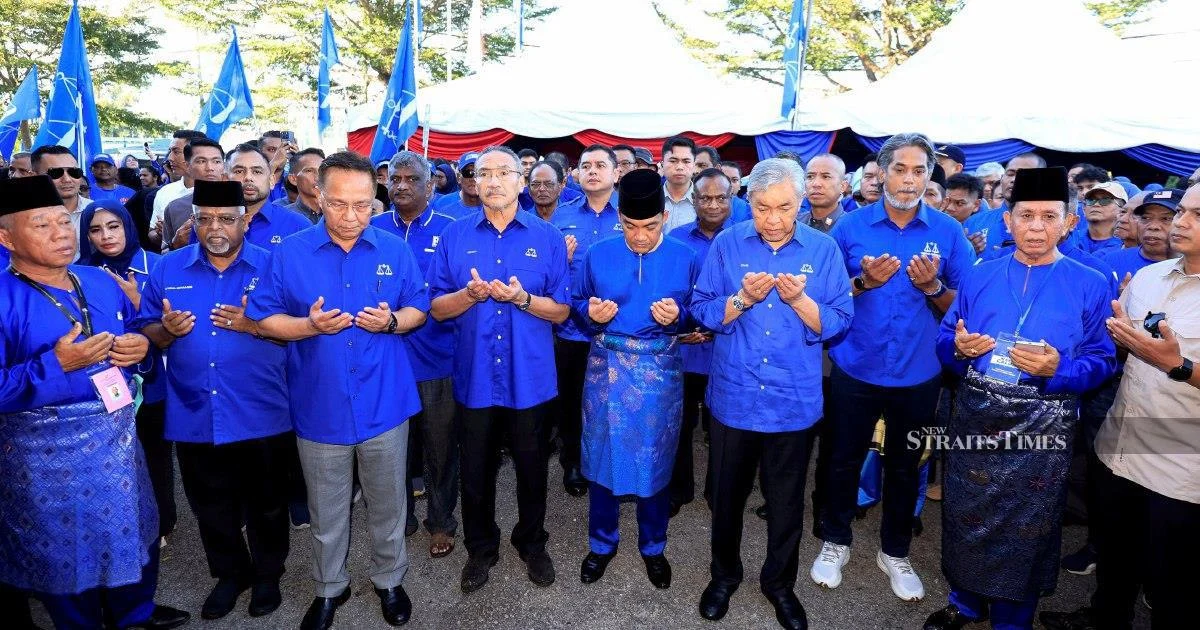
The corridors of power in Johor shifted noticeably on Monday when a constellation of Barisan Nasional heavyweights descended on Simpang Renggam District Council, their coordinated appearance delivering a pointed message of collective backing for Datuk Onn Hafiz Ghazi. The show of force underscores the coalition's determination to consolidate support in one of Malaysia's most politically significant states, where electoral momentum has become increasingly unpredictable in recent years.
Onn Hafiz, the Johor Menteri Besar, remains central to BN's calculations in the southern state, where the party has historically drawn its deepest roots. Yet the presence of multiple senior leaders at a single grassroots venue suggests something more tactical at play—a deliberate effort to signal organisational discipline and prevent any fracturing within party ranks. In Malaysian politics, such carefully orchestrated displays carry considerable symbolic weight, particularly in a state where internal BN tensions have occasionally threatened to undermine the coalition's electoral performance.
Johor occupies an outsized place in national political calculations. The state assembly comprises 56 seats, making it the largest state legislature after Sabah and Sarawak, and historically has served as a crucial testing ground for BN's broader electoral strategy. Any weakening of BN's position here ripples outward, affecting the coalition's confidence heading into national campaigns. The stakes have intensified given the competitive environment that has characterised Malaysian politics since 2018, when BN lost federal power for the first time in six decades.
The timing of this demonstration of solidarity merits scrutiny. Political cycles in Johor do not operate in isolation from developments elsewhere in the federation. Opposition parties have been actively wooing defectors and attempting to exploit perceived divisions within the ruling coalition. By assembling its senior figures in Simpang Renggam, BN sought to project an image of unshakeable cohesion that would deter ambitious politicians from considering alternative alignments.
For Malaysian voters watching from the sidelines, such gatherings reveal the mechanics of coalition politics in their most candid form. These are not primarily about policy platforms or developmental agendas—though those exist—but about signalling to party members, rival politicians, and the electorate that institutional structures remain intact and power remains consolidated. Onn Hafiz's continued elevation as a focal point for BN support indicates his standing within the coalition remains secure, despite the complex factional dynamics that persist within UMNO and other BN components.
The Simpang Renggam gathering carries particular resonance because the district, situated in Kluang parliamentary constituency, represents the kind of heartland territory where BN traditionally maintains commanding majorities. Demonstrating organisational presence and leadership attention in such areas serves multiple purposes: it reassures the grassroots that their concerns register at the highest levels, it provides optical evidence of party unity to news media and the broader public, and it creates an implicit hierarchy of importance that shapes internal party perceptions.
For Southeast Asian observers and international analysts tracking Malaysian politics, the appearance of BN unity masks deeper currents. The coalition has weathered significant electoral pressures over the past five years, including the loss of Sabah to opposition-aligned forces and numerous by-election setbacks. Maintaining Johor as a secure fortress remains essential to BN's long-term viability as a political force, which explains why senior figures would invest their personal prestige in such public demonstrations of support.
The engagement of multiple heavyweight figures also signals BN's readiness to contest seriously rather than rely on complacency or historical advantage. In an era when electoral expectations have become more volatile, even seemingly safe territories demand active cultivation. The party recognises that simply holding office no longer suffices; maintaining legitimacy requires demonstrating that leadership remains attentive to constituent needs and that party structures function effectively.
For Onn Hafiz personally, such displays of solidarity provide political capital that strengthens his hand in internal party negotiations and his standing with the state electorate. A Menteri Besar backed visibly by party elders possesses greater authority than one whose position depends merely on formal appointment. Malaysian political culture places considerable weight on these public expressions of support, which influence how politicians at all levels calculate their own alignments and career trajectories.
Looking forward, the trajectory of Johor politics will largely determine whether BN can stabilise its national position or faces further erosion. The Simpang Renggam gathering represents one chapter in an ongoing effort to prevent the kind of internal breakdown that devastated other coalitions in recent years. Whether this show of unity translates into sustained electoral advantage or merely delays inevitable shifts in voter preference will emerge as election schedules crystallise and campaign season intensifies.
The convergence of BN leaders in this Johor district ultimately reflects the coalition's recognition that power in Malaysia's most populous peninsula state cannot be taken as given. Political parties that assume permanent dominion over particular territories have historically paid steep prices when that assumption proves unfounded. By keeping Onn Hafiz in the spotlight and surrounding him with senior party figures, BN attempts to preempt such reckoning and maintain the coalition's grip on a state whose significance extends far beyond its borders.

