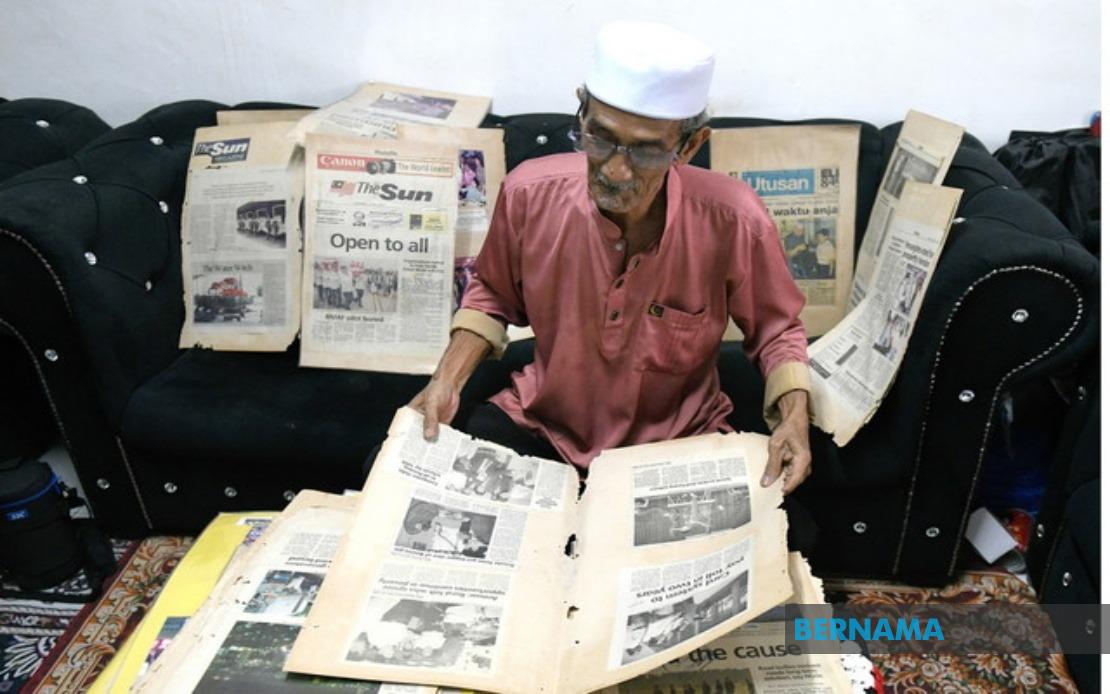
Azmi Sapiei carries memories that extend far beyond typical career milestones. The 64-year-old veteran photographer and cameraman has spent over thirty years navigating the demands of Malaysian newsrooms, accumulating experiences that range from capturing exclusive historical moments to weathering violence in the field. Among the most difficult recollections is an assault during court coverage in 2001, when a suspect attacked him with kicks and spittle—a stark reminder that news gathering carries real physical risk, yet one that never deterred him from returning to assignments that demanded his presence and skill.
Azmi's career trajectory reveals much about the evolution of Malaysian media itself. Beginning in the mid-1980s through factory work before relocating to Kuala Lumpur, he initially pursued independent photography contracts with agencies and women's magazines before his interest in journalism steered him toward Bernama in 1993. This nearly three-year tenure at Malaysia's national news agency proved formative, exposing him to coverage of major national events while instilling the discipline required for accurate, impactful visual storytelling. When he relocated to Penang and worked successively for The Sun, Bernama TV, and part-time at RTM Penang from 2003 until his retirement in mid-2020, he had already developed a reputation for reliability and technical competence that would define his professional identity.
One assignment particularly exemplifies the value Azmi brought to Malaysian journalism. In July 1994, he secured exclusive photographs documenting the return of Shamsiah Fakeh, a former Malayan Communist Party member, from exile in China to her nephew's residence in Gombak. By arriving early before authorities cordoned the area, Azmi and his journalist colleague managed to gain access that other media outlets could not. He shot three rolls of film—a significant commitment in the pre-digital era—yet his editor initially questioned whether three rolls warranted the film stock expended. However, when the photographs were developed, every major Malaysian newspaper featured them prominently the following day, vindicating both the assignment's importance and Azmi's editorial judgment about what constituted newsworthy visual content.
The transition from film to digital technology shaped Azmi's entire professional methodology. During the analogue era, photographers carried the psychological burden of uncertainty; every frame shot on film remained invisible until processing, meaning editors received caption submissions before seeing the actual images. This required photographers to possess not only technical skill but also comprehensive knowledge of what editors needed and what stories demanded visually. Azmi became proficient in writing photo captions that contextualised his work for editorial review before distribution to Bernama customers—a responsibility that disappeared once digital review became instantaneous. Yet this older discipline created photographers who understood news value intuitively rather than relying on instant feedback or image previews.
The physical demands of camera work evolved alongside technology, though not always in directions that reduced strain on operators. When Azmi transitioned to television work with Bernama TV, he encountered the Betacam system, equipment that industry professionals dismissively called "junk iron" due to its substantial weight. Carrying approximately twelve kilogrammes on his shoulders during coverage assignments required the kind of sustained physical endurance that younger readers accustomed to smartphones and lightweight mirrorless cameras might struggle to comprehend. Television cameramen needed not only photographic acumen but also the bodily strength to maintain steady footage while bearing equipment that modern standards would consider prohibitively heavy. This distinction between still photography and broadcast work meant that cameramen like Azmi possessed overlapping but distinct skill sets, each demanding different physical and mental resilience.
Azmi's perspective on his profession extends beyond technical competence to encompass the psychological maturation that comes from confronting real danger and setback in pursuit of stories. The assault he experienced while covering a court case represented an occupational hazard that few outside journalism fully appreciate. Yet rather than defining his career through that traumatic moment, Azmi characterises his three decades of work as fundamentally about developing "physical and mental endurance when facing various challenges in the field." This formulation acknowledges that journalism requires not stoicism but rather the capacity to process difficult experiences and return to work with commitment intact. His willingness to reflect candidly on both triumph—the Shamsiah Fakeh photographs—and trauma—the assault during court coverage—demonstrates a mature understanding of journalism's true cost.
Bernama's role as what Azmi terms a "school" for Malaysian photographers deserves particular attention in understanding his career trajectory. The national news agency functioned not merely as an employer but as an institution that systematised training in photojournalism standards, ethical picture selection, and the relationship between technical skill and editorial judgment. Azmi's early experience of seeing three rolls of film discarded by an editor frustrated him initially, yet proved instructive; it taught him that volume of output mattered less than accuracy and news value. This institutional knowledge, transmitted from editors to photographers across generations, created a professional culture distinct from freelance or magazine work. When Azmi eventually left Bernama, he carried these standards into subsequent positions, bringing consistency to Malaysian visual journalism across multiple platforms and decades.
The recognition Azmi received—including the 2006 Penang State Media Award in the visual electronic media category—validated his contributions to Malaysian journalism. Yet perhaps more significantly, his professional legacy continues through his second son, Muhammad Syafiq, now working with Media Prima Television Network at age thirty. Syafiq's career origin story, beginning with childhood observation of equipment his father brought home and evolving through assignment attendance after completing his Sijil Pelajaran Malaysia in 2016, reflects how professional knowledge transmits through families in media industries. More importantly, Syafiq explicitly credits his father not only as a parent but as "a teacher and mentor who taught me a lot, including filming techniques, choosing visual angles and work discipline while on duty." This articulation demonstrates that Azmi's most enduring contribution may involve not his individual photographs or news coverage but rather the professional standards and ethical framework he imparted to the next generation.
For Malaysian and Southeast Asian readers, Azmi's career illustrates broader transformations in regional journalism. His transition from Bernama to provincial outlets to part-time broadcast work mirrors consolidation and restructuring that characterised Malaysian media evolution over recent decades. The technical shifts from film to digital, from Betacam to modern broadcasting standards, compress what were once career-defining expertise hierarchies into accessible skillsets. Yet Azmi's emphasis on discipline, accuracy, and news judgment suggests that certain professional values persist despite technological disruption. His retirement in mid-2020, coinciding with Malaysia's pandemic onset and the acceleration of digital media transformation, marked the departure of a photographer who had witnessed Malaysian journalism's entire modern evolution. That his son now works in the industry suggests these values—however challenged by economic pressures on newsrooms—continue to influence how visual journalism operates in the region.
Azmi's reflection on three decades of work ultimately transcends individual accomplishment to address journalism's fundamental role in Malaysian society. His coverage of the Shamsiah Fakeh return allowed Malaysians to witness a historically significant moment; his daily work across court cases, political events, and institutional ceremonies created the visual record through which citizens understood their country. The assault he endured while performing this work represented not a reason to abandon journalism but rather an occupational hazard inherent in pursuing truth-telling that sometimes conflicts with subjects' interests. In an era when journalism faces unprecedented economic and political pressure across Southeast Asia, Azmi's career exemplifies a generation of journalists for whom documentation and accuracy constituted professional imperatives regardless of personal cost or public recognition. His legacy, embodied in both individual photographs and professional standards transmitted to his son, demonstrates how individual journalists sustain institutions and values that outlast their careers.