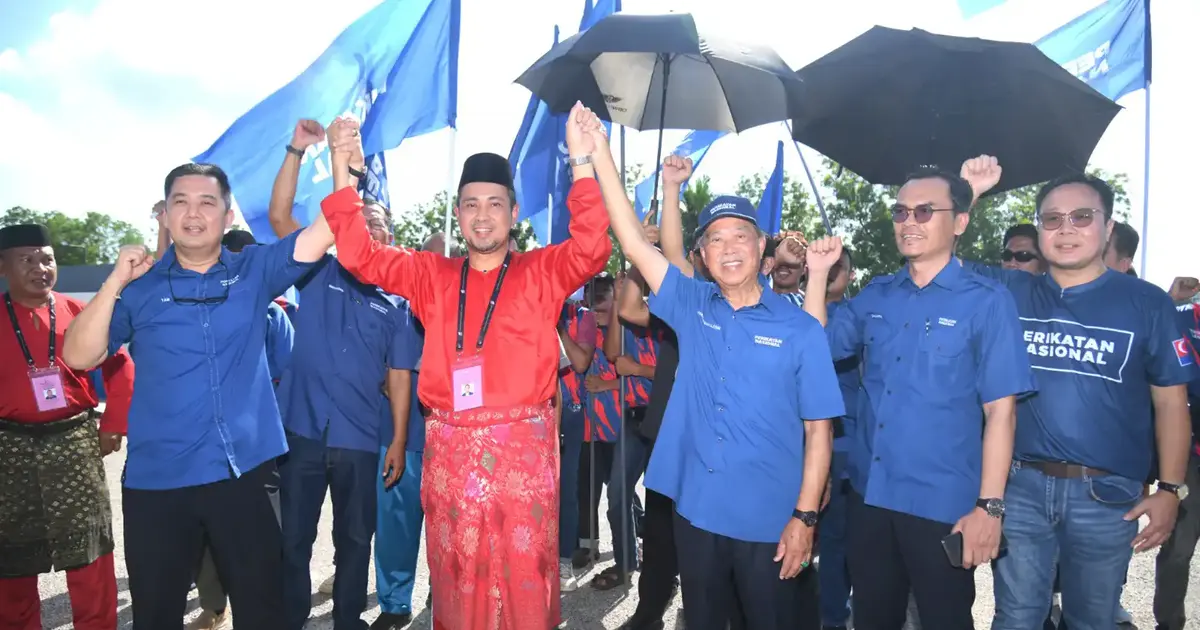
Bersatu's leadership has adopted a measured stance regarding PAS's decision to withhold campaign machinery and logistical support, with party president Muhyiddin Yassin indicating the matter reflects broader coalition dynamics rather than a fundamental breakdown in the Perikatan Nasional (PN) partnership. The response, delivered with apparent equanimity, suggests Bersatu is attempting to contain potential fallout from what many observers view as a significant erosion of goodwill between the two major Islamic-leaning parties that form the backbone of the PN coalition.
Muhyiddin's statement underscores a carefully calibrated political message: while cooperation and mutual assistance remain theoretical anchors of the PN framework, his party leadership has acknowledged that compelling other members to provide support contradicts the voluntary nature of coalition relationships. This formulation allows Bersatu to simultaneously maintain the facade of unity while signaling to party members and sympathetic observers that it will not accept subordinate treatment from coalition partners, a delicate balance in Malaysia's fractious political landscape.
The subtext of this exchange reveals underlying tensions within PN that have accumulated over months of electoral positioning and resource allocation disputes. PAS, commanding substantial organizational networks across several states and enjoying deep grassroots penetration particularly in the Malay-Muslim demographic, has historically leveraged its machinery as a central asset in coalition negotiations. The withdrawal of such support, whether temporary or strategic, constitutes a notable assertion of PAS's independent political weight and its willingness to prioritize its own organizational consolidation over unconditional coalition solidarity.
For Malaysian political observers, this friction illustrates a broader pattern in PN's evolution since its formation. The coalition initially unified as an anti-Pakatan Harapan force following the 2020 political realignment, but has increasingly struggled with resource competition, ideological nuances, and divergent electoral calculations among its members. Bersatu, despite holding the premiership at certain junctures, remains the numerically smaller partner relative to PAS in parliamentary terms, a dynamic that shapes negotiating power within coalition councils.
The implications of this machinery dispute extend beyond symbolic politics. Campaign infrastructure—including volunteer networks, logistics coordination, and ground-level mobilization capabilities—directly impacts electoral performance, particularly in marginal constituencies where organizational efficiency determines outcomes. By declining to mobilize its machinery for Bersatu's benefit, PAS is making a calculated decision about resource deployment that could meaningfully affect either party's electoral prospects depending on the specific constituencies affected.
Muhyiddin's insistence that his party will not compel others to render assistance reflects pragmatic acknowledgment of political realities. In Malaysia's coalition environment, attempting to coerce reluctant partners typically generates resentment that poisons working relationships across multiple policy domains. The Bersatu president appears to have concluded that maintaining sufficient cordial relations with PAS for governance purposes outweighs the short-term benefits of aggressive arm-twisting over campaign logistics.
This measured response also carries implications for Bersatu's positioning within the broader opposition landscape. The party, comprising largely Malay and Muslim constituencies, operates in a crowded political marketplace where both Pakatan Harapan and PN pursue overlapping voter demographics. Bersatu cannot afford to appear as the aggrieved party in coalition disputes if it hopes to maintain credibility as a competent coalition manager. Muhyiddin's calm acknowledgment of PAS's prerogative thus serves to reinforce Bersatu's claim to political maturity and coalition discipline.
For PAS, the machinery withdrawal signals its recognition of enhanced bargaining capacity within PN. The party has expanded its electoral footprint over successive election cycles and increasingly commands significant voting blocs in strategically important states. Its decision to preserve machinery resources rather than freely deploy them across all coalition initiatives suggests PAS leadership views its organizational assets as finite resources requiring careful stewardship for the party's own strategic objectives.
The regional context amplifies these internal coalition dynamics. Southeast Asian coalition politics increasingly feature temporary alignments rather than durable institutional partnerships, with member parties constantly recalibrating their positions based on perceived electoral advantage. PAS and Bersatu's mutual accommodation in some spheres combined with resource competition in others mirrors patterns observable across the region's multiparty democracies, where coalition members maintain formal partnerships while preserving maximum flexibility for independent action.
Muhyiddin's comments reflect diplomatic language calculated to manage perceptions among multiple audiences simultaneously. Party loyalists receive assurance that Bersatu maintains backbone and will not accept demeaning treatment, while coalition partners observe a commitment to maintaining professional relationships regardless of temporary resource disputes. This multivalent messaging represents essential political skill in Malaysia's delicate coalition environment.
The machinery dispute, while contained by careful rhetoric, nevertheless underscores PN's ongoing internal stress. As the coalition approaches successive electoral cycles, managing resource allocation and mutual support expectations will require sophisticated negotiation between PAS and Bersatu. Muhyiddin's steady response suggests the Bersatu leadership recognizes that escalating this particular dispute would yield diminishing returns while damaging the broader coalition framework both parties depend upon for political viability.

