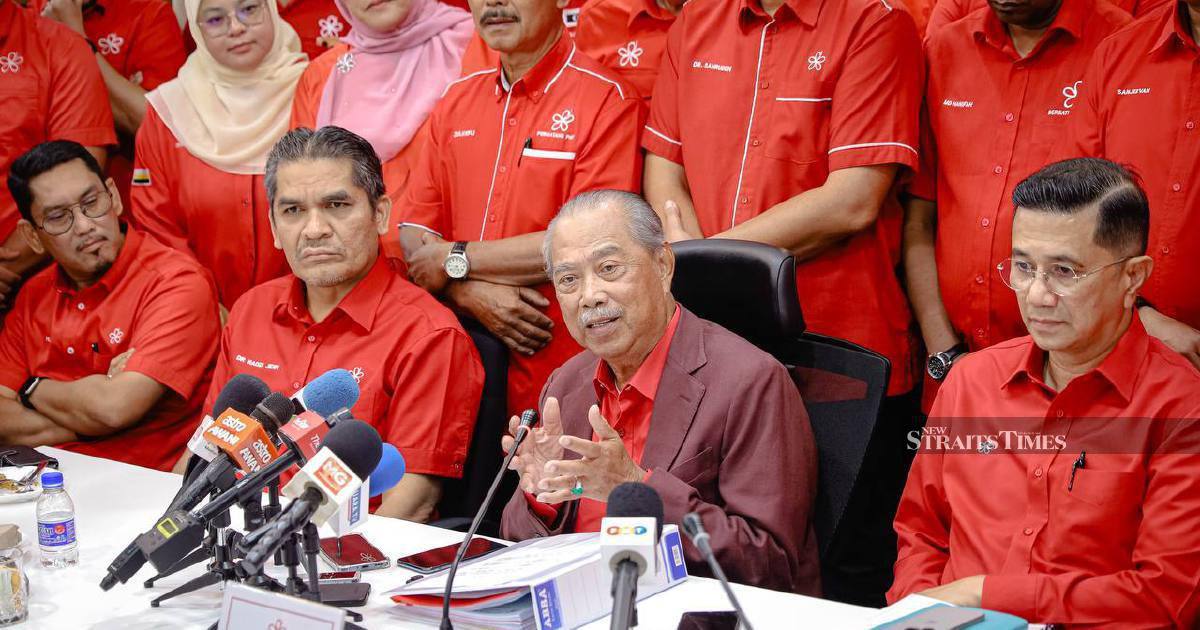
Bersatu's willingness to engage in a direct electoral contest with Pas in Johor underscores mounting tensions within Malaysia's Islamist political bloc, revealing deepening rifts between two parties that once operated as allies in the fallen Perikatan Nasional government. Party president Tan Sri Muhyiddin Yassin made the declaration, signalling that his organisation will not shy away from competing head-to-head with the Pan-Malaysian Islamic Party should seat negotiations between the two break down ahead of the state election.
The statement reflects a significant shift in the political landscape of Johor, where Bersatu has been building momentum as a credible alternative to the long-dominant United Malays National Organisation. Since the party's formation a decade ago as a breakaway faction, it has increasingly positioned itself as capable of challenging established political orders across multiple states. Muhyiddin's confidence in facing Pas—a party with deep roots in Johor's Islamic community—suggests Bersatu believes it has sufficient ground support and organisational capacity to withstand a direct contest.
Pas has traditionally dominated Johor's political narrative, particularly among rural and semi-urban constituencies with significant Muslim voter concentrations. However, changing demographics and shifting voter preferences have eroded some of the party's electoral hegemony. The emergence of Bersatu as a competing Islamic-oriented party has complicated the political calculus for both organisations, forcing them to vie for overlapping constituencies rather than maintain traditional territorial divisions. This competition reflects broader fragmentation within Malaysia's Islamic political sphere, where theological alignment no longer guarantees electoral cooperation.
The context of Bersatu's preparedness extends beyond mere electoral arithmetic. The party's success in the 2022 Kuala Lumpur federal elections and its recent gains in state-level contests have emboldened its leadership to view confrontation with established competitors as strategically viable. Bersatu's capacity to mobilise support among traditionally conservative constituencies has surprised political observers who assumed Pas would maintain unchallenged dominance in these areas. This shift represents a generational recalibration of Islamist politics in Malaysia, where multiple parties now compete for the same religious-nationalist voter base.
For Malaysian readers and regional observers, the Bersatu-Pas dynamic carries implications extending beyond Johor's borders. The struggle between these two parties mirrors broader tensions across Southeast Asia, where Islamic political movements grapple with questions of representation and legitimacy. In Indonesia, the Philippines, and Thailand, similar competitions have emerged between multiple Islamist parties, suggesting a region-wide trend toward political pluralisation within religious movements. The Malaysian experience offers insights into how such fragmentation develops and what electoral outcomes it produces.
Muhyiddin's statement also signals Bersatu's confidence in its organisational machinery and grassroots networks. By publicly announcing readiness for direct competition, the party president demonstrates resolve to party members and supporters while testing political opponents' resolve. Such public declarations serve dual purposes: they energise internal party cohorts by portraying their organisation as unafraid of established rivals, while simultaneously sending messages to potential coalition partners about Bersatu's leverage in negotiations. The statement essentially places the onus on Pas to reach acceptable seat-sharing arrangements, implying that failure to do so would result in contested constituencies favourable to neither party.
The electoral implications for Johor are substantial. Should Bersatu and Pas contest overlapping seats, vote-splitting among Muslim and conservative constituencies could reshape the state's political configuration. Such fragmentation could inadvertently benefit the Democratic Action Party and other non-Bumiputera-focused parties, which would capture votes from constituencies where Bumiputera-oriented competitors divide support. This mathematical reality has motivated significant effort toward coalition-building across Malaysian politics, yet Muhyiddin's willingness to contemplate direct competition suggests negotiations may have stalled or broken down in specific constituencies.
The broader political context frames Johor as increasingly significant within national Malaysian politics. The state's electoral outcomes disproportionately influence federal coalition arithmetic and government formation. With Bersatu positioning itself as a serious contender in Johor—rather than a regional force confined to specific areas—the party challenges UMNO's traditional supremacy in the state. This three-way competition between Bersatu, Pas, and UMNO represents a fundamental restructuring of Johor's political landscape, fragmenting the Bumiputera-Muslim voting bloc that historically delivered commanding majorities to single parties.
Muhyiddin's declaration must also be understood within the context of internal Bersatu dynamics and his own political survival. As party president, maintaining an image of strength and political relevance remains essential to retaining support from party members and coalition partners. Projecting willingness to face any competitor, regardless of electoral difficulty, reinforces perceptions of Bersatu as a serious political force. This positioning becomes particularly important as Bersatu navigates its role within broader federal coalition arrangements and determines its strategic direction heading toward general elections.
The statement ultimately reveals the complexities of modern Malaysian politics, where traditional alliance patterns have fractured and religious identity no longer automatically determines party affiliation or coalition membership. Bersatu's emergence as a credible competitor to Pas in Johor marks a significant departure from earlier decades when such direct competition between Islamic-oriented parties would have been virtually unthinkable. This evolution reflects changing voter preferences, generational shifts in political engagement, and the personalisation of politics around individual leaders rather than institutional party structures. How these tensions resolve in Johor's electoral contest will significantly influence Malaysian politics for years ahead.