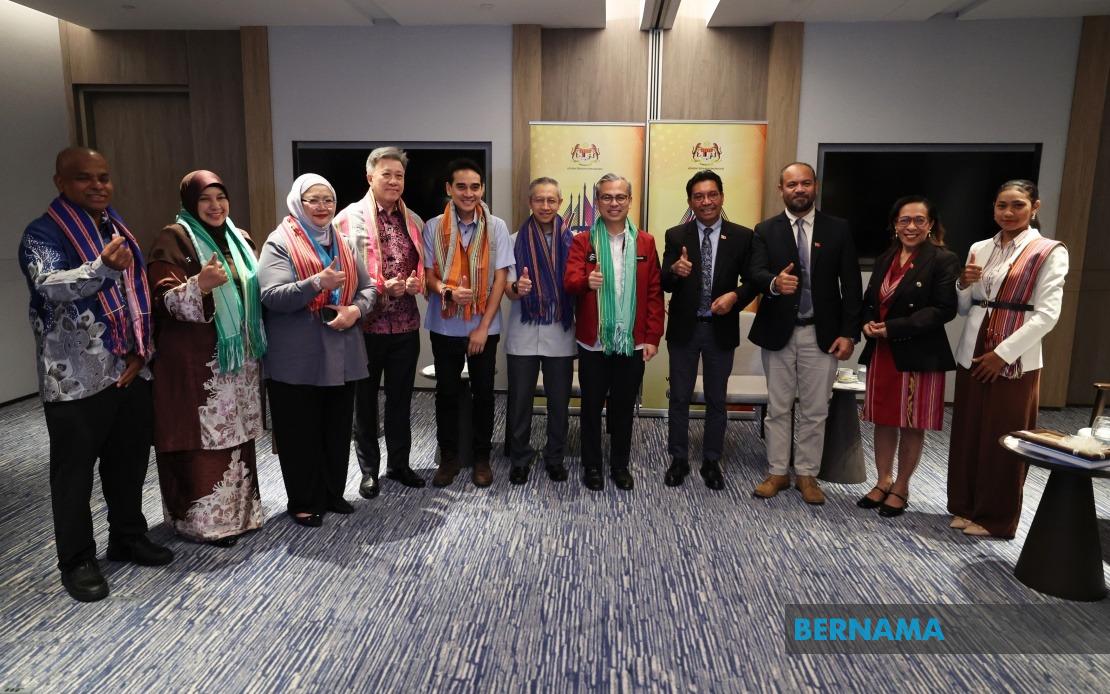
Malaysia's national news agency Bernama and Timor-Leste's news agency TATOLI have formalized a strategic partnership aimed at deepening media cooperation across Southeast Asia. The memorandum of understanding, signed during celebrations of National Journalists' Day (HAWANA) 2026 in Butterworth, establishes a framework for regular exchange of news content, photographic materials, and multimedia resources between the two organizations, while also laying groundwork for structured journalism training programmes that will benefit staff from both agencies.
The agreement represents a significant step forward for regional news collaboration at a time when Timor-Leste has only recently assumed full membership in ASEAN, having formally joined the regional bloc in October 2025. Bernama Chief Executive Officer Datin Paduka Nur-ul Afida Kamaludin emphasized that this partnership extends beyond mere content sharing, positioning regional news agencies as custodians of ASEAN's narrative and ensuring that the organization's voice remains shaped by local perspectives rather than external sources. The partnership carries implications for how Southeast Asian news is sourced, verified, and disseminated across the region's increasingly interconnected media landscape.
A particularly notable dimension of the collaboration involves the expansion of Bernama's multilingual capabilities. Currently reporting in six languages—Bahasa Melayu, English, Tamil, Mandarin, Arabic, and Spanish—Bernama is now considering the addition of Portuguese to its portfolio, a development directly prompted by the TATOLI partnership. This linguistic expansion will enable the Malaysian agency to reach Portuguese-speaking communities globally, while simultaneously ensuring that Timor-Leste's content reaches audiences through TATOLI's platforms in Tetum, Portuguese, Bahasa Indonesia, and English. The move reflects a broader strategic calculation that media influence in the digital age depends partly on accessibility across language barriers.
The training component of the agreement holds particular significance for capability-building in the Southeast Asian media sector. Bernama has committed to hosting groups of TATOLI reporters for professional development programmes before the end of 2024, leveraging its extensive institutional experience in journalism education. The Malaysian agency operates the Bernama School of Journalism and has accumulated over two decades of experience in conducting specialized training courses across multiple media formats. This includes dedicated instruction in online journalism, television reporting, digital media production, radio broadcasting, and photojournalism—areas where TATOLI staff will gain direct exposure to best practices developed at one of the region's most established news organizations.
The partnership was officially formalized through an exchange ceremony overseen by Malaysia's Communication Minister Datuk Fahmi Fadzil and Timor-Leste's Secretary of State for Social Communication, Expedito Loro Dias Ximenes, with Prime Minister Datuk Seri Anwar Ibrahim witnessing the event. The high-level involvement of government officials from both nations underscores the political importance placed on media cooperation, reflecting broader ASEAN integration efforts and recognition that a coordinated regional news infrastructure serves mutual diplomatic interests. The presence of representatives from other ASEAN members, including Cambodia and Laos, at the HAWANA 2026 ceremony indicated that this bilateral arrangement may presage wider regional journalism initiatives.
TATOLI President Noémio Mateus Soares Falcão articulated the younger agency's commitment to leveraging the partnership for institutional development, emphasizing that strengthened cooperation would enhance journalists' professional capacity and promote innovation across the media sector. His remarks highlighted the critical challenge facing contemporary journalism throughout Southeast Asia: maintaining credibility and factual accuracy in an environment where information circulates rapidly across social media platforms and digital channels. Falcão underscored that professional journalistic principles and editorial verification become increasingly vital when misinformation can spread with unprecedented speed and reach.
The backdrop for this agreement reveals important strategic timing. TATOLI, established in 2016, had begun exploring collaborative opportunities with Bernama before Timor-Leste's formal accession to ASEAN in October 2025. Bernama's evaluation of the partnership proposal prioritized ensuring mutual benefit for both organizations and their respective staffing needs, reflecting a pragmatic approach to institutional cooperation rather than rushed commitments. This measured approach suggests that the partnership is built on realistic assessments of what each agency can contribute and receive, rather than symbolic gestures lacking substantive implementation mechanisms.
For Malaysian readers and media professionals, the partnership reinforces Bernama's positioning as a regional authority in journalism standards and professional practice. Established through an Act of Parliament on April 6, 1967, and officially launched during Malaysia's independence decade, Bernama has evolved into an institution whose expertise and infrastructure are now being actively sought by newly-integrated ASEAN members. The arrangement also provides Malaysian news organizations access to Timor-Leste's political and social coverage, enriching the regional news ecosystem and ensuring that Malaysian audiences gain direct, locally-sourced information about this newest ASEAN member.
The implications for press freedom and journalistic ethics across Southeast Asia deserve careful attention. Falcão's emphasis on the responsibility accompanying rapid information distribution aligns with ongoing regional conversations about balancing media freedom with professional accountability. By establishing training partnerships and shared standards, Bernama and TATOLI are effectively creating mechanisms for informal normalization of professional practices across borders. This approach differs markedly from government-imposed press controls; instead, it leverages professional networks and peer learning to enhance editorial quality and public trust in news reporting.
The partnership also addresses a practical media reality in Southeast Asia: the disparity in institutional capacity and experience between news agencies across the region. Timor-Leste, as the newest ASEAN member, faced particular challenges in developing state-of-the-art news operations while competing for scarce resources and skilled journalism talent. Through arrangement with Bernama, TATOLI gains access to proven systems, training methodologies, and editorial expertise without requiring massive capital investment in developing entirely independent capabilities. Conversely, Bernama expands its regional footprint and demonstrates institutional relevance beyond Malaysia's borders, positioning itself as an indispensable partner for smaller regional media organizations.
Looking forward, this collaboration may establish a template for similar partnerships between established news agencies and those in developing or recently-integrated ASEAN member states. The emphasis on training, content sharing, and professional standards rather than editorial control or ideological alignment suggests a model that respects organizational independence while facilitating genuine capacity building. As digital journalism continues evolving and media organizations grapple with financial pressures and misinformation challenges, regional cooperation mechanisms such as the Bernama-TATOLI partnership offer practical pathways for strengthening institutional resilience and maintaining professional journalistic standards across Southeast Asia.

