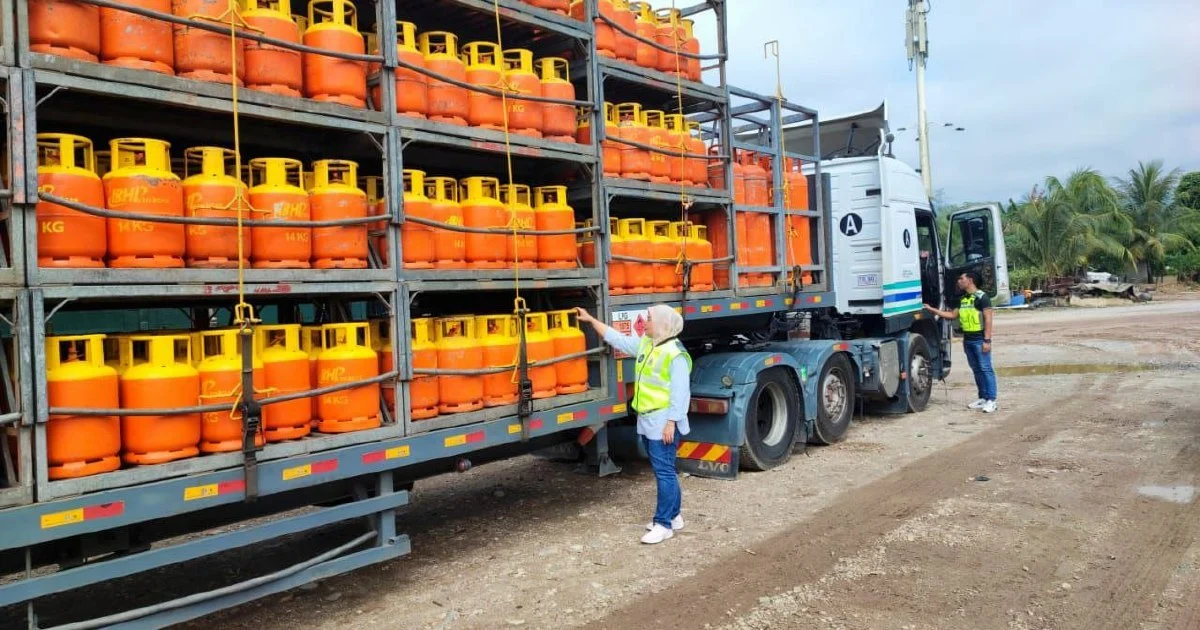
Officers conducting enforcement operations in Bentong uncovered a substantial cache of liquefied petroleum gas cylinders stashed within a fenced storage facility, leading to the confiscation of stock valued at RM405,000. The discovery, made on a trailer within the secure compound, signals ongoing concerns about unauthorised fuel storage and irregular distribution chains across Malaysian commercial zones.
The seized LPG cylinders represent a significant quantity of controlled fuel materials, the kind typically subject to strict licensing and regulatory oversight by authorities. Storage facilities housing such volumes ordinarily require proper permits, regular inspections, and compliance with stringent safety protocols designed to prevent catastrophic accidents. The presence of this cache at an apparently unauthorised location underscores persistent enforcement challenges in monitoring fuel-related activities across the peninsula.
Liquefied petroleum gas forms a critical part of Malaysia's domestic energy infrastructure, with residential households, commercial kitchens, and industrial operations all depending on steady, regulated supply chains. When cylinders escape official channels and accumulate in unauthorised depots, the consequences extend beyond regulatory violations to encompass genuine public safety risks. Improperly stored cylinders in unmonitored environments can degrade, leak, or rupture, creating fire and explosion hazards that threaten surrounding communities.
Enforcement agencies have intensified scrutiny of fuel-related activities nationwide following recurring incidents of black-market distribution networks operating across different states. These illicit operations often undersell licensed distributors, undercutting legitimate businesses whilst simultaneously bypassing safety checks and tax obligations. The Bentong discovery fits a broader pattern of raids targeting hidden stockpiles, suggesting coordinators have deliberately obscured their operations from official oversight.
The Pahang district, where Bentong is situated, sits at a crossroads of supply routes that makes it strategically significant for fuel distribution. Its proximity to both urban consumption centres and rural communities means that disrupted supply chains quickly generate shortages affecting diverse user bases. Unauthorised facilities diverting volumes into black markets effectively distort demand signals and create artificial scarcity in regulated distribution networks.
Beyond immediate regulatory breaches, such discoveries raise fundamental questions about security lapses permitting large quantities of hazardous materials to accumulate outside official systems. The fenced nature of the compound itself suggests deliberate effort to conceal operations, yet officers successfully penetrated these defences during routine patrols. This indicates that determined enforcement work can still locate such caches, though the efficiency of detection mechanisms remains open to scrutiny.
The financial value attached to the seized stock—RM405,000—demonstrates the economic incentives driving illicit fuel distribution. Operators accumulating cylinders evidently calculated sufficient profit margins to justify the substantial capital investment and inherent regulatory risks. This economic calculus explains why penalties and fines, often modest relative to operational profits, struggle to deter underground networks from maintaining their activities.
Investigators will likely probe the ownership and intended recipients of the cylinder batch, tracing operational links to other nodes within suspected smuggling networks. Such investigations frequently reveal interconnected depots, transportation arrangements, and end-user relationships spanning multiple jurisdictions. Understanding these networks helps authorities identify systemic vulnerabilities and coordinate preventive measures across state boundaries.
For Malaysian consumers relying on legitimate LPG supply, these enforcement actions theoretically protect market integrity and pricing stability. When underground operators divert substantial volumes, reduced availability in official channels can theoretically elevate consumer costs. Conversely, if black-market suppliers flood certain localities with underpriced cylinders, they undercut legitimate retailers whilst conditioning consumers to expect artificially depressed pricing unsustainable within regulated frameworks.
The Bentong case exemplifies pressures facing enforcement personnel tasked with regulating fluid commodity markets where demand remains robust and profit opportunities substantial. Successfully detecting and dismantling individual caches provides temporary supply-chain disruption but addresses symptoms rather than underlying incentive structures driving underground operations. Sustained effectiveness requires complementary strategies addressing licensing requirements, pricing mechanisms, tax compliance, and cross-border coordination.
Government agencies, particularly those overseeing fuel distribution and consumer affairs, face mounting expectations to improve detection methodologies and prosecution success rates. Intelligence sharing between federal and state enforcement bodies, collaboration with industry associations, and community tip-offs collectively strengthen detection capabilities. The Bentong discovery demonstrates that existing mechanisms generate results, yet operational scale suggests considerable volumes remain undetected.
Moving forward, stakeholders including legitimate LPG retailers, consumer advocacy groups, and regulatory authorities must collectively address vulnerabilities permitting such unauthorised caches to establish. Enhanced facility inspections, stricter liability standards for licensed operators, and consumer education regarding safety risks of uncertain-origin cylinders all contribute toward systematic improvement. The RM405,000 seizure, whilst representing important enforcement success, ultimately reflects broader challenges requiring sustained multi-sector commitment.

