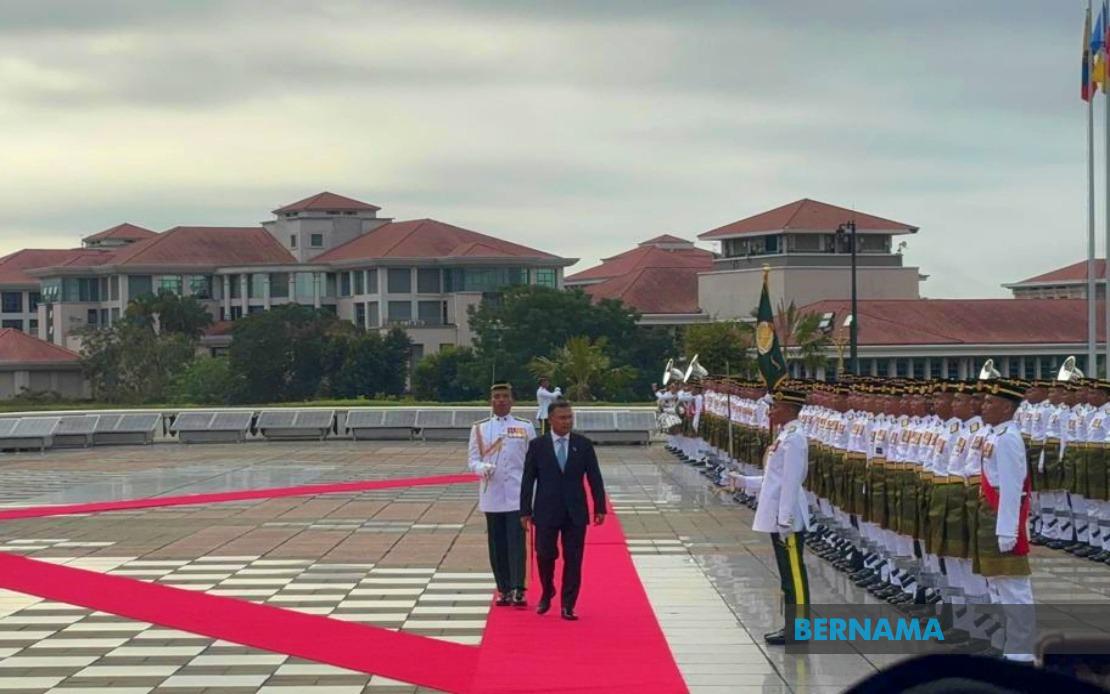
Bangladesh Prime Minister Tarique Rahman touched down at Putrajaya on June 22 for a two-day official visit to Malaysia, greeted with full ceremonial protocols befitting a state guest. Prime Minister Datuk Seri Anwar Ibrahim personally received the visiting dignitary at the Perdana Putra Complex, where the national anthems of both nations were performed as part of the formal welcome procedure. The reception underscored Malaysia's commitment to strengthening ties with a significant South Asian partner at a time when regional cooperation mechanisms are becoming increasingly important for economic resilience and stability across Southeast Asia and South Asia.
The ceremonial reception featured traditional military honors, with Tarique inspecting a guard mounted by three officers and 103 personnel from the First Battalion of the Royal Ranger Regiment under the command of Major Nur Ahmad Zaim Zahari. This display of military protocol reflects the diplomatic significance Malaysia places on the relationship with Bangladesh, one of the region's most populous and economically dynamic nations. The presence of multiple senior Malaysian Cabinet members—including Deputy Prime Minister Datuk Seri Dr Ahmad Zahid Hamidi, Foreign Minister Datuk Seri Mohamad Hasan, Home Minister Datuk Seri Saifuddin Nasution Ismail, and Communications Minister Datuk Fahmi Fadzil—demonstrated high-level commitment to the bilateral engagement. The assembled diplomatic corps and government officials further illustrated the strategic importance attached to this visit.
Following the ceremonial components, Tarique proceeded into private discussions with Prime Minister Anwar, a critical first step in any bilateral engagement that allows leaders to establish personal rapport and discuss sensitive matters away from public scrutiny. These private meetings often set the tone for broader negotiations and help identify shared priorities before more formal diplomatic machinery engages. The subsequent bilateral meeting, which brought together senior ministers and officials from both governments, created a comprehensive forum for detailed discussion of bilateral frameworks and sectoral cooperation.
The agenda for these discussions spans multiple critical economic and strategic sectors. Malaysian and Bangladeshi officials were expected to examine progress in existing bilateral relations while identifying fresh opportunities for deeper cooperation in trade and investment, a natural focus given the region's economic interdependencies. Human resource management represents another key area, reflecting both nations' shared experiences managing large populations and labor markets. The semiconductor sector has emerged as a priority for both countries as they position themselves within global supply chains increasingly conscious of geographic diversification. Energy cooperation remains vital for Bangladesh, which faces chronic power challenges, while Malaysian expertise in renewable energy and hydrocarbon management could offer valuable solutions. Agricultural collaboration taps into complementary strengths, while educational exchange strengthens people-to-people connections essential for long-term partnership sustainability.
Diplomatically, both leaders intended to exchange views on regional and international issues of mutual concern. For Malaysia, this encompasses security challenges in Southeast Asia, maritime concerns, and the broader geopolitical dynamics shaping the Indo-Pacific region. For Bangladesh, regional stability in South Asia, connectivity initiatives, and multilateral trade frameworks represent pressing concerns. These conversations often generate consensus on positions within international forums and strengthen coordination on global governance matters.
The visit was formalised through several binding instruments. An Memorandum of Understanding on Cultural Cooperation signals recognition that sustained bilateral relations require vibrant people-to-people connections beyond government-to-government channels. Two Exchanges of Notes addressing counter-terrorism research and investment promotion reflect contemporary security and economic imperatives. Counter-terrorism cooperation has become essential as both nations contend with extremist threats in their respective regions, while investment facilitation frameworks help remove impediments to business activity. These instruments create institutional mechanisms ensuring cooperation continues beyond the immediate visit.
Prime Minister Anwar hosted an official luncheon in Tarique's honor, a traditional diplomatic courtesy that provides informal settings for relationship-building and candid discussions outside formal meeting rooms. Tarique arrived with his spouse, Dr Zubaida Rahman, along with Foreign Minister Dr Khalilur Rahman and other senior officials, indicating the visit's importance to Bangladesh's foreign policy priorities.
Commercially, the bilateral relationship has matured into significant economic interdependence. In 2025, total bilateral trade reached RM12.18 billion (USD2.84 billion), establishing Bangladesh as Malaysia's 28th largest trading partner globally. More impressively, Bangladesh ranks as Malaysia's second-largest trading partner, export destination, and import source within the entire South Asian region, exceeded only by India. This positioning underscores Bangladesh's economic weight and Malaysia's commercial priorities in the subcontinent.
Malaysia's export profile to Bangladesh demonstrates energy sector dominance, with petroleum products constituting the principal category of Malaysian shipments valued at RM10.08 billion (USD2.35 billion). This pattern reflects Bangladesh's energy deficits and Malaysia's established position as a hydrocarbon supplier, though it also highlights potential diversification opportunities. Bangladesh's imports from Malaysia could expand into higher-value manufactured goods and technology services as both economies evolve.
Bangladesh's exports to Malaysia totalled RM2.10 billion (USD0.50 billion), primarily textiles, apparel, and footwear—traditional sectors reflecting Bangladesh's competitive advantages in labor-intensive manufacturing. The relatively lower import value compared to exports suggests untapped potential in Bangladeshi goods diversification. As Bangladesh develops downstream textile processing capabilities and moves into higher-value apparel segments, Malaysian importers represent a substantial market opportunity. The trade imbalance also suggests scope for Malaysian investment in Bangladeshi manufacturing to capture value across the supply chain.
For Malaysian readers and policymakers, this visit carries multiple implications. Bangladesh represents an emerging market with significant growth potential as it continues demographic transitions and infrastructure development. The bilateral frameworks established during this visit can facilitate Malaysian business entry into Bangladesh's expanding consumer and industrial markets. Conversely, continued Bangladeshi apparel exports offer Malaysian retailers and distributors access to competitive sourcing alternatives. The cooperation frameworks in semiconductors and energy position both nations to collaborate in technologies essential for regional development.
Regionally, strengthening Malaysia-Bangladesh ties contributes to broader South Asian integration with Southeast Asia. As initiatives promoting Indo-Pacific connectivity gain momentum, bilateral relationships between individual nations become building blocks for larger regional frameworks. Malaysia's engagement with Bangladesh supports its broader strategic positioning as a connector between Southeast Asia and South Asia, enhancing its influence in regional architecture discussions.
The visit also reflects contemporary diplomatic recognition that sustainable partnerships require regular high-level engagement, institutional mechanisms, and deliberate efforts to expand cooperation across multiple sectors. As global supply chains reorganise and regional powers compete for influence, nations like Malaysia and Bangladesh benefit from deepened bilateral relationships that create mutual advantages and shared interests in stability and prosperity.

