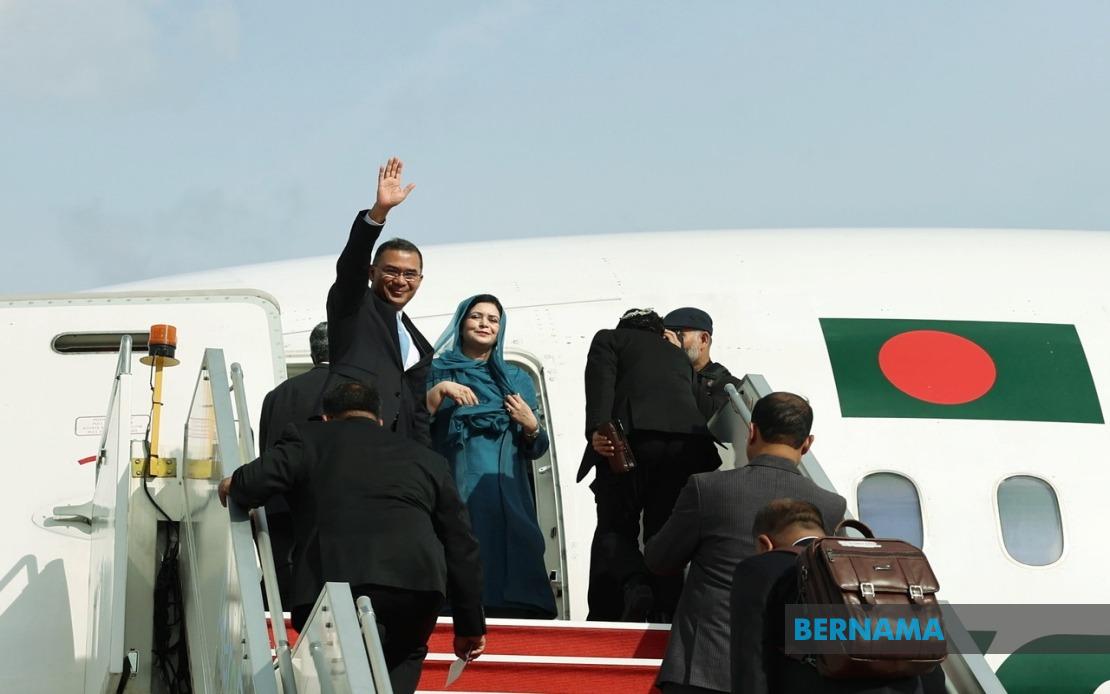
Bangladesh Prime Minister Tarique Rahman flew out of Malaysia today, concluding a two-day official visit that produced several bilateral cooperation agreements. His special aircraft departed from Kuala Lumpur International Airport at 5 pm, where Minister in the Prime Minister's Department (Religious Affairs) Dr Zulkifli Hasan witnessed a ceremonial send-off that included a 28-person guard of honour from the First Battalion of the Royal Ranger Regiment. The Prime Minister was accompanied by his spouse Dr Zubaida Rahman and members of the Bangladeshi delegation.
Tarique's journey from Kuala Lumpur to China represents a significant diplomatic swing through Southeast Asia, underscoring Bangladesh's growing engagement with the region and beyond. This marks his first bilateral official visit abroad since assuming office in February 2026, reflecting the priority Bangladesh places on strengthening ties with Malaysia and, by extension, with ASEAN at large. The timing and trajectory of his travels signal an intention to position Bangladesh as an increasingly active player in regional geopolitics and economic cooperation.
During his final morning in Malaysia, Tarique and Prime Minister Datuk Seri Anwar Ibrahim held substantive bilateral discussions at the Perdana Putra Complex, examining regional and international questions where their nations share interests. The talks extended beyond routine diplomatic pleasantries to encompass concrete economic and strategic objectives. Both leaders identified potential avenues for deepening engagement across multiple sectors, recognising that Malaysia and Bangladesh possess complementary strengths in areas ranging from semiconductors and energy to agriculture and human resource development.
The formal outcomes of the visit were codified through three separate instruments. A Memorandum of Understanding on Cultural Cooperation was signed, reflecting both nations' commitment to people-to-people exchanges and shared heritage. Two Exchanges of Notes followed, one addressing Counter-Terrorism Research and the other focused on Investment Promotion and Facilitation. These agreements are not merely symbolic; they establish institutional frameworks through which cooperation can be operationalised and monitored. The counter-terrorism element is particularly significant given regional security challenges, while the investment protocols are designed to reduce barriers and create predictability for businesses operating between the two countries.
A central commitment made during the visit involves fast-tracking a free trade agreement between Malaysia and Bangladesh, coupled with expanded cooperation in energy and the halal industry. These priorities reflect both nations' economic development strategies. Bangladesh, increasingly looking to diversify its energy sources and modernise its industrial base, sees Malaysia as a valuable partner with expertise in energy management and Islamic financing. Conversely, Malaysia views Bangladesh as an expanding market and a source of competitive manufacturing capacity, particularly in labour-intensive sectors. The emphasis on halal industry cooperation taps into growing global demand and aligns with both nations' positioning as Islamic economies.
Bangladesh's aspirations within the regional architecture featured prominently in the discussions. Tarique reiterated his country's ambition to become an ASEAN Sectoral Dialogue Partner and expressed interest in joining the Regional Comprehensive Economic Partnership (RCEP). These objectives reflect Bangladesh's strategic calculation that deeper integration into Southeast Asian institutional structures will enhance its economic prospects and geopolitical standing. Malaysia's willingness to discuss these matters suggests support for Bangladesh's regional integration, though formal progression on such matters requires broader consensus among ASEAN members and other RCEP participants.
On the international stage, Tarique and Anwar discovered substantial common ground on key geopolitical issues. Both leaders articulated support for the Palestinian cause and expressed concern regarding the humanitarian situation in Gaza, positions that reflect the weight of Islamic and developing-world solidarity in their respective foreign policies. They also discussed efforts to achieve lasting peace initiatives concerning the Gulf region and Iran, and committed to seeking just and sustainable resolutions to ongoing global conflicts. These alignments suggest that Malaysia and Bangladesh can serve as coordinating voices within international forums when advocating for positions favourable to developing nations and the Islamic world.
A particularly important area of agreement concerns the Rohingya refugee crisis, which has profound implications for both nations and the broader region. Malaysia hosts one of the world's largest Rohingya populations, with hundreds of thousands living in camps and informal settlements. Bangladesh, despite its own development challenges, hosts nearly one million Rohingya refugees in camps in Cox's Bazar, constituting an enormous humanitarian and economic burden. Both leaders pledged to strengthen cooperation through ASEAN mechanisms to find enduring solutions, including enhanced engagement with Myanmar authorities. This commitment is essential because neither nation can resolve the crisis unilaterally; it demands regional coordination and, ultimately, Myanmar's repatriation commitments and governance reforms.
The bilateral economic relationship provides a foundation for these political and security partnerships. In 2025, total trade between Malaysia and Bangladesh reached RM12.18 billion (US$2.84 billion), with Malaysia running a substantial surplus. Malaysian exports to Bangladesh totalled RM10.08 billion (US$2.35 billion), dominated by petroleum products that fuel Bangladesh's expanding economy and power generation. Bangladesh supplied RM2.10 billion (US$500 million) in imports to Malaysia, primarily textiles, apparel and footwear that feed into Malaysian manufacturing and retail sectors. Bangladesh ranked as Malaysia's 28th-largest trading partner globally and second in South Asia after India, a position reflecting Bangladesh's significant but still underdeveloped economic relationship with Malaysia.
These trade statistics underscore untapped potential. Bangladesh, with a population exceeding 170 million and an emerging manufacturing base, represents a substantial market for Malaysian energy exports and a competitive source for textiles and light manufactures. The proposed fast-track free trade agreement aims to unlock this potential by reducing tariff barriers and simplifying regulatory procedures. For Malaysian companies, Bangladesh offers opportunities to participate in infrastructure development, energy projects and industrial manufacturing. For Bangladeshi exporters, Malaysian markets and regional supply chains offer pathways to value-addition and export expansion. Both economies stand to gain from reduced trade friction and enhanced investment flows.
Tarique's onward journey to China signals Bangladesh's multi-alignment approach to great power relations. Bangladesh, positioned geographically and strategically between India and China, seeks to maintain balanced relationships with both Asian superpowers while deepening ties with Southeast Asia. China's investments in Bangladesh through the Belt and Road Initiative and in the development of the Chittagong and Mongla ports make Beijing a crucial partner for Bangladesh's infrastructure ambitions. By visiting China immediately after Malaysia, Tarique emphasises that Bangladesh is not aligning exclusively with any single power but rather pursuing pragmatic partnerships with multiple actors. This hedging strategy is essential for a South Asian nation conscious of regional power dynamics and determined to advance its development agenda.
The visit's conclusion marks a critical juncture in Malaysia-Bangladesh relations, moving them from general goodwill to concrete institutional and economic engagement. The agreements signed provide scaffolding for sustained cooperation, while the fast-tracked free trade negotiation signals serious intent on both sides to deepen economic integration. For Malaysian policymakers, supporting Bangladesh's regional integration and economic development serves multiple interests: it positions Malaysia as a responsible ASEAN leader, strengthens economic ties with an emerging market, and contributes to regional stability. For Bangladesh, the Malaysian visit and its outcomes represent validation of its regional aspirations and practical support for its development priorities. As both nations implement the commitments made during these two days in Kuala Lumpur, the relationship is likely to grow in strategic importance.

