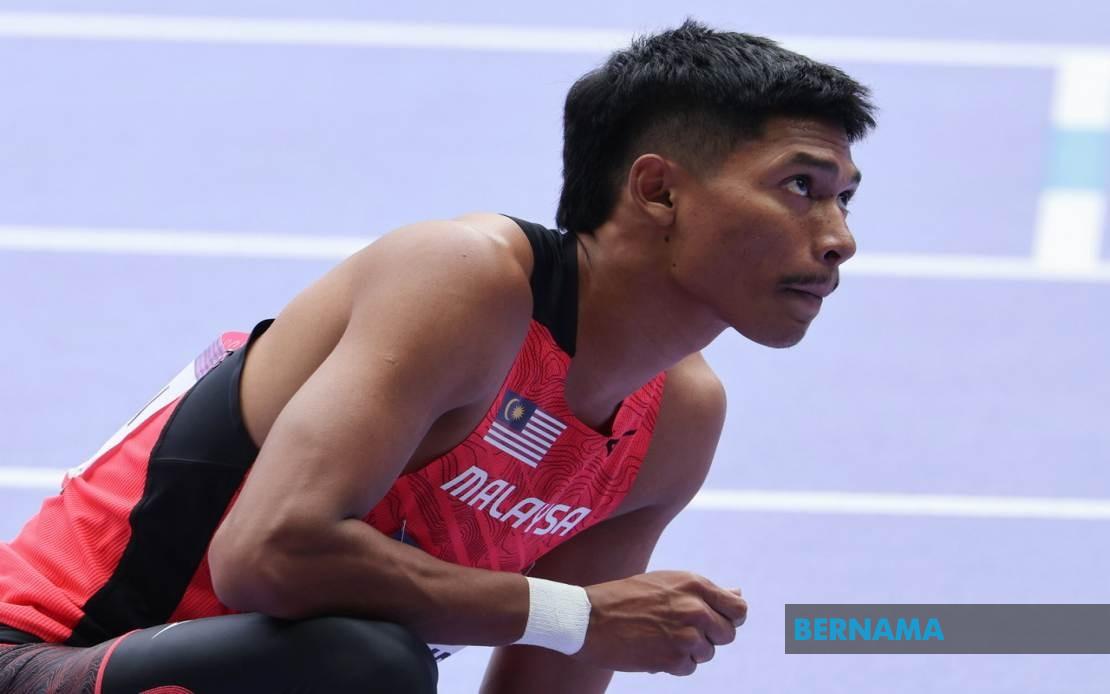
National sprinter Muhammad Azeem Mohd Fahmi has decided to base himself in Malaysia rather than return to the United States, marking a significant shift in focus for the country's flagship track and field talent. The 22-year-old 100-metre record holder, who clocked 10.09 seconds, recently graduated from Auburn University after four years of tertiary education abroad. His decision to establish himself domestically underscores a growing commitment to developing Malaysia's elite athletics pipeline closer to home, where support structures and coaching infrastructure have matured considerably over the past decade.
Azeem's choice reflects a personal recalibration of priorities after an extended period overseas. Having spent the formative years of his young adulthood pursuing both education and athletic development in the United States, he now recognises the psychological and emotional toll of prolonged separation from his immediate circle. He emphasised to reporters that family connections have become his principal concern, and he views the next phase of his career as an opportunity to rebuild those bonds. This sentiment resonates across Malaysian sports, where athletes frequently grapple with the tension between pursuing world-class training environments abroad and maintaining roots within their home communities.
The sprinter's commitment to remaining in Malaysia does not signify any retreat from his athletic ambitions or a diminishment of his competitive standards. Instead, he has engineered a hybrid coaching arrangement designed to leverage the expertise he accumulated under American tutelage whilst embedding himself within Malaysia's domestic athletics ecosystem. His American coach, Ken Harnden, will continue designing his training programmes remotely, ensuring that the athlete retains access to the sophisticated periodisation and technical refinement he received at Auburn. This transnational coaching model represents a pragmatic solution that allows Azeem to maintain the rigour and innovation of his international development without geographic displacement.
Local coach Muhammad Amir Izwan Tan Abdullah has been appointed to provide day-to-day oversight and supervision of Azeem's training regimen in Malaysia. This arrangement places the responsibility for implementing Harnden's blueprint in the hands of a coach familiar with domestic facilities, climate conditions, and the rhythms of Malaysia's athletic calendar. Tan Abdullah's direct involvement also signals confidence in the quality of local coaching expertise, challenging a historical perception that elite athlete development necessarily requires overseas bases. The partnership between international and domestic coaching authorities reflects a maturation of Malaysia's athletics infrastructure and a recognition that world-class performance can be achieved through collaborative, geographically distributed coaching models.
Azeem's decision arrives at a pivotal moment for Malaysian sprinting. The country has invested considerably in track and field development over recent years, and having a national record holder competing and training domestically provides both inspiration and benchmarking for younger athletes. His presence at local competitions and training facilities creates visibility and legitimacy for the sport within Malaysia, potentially catalysing greater investment and participation in sprinting at grassroots levels. The symbolic importance of a young athlete of Azeem's calibre choosing to remain and compete at home should not be underestimated in a sporting context where overseas success often translates to emigration.
Beyond athletics, Azeem has signalled an intention to pursue postgraduate education, though he has deliberately sequenced this ambition to follow rather than run parallel to his athletic peak years. He indicated plans to take a few months' break from formal academic engagement to concentrate entirely on his sport. This prioritisation demonstrates sophisticated career planning and an understanding that the window for elite athletic performance is finite. By deferring master's degree studies, Azeem is maximising the return on the physical investments he has made and the training infrastructure now available to him, reserving academic advancement for a later career phase when his competitive years naturally decline.
The sprinter's emphasis on family support as instrumental to his success highlights a dimension of athlete development that transcends coaching and training. He explicitly acknowledged that his parents, siblings, coaches, and friends have collectively enabled his progression to the elite level. This framing places family at the centre of his sporting identity rather than treating family time as secondary to athletic commitments. For Malaysian athletes, particularly those emerging from modest backgrounds, this acknowledgment carries weight and authenticity. It suggests a holistic approach to performance that recognises the interdependence between personal wellbeing and athletic excellence.
Azeem's return also has implications for Malaysia's preparation for regional and international athletics calendars. As the national 100-metre record holder, his performances will factor into team selection for Southeast Asian Games, Commonwealth Games, and potentially Olympic qualifiers. Having him based domestically ensures consistent visibility in competitive rankings and reduces logistical complexity for national team assembly. Furthermore, his presence at local meets provides younger sprinters with direct observation of elite technique and competition standards, creating a developmental ladder that can elevate the entire cohort of Malaysian short-distance runners.
The arrangement negotiated by Azeem reflects broader trends within elite sport, where athletes increasingly operate across transnational networks rather than within single geographic locations. His ability to access world-standard coaching whilst maintaining social and family anchors in Malaysia demonstrates that geographic isolation is no longer a prerequisite for high-performance athletics. This flexibility may encourage other Malaysian athletes to consider domestic-based careers without perceiving this as a compromise on their competitive potential. As Malaysia continues building its sporting infrastructure, examples like Azeem's become increasingly important in establishing the credibility and viability of home-based elite development pathways.

