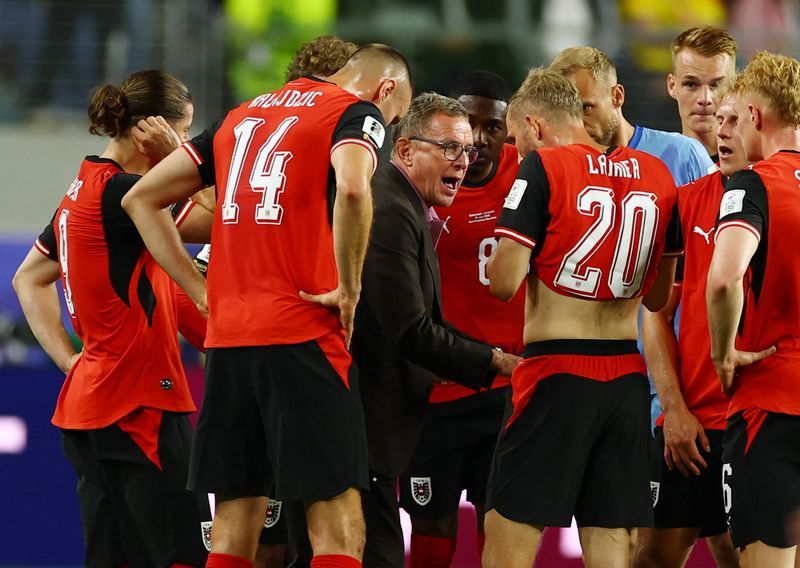
Austria manager Ralf Rangnick was full of admiration for World Cup newcomers Jordan following a tense 3-1 encounter at Santa Clara, California on Tuesday, reflecting a broader shift in how elite coaches view smaller footballing nations at major tournaments. Rather than dismissing the result as a straightforward victory for the stronger side, Rangnick offered genuine respect for Jordan's showing, acknowledging that his team's path to victory proved far more complicated than pre-match predictions had suggested.
The Austrian side, riding high on the back of an impressive Euro 2024 campaign that had elevated expectations considerably, found themselves repeatedly vulnerable to Jordan's tactical approach and physical commitment. What unfolded was not the measured demolition that many observers anticipated from a team favoured to progress easily from their group, but instead a grinding contest where the outcome remained uncertain for long stretches. Austria ultimately secured the win through Marko Arnautovic's penalty deep into the second-half stoppage time, a dramatic conclusion that underscored how thoroughly Jordan had tested their credentials.
Rangnick's perspective on the match diverged markedly from the notion that Austria had simply outclassed inferior opposition. When asked about his side's apparent struggles, he pointedly attributed the performance not to Austrian failings but to Jordan's admirable quality and tactical discipline throughout the ninety minutes. This perspective carries significant weight, suggesting that the gap between historically strong European sides and emerging nations has narrowed considerably in recent years. The Austrian coach noted that he and his backroom team had indeed expected a difficult examination, though he suggested that Jordan's actual execution exceeded even those realistic pre-match assessments.
Jordan's first-ever World Cup appearance thus served as a statement about the globalisation of elite football. Their willingness to press aggressively and commit substantial bodies to attack demonstrated a willingness to compete boldly rather than simply attempt damage limitation against stronger opposition. Such an approach carries inherent risks, particularly when facing well-organised European sides with greater technical depth, yet it also created genuine problems for Austria's defensive organisation and forced constant vigilance.
Rangnick framed the World Cup's expansion to 48 teams as fundamentally positive, viewing the enlargement as an enriching development that broadens football's global reach and competitive opportunity. Rather than viewing the increase in participating nations as diluting the tournament's quality—a common criticism among traditionalists—the Austrian tactician saw it as an appropriate reflection of modern football's development across continents. This inclusive stance reflects a coaching philosophy that respects excellence regardless of geography or historical pedigree.
The manager drew attention to several recent tournament results that illustrated his broader point about narrowing competitive gaps. Spain's surprising draw with Cape Verde and Australia's upset victory against Turkey demonstrated that established hierarchies no longer guarantee predictable outcomes. Haiti's spirited performance against Scotland further supported his contention that even the tournament's newest or historically weaker participants now possess the tactical knowledge, physical conditioning, and technical proficiency to trouble traditional powerhouses. These examples were not outliers but rather symptoms of a transformed competitive landscape.
Rangnick's emphasis on the fundamental levelling of world football over the past fifteen years carries particular relevance for Asian football development. Teams across Southeast Asia and the broader Asian confederation have invested substantially in technical infrastructure, coaching education, and player development systems that mirror those of established European nations. The international visibility of top-tier Asian leagues and the increasing presence of Asian players in European competitions have accelerated knowledge transfer and tactical sophistication. Jordan's World Cup showing exemplifies this broader trend of rising competitive standards across the Asian confederation.
Austria's immediate challenge now shifts toward Group J leaders Argentina, who demonstrated their formidable quality with a commanding 3-0 victory over Algeria. The contrast between that performance and Austria's narrow escape against Jordan already illustrates the tournament's unpredictability. A team that laboured against debutants now faces a recalibration of intensity and precision to compete against Lionel Messi's squad and their established winning template. Rangnick's concerns about his side's defensive solidity will intensify when confronting Argentina's attacking prowess.
The Austrian coach's willingness to credit opponents rather than deflect onto his own team's execution also reflects a sophisticated understanding of modern football's complexity. Rather than emphasising Austria's superiority and Jordan's limitations, Rangnick's analysis suggested mutual respect and acknowledgement of genuine quality across the sport. This intellectual honesty in evaluating opponents forms part of contemporary elite coaching culture, where detailed analysis and competitive appreciation have replaced the dismissiveness that once characterised discussions of weaker nations.
For Malaysian and Southeast Asian football observers, Rangnick's assessment carries encouraging implications. The region's national teams and developing leagues operate within a global footballing ecosystem that is becoming increasingly competitive and meritocratic. Investment in infrastructure, coaching, and player development produces measurable returns, as evidenced by the performances of nations like Jordan that have systematically improved their football systems. The notion that established European powers hold unassailable advantages no longer reflects contemporary reality, opening pathways for improvement and meaningful tournament participation across Asia's diverse football cultures.