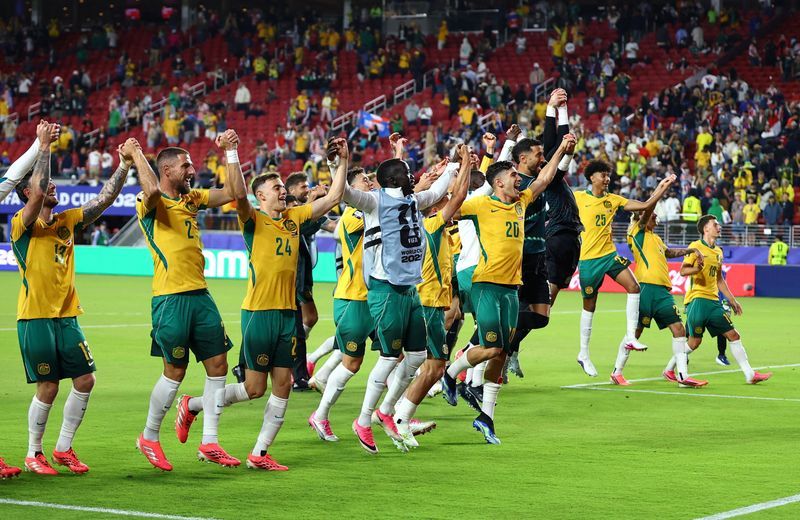
Australia qualified for the knockout phase of the World Cup on Thursday with a scoreless stalemate against Paraguay at San Francisco Bay Area Stadium in California, marking the Socceroos' third appearance in the tournament's round of 32. The result handed Tony Popovic's side second place in Group D behind co-hosts the United States, while Paraguay must now endure an anxious wait to determine whether they have accumulated sufficient points to progress as one of the competition's eight best third-placed finishers. Australia last reached the last 16 four years ago in Qatar, making this tournament return a significant achievement for the football programme.
The match itself unfolded as a tightly contested affair characterised more by defensive solidity than attacking flair. Both teams created opportunities throughout the encounter, yet neither could find the clinical finishing required to breach resolute defences. Australia dominated proceedings in the opening stages, with Paraguay gradually asserting themselves as the contest progressed, but the final scoreline reflected neither side's ability to convert their chances into goals. This gruelling stalemate epitomised the unpredictable nature of knockout qualification, where a single moment of quality or lapse in concentration can prove decisive.
Popovic made a bold tactical statement by rotating six players from his previous starting eleven, introducing attacking reinforcements in the form of livewire midfielder Nestory Irankunda and forward Cristian Volpato. The managerial decision signalled clear intent to press for victory and an attacking approach, yet the execution fell short of the ambition. Jordan Bos switched positions from left back to right side to accommodate an injury absence, tasking him with providing width in attacking movements down the flank—a responsibility he fulfilled with energy and creativity throughout.
Australia's early possession brought promising moments, particularly down the right side where Bos and Volpato combined to create space. Jackson Irvine squandered a clear opening when Volpato set him up in the penalty area, firing his angled attempt directly at Paraguay goalkeeper Orlando Gill rather than finding the target's edges. Additional opportunities emerged later in the opening half through both Bos and Volpato, yet neither player could trouble the goalkeeper sufficiently to test his reflexes, indicating a lack of precision in the final delivery.
Paraguay operated with considerable caution during the opening period, registering just a solitary shot before the interval as coach Gustavo Alfaro adopted a defensive framework. The introduction of Brazilian-born forward Mauricio at the interval provided the South American side with a more aggressive focal point, and he immediately tested Australia's goalkeeper with a speculative long-range effort within five minutes of resuming. Julio Enciso emerged as Paraguay's most threatening creative force, repeatedly piercing through Australia's defensive lines with penetrating runs that threatened to unlock the opposition backline.
The contest evolved into an increasingly competitive encounter as Paraguay found their rhythm, with Enciso's energetic displays spurring his teammates toward more ambitious attacking play. Eight minutes from full-time, Enciso engineered one of Paraguay's clearest opportunities when he latched onto possession on the left side and unleashed a low drive that tracked narrowly past the far post, highlighting how close either team came to breaking the deadlock. The narrative shifted as Paraguay pressed for victory in the closing stages, sensing an opportunity to secure victory that would significantly improve their progression prospects.
Australia mounted a counter-response in the final moments, with Bos orchestrating a dangerous raid that had supporters momentarily celebrating. The defender collected possession deep in his own half, surged forward past two Paraguayan defenders, and powered into the penalty area before firing a shot across goal that whistled agonisingly past the far post. Mauricio subsequently forced Australia's goalkeeper into action with a low effort from the edge of the area, yet the keeper comfortably collected the strike. Australia's ability to withstand late pressure demonstrated the defensive discipline required at tournament level.
With qualification secured, Australia can now focus on their round-of-32 opponent, which will be determined by Group G's outcomes. Egypt and Iran remain poised to play on Friday, as do Belgium and New Zealand, leaving the second-placed finisher in that group unconfirmed. The Socceroos' advancement represents a considerable achievement given the competitive strength of their group and the rotation Popovic implemented, suggesting the squad possesses sufficient depth to compete across multiple matches in the tournament's rigorous schedule.
Paraguay's situation presents a contrasting narrative, with the South Americans requiring other results to favour their progression aspirations. The 2010 quarter-finalists' four points may prove sufficient to secure a spot among the eight best third-placed teams, yet their fate depends upon outcomes beyond their control. This uncertainty underscores how the tournament's group-stage mathematics can create tension for teams whose advancement hangs in the balance, particularly those occupying the precarious third-place position. The outcome also highlights the tactical conservatism both teams displayed, suggesting that in contemporary tournament football, clean sheets and defensive organisation frequently outweigh attacking ambition, especially when progression is at stake.
For Malaysia and other Southeast Asian observers following the tournament, Australia's advancement carries particular relevance as the region's most successful football nation at World Cup level. The Socceroos have consistently punched above their weight in continental contexts, serving as a benchmark for Asian football development. Their qualification from a competitive group featuring the United States and Paraguay demonstrates the competitive level required to succeed globally and underscores the challenges facing regional programmes seeking to establish themselves at football's highest echelon.

