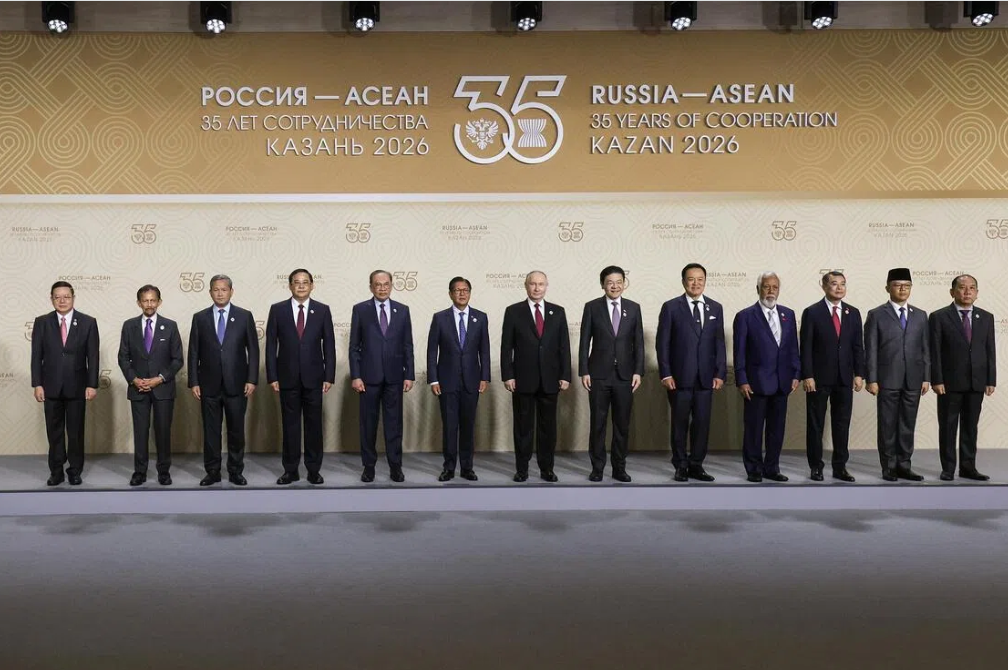
Asean and Russia have stepped up their partnership commitment, adopting a suite of joint agreements during the Asean-Russia Commemorative Summit held in Kazan on June 17 and 18. The gathering, presided over by Russian President Vladimir Putin, marked a significant diplomatic moment by celebrating three and a half decades of bilateral relations and three decades of formal dialogue partnership structures. The summit produced three major policy documents that will shape practical engagement between the bloc and Moscow through 2030, signalling the desire of both parties to move beyond rhetorical gestures towards concrete institutional cooperation.
The centrepiece agreement, the Kazan Declaration, provides a comprehensive assessment of how Asean-Russia ties have evolved since 1989 and establishes priorities for the next phase of engagement. The document identifies maritime affairs, trade and investment flows, energy cooperation, infrastructure connectivity, security matters, educational exchange, and cultural promotion as key pillars where both sides intend to intensify efforts. Complementing this framework is a dedicated Joint Statement on Cultural Cooperation that emphasises the need for stronger people-to-people connections and deeper cultural dialogue, reflecting recognition that lasting bilateral relationships require social foundations beyond government-to-government interaction. Perhaps most operationally significant is the Asean-Russia Comprehensive Plan of Action for 2026–2030, which provides a specific roadmap for implementing these priorities over the coming five years.
Singapore's delegation, led by Prime Minister Lawrence Wong, articulated a carefully balanced diplomatic position that acknowledged both the value of engagement and the constraints imposed by international law and principles. Wong stated that Asean and Russia should concentrate their cooperation efforts on areas where strategic interests align, while also working jointly on issues such as natural disaster management and combating drug trafficking—challenges that transcend ideological divides and demand cross-border collaboration. He highlighted Russia's consistent participation in Asean-led regional dialogue mechanisms, including the Asean Regional Forum and the East Asia Summit, describing this engagement as essential to building trust and maintaining communication channels in an increasingly tense geopolitical environment.
The Singapore Prime Minister used the summit platform to articulate why international law and the rules-based global order remain non-negotiable anchors for Asean's foreign policy, even as the bloc pursues pragmatic cooperation with multiple powers. Wong stressed that Asean's dual imperatives—deepening internal integration while simultaneously expanding external partnerships—have become more strategically important as global uncertainties multiply. He explicitly connected this rationale to ongoing territorial and maritime disputes, emphasising Asean's unwavering commitment to freedom of navigation through critical international waterways consistent with the United Nations Convention on the Law of the Sea. These statements served as subtle but unmistakable reminders to Moscow that Asean will not abandon fundamental principles even while seeking productive dialogue.
The geopolitical context for this summit cannot be overlooked. Singapore and Asean have maintained a consistent, principled stance on Russia's invasion of Ukraine, with Singapore imposing sanctions and restrictions in 2022 that remain in force. Despite this principled opposition to Russian military action, Singapore has determined that maintaining diplomatic channels and seeking areas of constructive engagement serves broader regional stability objectives. Prime Minister Wong's bilateral meeting with President Putin illustrated this careful calibration—acknowledging bilateral ties while not papering over fundamental disagreements. In remarks following the Putin meeting, Wong noted that dialogue and engagement retain value precisely because countries do not align on every issue, and that Singapore and Russia both benefit from identifying cooperation opportunities within areas of mutual interest.
Wong's comments regarding the Middle East and the Strait of Hormuz signalled Asean's concern with global economic resilience and maritime security. He welcomed the peace agreement between the United States and Iran, framing it as potentially opening pathways toward lasting regional stability and the critical reopening of the Strait of Hormuz—a waterway through which roughly one-third of global seaborne oil passes. For Southeast Asian economies dependent on uninterrupted energy supply chains and open sea lanes, such developments carry immediate practical implications. The statement reflected Asean's pragmatic engagement with all major powers and its stake in conflict resolution globally, not merely in its immediate geographic neighbourhood.
Russia's participation in Asean-led mechanisms has been relatively modest compared to other major powers, but the Kazan summit signals an intention to elevate Moscow's institutional presence. Wong indicated that Singapore anticipates Russian participation in Asean Regional Forum and East Asia Summit meetings scheduled for the Philippines later in 2024, and expressed hope for enhanced Russian engagement when Singapore assumes the rotating Asean chair in 2027. This gradual deepening of institutional ties serves both parties' interests: Russia gains additional platforms to defend its positions on various regional and global issues, while Asean reinforces its principle of inclusive dialogue mechanisms and non-alignment away from geopolitical camps.
Educational and people-to-people exchanges represent another dimension where both sides see potential for development without political risk. Wong noted that Russian officials regularly participate in civil service training programmes across Asean member states, including Singapore, indicating that bureaucratic-level engagement continues despite political tensions. The Cultural Cooperation statement commits both sides to expanding these human connections, recognising that individuals and communities rather than governments ultimately sustain long-term bilateral relationships. Such programmes also serve Asean's interest in drawing on Russia's expertise in areas like natural disaster management and environmental protection.
Prime Minister Wong's bilateral engagement with Rustam Minnikhanov, the Rais of Tatarstan, extended partnership discussions to Russia's regions. Singapore and Tatarstan have maintained relations dating to 2007, when then-Minister Mentor Lee Kuan Yew visited the region. The Wong-Minnikhanov meeting covered cultural cooperation, education exchange, and people-to-people ties, reflecting how Singapore often pursues multi-level diplomacy with major powers to maximize engagement opportunities and demonstrate commitment to relationships with Russia beyond the federal government level.
The broader strategic significance of the Kazan summit lies in its affirmation that Asean can maintain substantive partnerships with all major powers while refusing to choose sides in great power competition. By adopting a comprehensive five-year plan despite Ukraine-related sanctions and fundamental disagreements on international law, Asean demonstrates commitment to its long-established policy of constructive engagement. This approach carries risks—critics might argue Asean is normalising Russian behaviour—but also maintains access, influence, and dialogue channels that isolation would eliminate. For Malaysia and other Southeast Asian nations, the precedent set at Kazan signals that geopolitical realities need not preclude pragmatic cooperation, even between parties with serious disputes.

