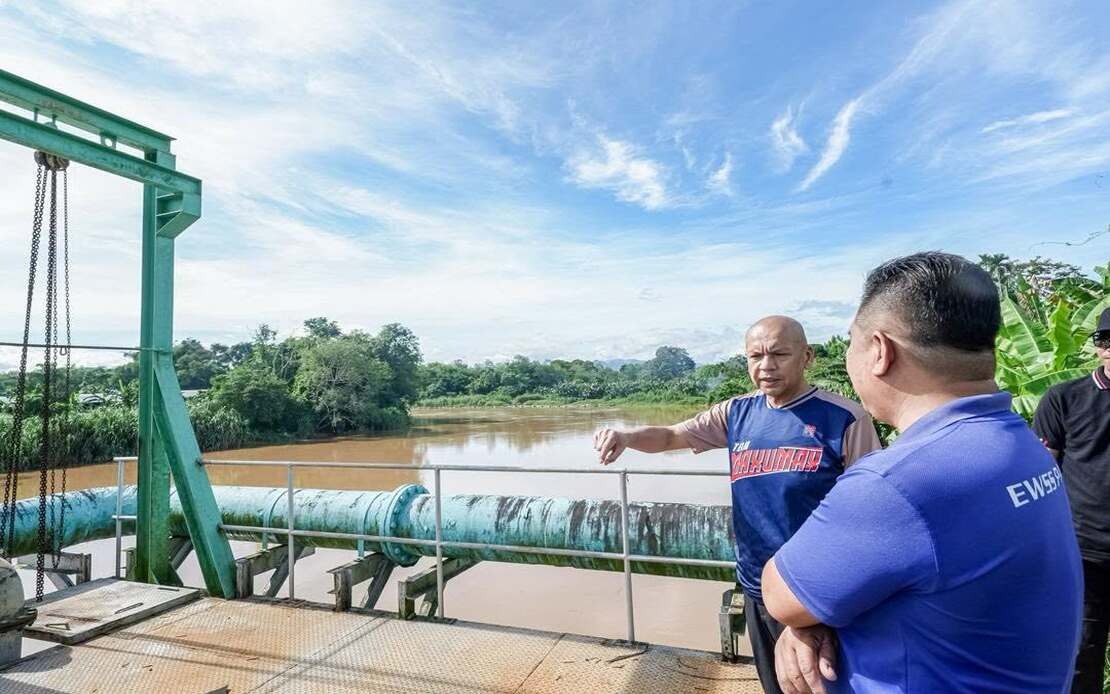
Minister of Domestic Trade and Cost of Living Datuk Armizan Mohd Ali conducted an on-site inspection of water supply enhancement initiatives across Papar district on June 19, seeking to verify that implementation timelines remain on track and that planned interventions will adequately resolve persistent water availability concerns affecting residents.
The ministerial visit followed discussions held five days earlier to assess progress on the district's water stabilisation programme. Armizan, who represents Papar in Parliament, emphasised the critical importance of direct field oversight to gain authentic insight into operational obstacles and to facilitate timely deployment of remedial measures that safeguard reliable water delivery to households and businesses across the constituency.
Two flagship infrastructure projects currently under development form the backbone of Papar's water security strategy. The Kogopon Water Treatment Plant is undergoing a significant capacity expansion designed to raise daily production from 40 million litres to 80 million litres, effectively doubling output. This augmentation is paired with infrastructure work at Kampung Kabang intake, with both initiatives positioned as essential components addressing the district's mounting consumption pressure as population and economic activity continue their upward trajectory.
Water demand in Papar has accelerated substantially over successive periods, reflecting broader growth patterns across Sabah. The dual upgrade scheme represents a strategic response to this trajectory, intended to establish sufficient headroom within the distribution system to accommodate future expansion without recourse to emergency rationing or rolling supply restrictions that have historically plagued the region during seasonal dry phases.
During his inspection circuit, Armizan visited the EWSS Plant and JETAMA Limbahau Plant, both of which encountered operational interruptions during the preceding seven days stemming from water quality deterioration. The raw water turbidity measurements—expressed in nephelometric turbidity units, or NTU—at both facilities' intake points exceeded treatable thresholds, necessitating temporary facility shutdowns while conditions stabilised to acceptable parameters.
Turbidity spikes represent a recurring challenge in water systems throughout the region, particularly during heavy rainfall episodes or following upstream land disturbance. When sediment concentration rises precipitously, treatment plants face operational constraints. Operators must either reduce throughput substantially or cease intake entirely until sedimentation reverses and water clarity returns. This operational inflexibility directly curtails supply to downstream communities and underscores the vulnerability of systems dependent on surface water sources susceptible to environmental variability.
The temporary closure protocol at both facilities, while necessary to preserve treatment integrity and consumer safety, illustrates the precarious balance water managers navigate between maintaining system reliability and preventing contamination. Allowing degraded raw water to proceed through treatment risked system-wide damage and potential health consequences, making judicious shutdown decisions operationally sound despite short-term supply disruption.
Armizan's emphasis on ground-level assessment reflects evolving governance approaches that prioritise direct ministerial engagement with infrastructure challenges rather than reliance solely on administrative reporting channels. This hands-on methodology enables decision-makers to observe practical constraints that technical summaries may insufficiently convey and to identify systemic inefficiencies obscured by normalised operational procedures.
For Malaysian water consumers, particularly those in growth corridors like Papar, infrastructure expansion and reliability enhancement represent central developmental imperatives. Water supply stability directly influences residential quality of life, commercial competitiveness, and industrial viability. Disruptions to treatment capacity or operational continuity cascade through communities, affecting hospitals, schools, manufacturing facilities, and agricultural enterprises that depend on consistent supply.
The Papar situation exemplifies challenges confronting water authorities across Southeast Asia as rapid urbanisation and climate variability simultaneously elevate demand and heighten environmental volatility. Solutions require simultaneous investment in treatment infrastructure expansion, source protection initiatives, and resilience mechanisms capable of accommodating environmental fluctuations. Sabah's water authorities must therefore balance immediate capacity augmentation with longer-term source security and climate adaptation strategies.
Armizan's inspection programme signals governmental commitment to tracking implementation progress and maintaining political oversight of infrastructure timelines. Public confidence in water security depends substantially on visible ministerial engagement and transparency regarding project status. By conducting documented site visits and issuing progress statements, the minister reinforces institutional accountability and demonstrates responsiveness to constituent concerns regarding essential services.
The trajectory of Papar's water infrastructure development will significantly influence the district's capacity to sustain economic expansion and population growth over coming years. Successful on-schedule completion of the Kogopon upgrade and Kampung Kabang intake work would position the system to accommodate demand growth through the medium term. Conversely, project delays or cost overruns would perpetuate the supply constraints that presently constrain community prosperity and necessitate continued ministerial crisis management.

