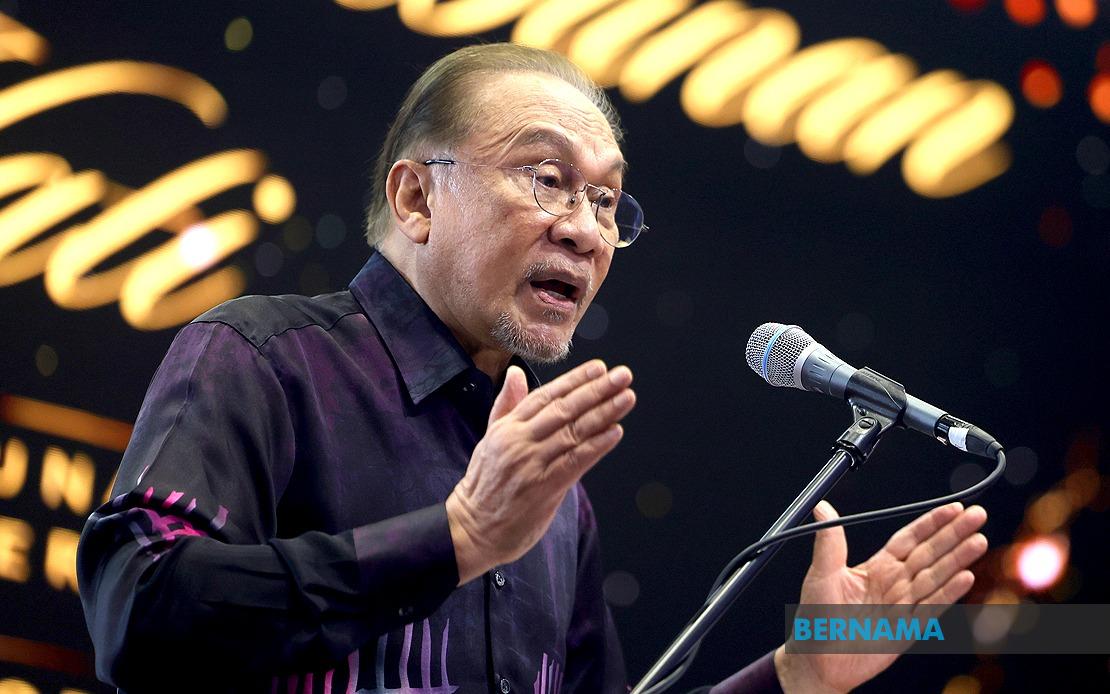
Prime Minister Datuk Seri Anwar Ibrahim has issued a forceful appeal to the Malaysian public to safeguard national cohesion by actively rejecting racial divisions being deliberately cultivated by certain political figures. Speaking at a dinner gathering in Seremban organised by Pertubuhan Lima Generasi (PLG) Malaysia on June 20, Anwar emphasised that the country's multiethnic composition represents a significant competitive advantage only when underpinned by genuine understanding and collaborative effort among communities.
Anwar's remarks come amid ongoing concerns about inflammatory political rhetoric that seeks to inflame tensions between Malaysia's major ethnic groups. He directly addressed what he characterised as deliberate attempts by some leaders to foster animosity, noting that efforts to pit Malays against Chinese, Chinese against Indians, and Indians against Malays fundamentally contradict Malaysia's founding principles and contemporary national interests. The prime minister stressed that such divisive narratives, if left unchecked, threaten to erode the social bonds that have historically held the nation together.
The gathering attracted over 1,000 PLG members and included Negeri Sembilan Menteri Besar Datuk Seri Aminuddin Harun, reflecting the cross-party significance of Anwar's message. By hosting the event in Seremban, a state known for its multicultural composition, the prime minister sought to demonstrate tangible commitment to unity at the regional level. The substantial turnout indicated considerable public receptivity to calls for strengthened intercommunal harmony at a time when polarising rhetoric increasingly dominates political discourse across Southeast Asia.
Anwar's perspective on Malaysia's diversity reflects a pragmatic rather than merely idealistic understanding of national dynamics. The prime minister articulated a vision wherein Malays, Chinese, Indians, Kadazans and other communities function as an integrated force rather than competing demographic blocs. This framing shifts discussion away from zero-sum thinking about resource distribution and political representation, instead positioning diversity as a foundation for enhanced economic dynamism and social stability.
The timing of Anwar's intervention carries particular weight given Malaysia's recent political volatility and the resurgence of communal messaging in electoral campaigns. Several opposition parties have increasingly relied upon ethno-nationalist appeals to mobilise their base, creating an environment where centrist voices emphasising shared citizenship risk being drowned out. By articulating a vision of interethnic cooperation explicitly tied to national strength, Anwar positions the government as the custodian of Malaysia's plural heritage.
Malaysia's historical model of managing ethnic diversity, rooted in the social contract formalised during independence, has come under strain from economic pressures, urbanisation, and the globalisation of political communication. The rise of social media has amplified voices promoting divisive narratives, while traditional institutions that once mediated intercommunal relations have weakened. Anwar's public advocacy suggests recognition that the default institutional mechanisms for preserving unity require reinforcement through high-level political leadership.
For Malaysian business and civil society, the prime minister's message carries strategic implications. Companies operating across communities benefit from stable plural environments; ethnic tension introduces operational and reputational risks. Similarly, civil society organisations working on development, health, or education initiatives function more effectively when cooperation transcends community boundaries. Anwar's framing validates these pragmatic concerns by linking unity to national strength rather than treating it merely as an ethical imperative.
The regional context amplifies the relevance of Anwar's call. Throughout Southeast Asia, politicians have exploited identity divisions to consolidate power, often with destabilising consequences for economic growth and democratic governance. Malaysia's experience as a multiethnic nation that has largely avoided the communal violence that has afflicted some neighbours positions it as a regional model—but only if political leaders continue prioritising unity over short-term electoral advantage through divisive appeals.
Critically, Anwar's remarks implicitly challenge the assumption that pandering to single-community grievances represents an effective governing strategy. Instead, he argues that leaders who successfully articulate cross-cutting interests and shared stakes in national prosperity command greater legitimacy and deliver superior outcomes. This represents a distinct ideological stance in contemporary Malaysian politics, where identity-based mobilisation has become increasingly sophisticated and pervasive.
The emphasis on mutual understanding rather than mere coexistence distinguishes Anwar's formulation from earlier multicultural rhetoric. Understanding implies active engagement with different perspectives, while coexistence can mean passive tolerance. By stressing the need for reinforced cooperation, the prime minister suggests that unity requires deliberate cultivation through education, inclusive policymaking, and consistent political messaging—not simply the absence of violence.
Looking forward, the sustainability of Anwar's message depends partly on whether government policies demonstrate commitment to equitable outcomes across communities. Citizens evaluate elite rhetoric through the lens of material experience; if certain groups perceive disadvantage despite unifying appeals, calls for unity risk becoming hollow. The PLG gathering thus represents both genuine advocacy for pluralism and implicit commitment to deliver tangible benefits across Malaysia's diverse constituencies.

