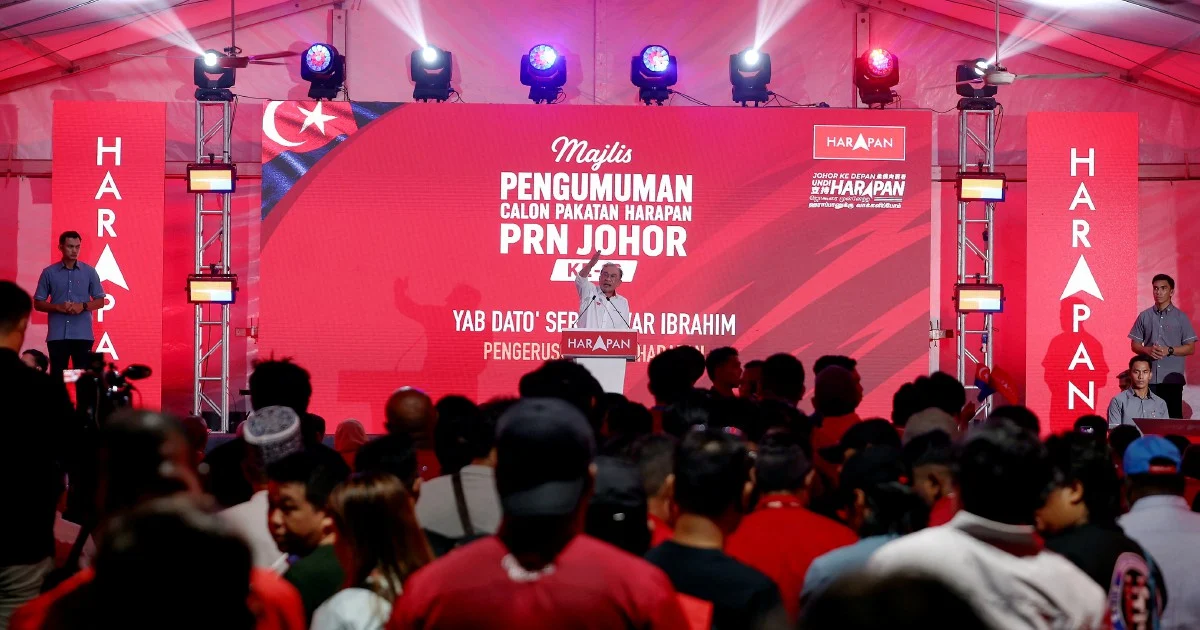
Pakatan Harapan chairman Datuk Seri Anwar Ibrahim has drawn a firm line regarding the forthcoming Johor state election, insisting that the contest should unfold as a purely political affair without the involvement of any royal institutions. Speaking in Tangkak, Anwar made clear his position that electoral campaigns and political competition in the state should be confined to the realm of partisan politics, signalling a desire to keep constitutional institutions separate from the electoral process.
The statement carries significant implications for how Malaysia's electoral system is perceived and conducted, particularly in states where the monarchy maintains considerable cultural and constitutional prominence. Anwar's intervention reflects a growing tension in Malaysian politics regarding the boundaries between the political sphere and institutional arrangements involving royal figures. By explicitly calling for the exclusion of Malay Rulers' institutions, he is articulating a principle about democratic process that extends beyond Johor itself, touching on broader questions about institutional independence and electoral integrity.
Anwar's remarks arrive at a juncture when Johor politics has been experiencing considerable turbulence and realignment. The state has been witnessing shifts in political allegiances and contests over electoral boundaries, making his statement a timely reminder about maintaining constitutional propriety. His emphasis on keeping the election within conventional political bounds suggests concern that external institutional involvement could compromise the legitimacy of the electoral outcome or create complications in terms of governance and political stability.
The Johor state election represents a crucial test for various political coalitions operating in Malaysia. As one of the nation's most populous and economically significant states, Johor serves as a bellwether for broader political trends affecting the country. An election confined to political competition allows voters to make choices based on policy platforms, governance records, and party performance rather than being influenced by factors external to the conventional electoral sphere. Anwar's position effectively argues for voters to determine outcomes through their own political preferences.
This call for boundary maintenance between electoral politics and royal institutions resonates with international democratic norms, where separation of powers and institutional independence are considered fundamental. In Malaysia's constitutional monarchy, the respective roles of the monarchy, executive government, legislature, and judiciary have evolved over decades, with ongoing negotiations about appropriate spheres of influence. Anwar's statement can be interpreted as advocating for a clear democratic principle: elections belong to voters and political parties, while royal institutions should maintain their constitutional roles without becoming entangled in partisan competition.
The timing of Anwar's statement suggests he may be responding to specific developments or concerns surrounding the Johor election that have prompted him to spell out these principles explicitly. Whether responding to perceived interference or attempting to preempt potential complications, his message is unambiguous about the need for institutional restraint. This kind of public clarification serves to set expectations for how all stakeholders should conduct themselves during the electoral period, potentially preventing misunderstandings or constitutional conflicts down the line.
For Malaysian observers and regional analysts, Anwar's position illuminates the delicate balance that Southeast Asian democracies must maintain when traditional institutions intersect with modern electoral systems. Malaysia's unique constitutional arrangement, where rulers play formal roles in government while the country operates as a democracy, requires careful navigation. The PKR leader's statement suggests that he believes the strongest and most sustainable electoral outcomes emerge when political actors compete on equal footing within established democratic rules, rather than through involvement of institutions whose power derives from different sources.
The practical implications of keeping royal institutions separate from electoral campaigns also extend to governance stability. When elections are contested purely on political grounds, the victor gains a mandate specifically rooted in political support. This clarity prevents later disputes about the basis of political authority or suggestions that election outcomes were influenced by non-political factors. For Johor, which faces development challenges and economic competition from neighbouring states and countries, a straightforward political process allows for clearer mandates and more focused governance agendas.
Anwar's intervention also reflects the increasingly sophisticated understanding within Malaysian politics about institutional roles and democratic practice. Rather than simply dismissing concerns or remaining silent, the PH chairman has articulated a principle that can guide all parties' conduct during the election period. By framing the issue as one of democratic propriety rather than partisan advantage, he appeals to broader constituencies who value constitutional stability regardless of which party wins electoral contests. This approach strengthens the legitimacy of democratic processes themselves, which ultimately benefits all political actors operating within the system.
The statement carries particular weight given Anwar's current position as Prime Minister's party chairman and his national leadership role. His words set a standard that other major political figures and institutions are likely to acknowledge, even if implementation varies. Whether this translates into concrete restraint across all stakeholders during the actual campaign period remains to be seen, but publicly enunciating such principles creates benchmarks against which conduct can be evaluated and helps establish what constitutes appropriate electoral behaviour in Malaysia's evolving democratic culture.

