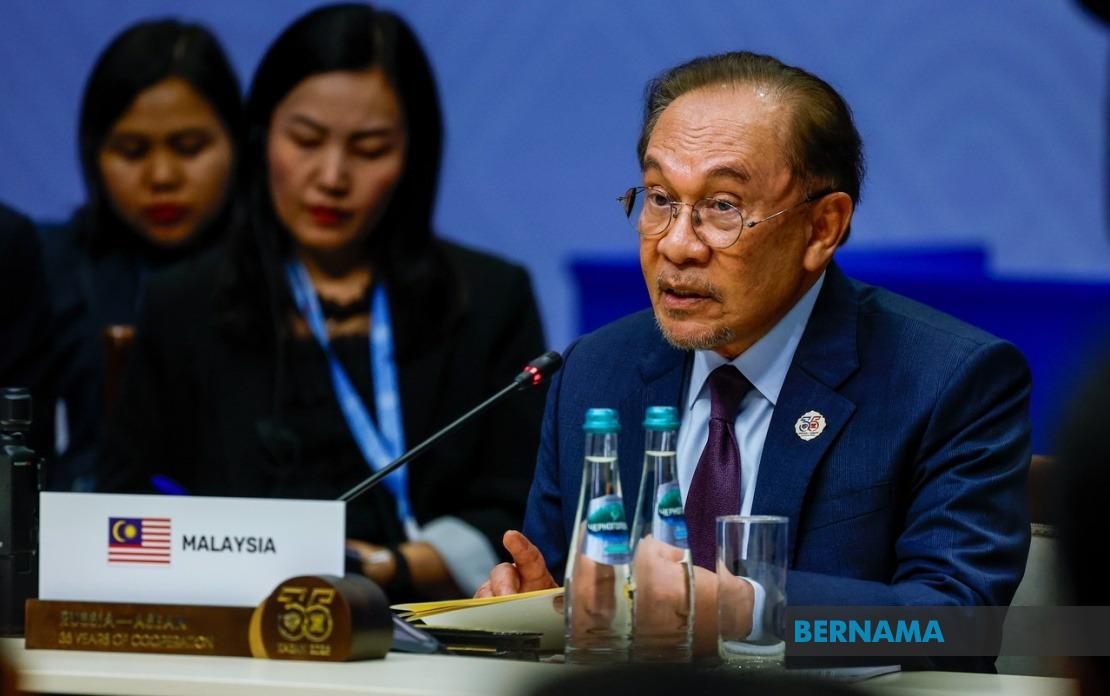
Prime Minister Datuk Seri Anwar Ibrahim has called for ASEAN and Russia to expand their strategic partnership across diverse economic and technological domains, addressing an audience at a landmark commemorative summit in Kazan. Speaking during the plenary session of the ASEAN-Russia Commemorative Summit, Anwar positioned dialogue and diplomacy as non-negotiable foundations for managing international disputes and the mounting geopolitical uncertainties confronting the world today.
The summit represents a significant gathering for regional cooperation, bringing together the ten ASEAN member states with Russia at a time when the global landscape remains fractured by competing interests and military escalations. Anwar framed the occasion as a critical platform for channelling collaborative efforts that can generate tangible advantages for all participating nations. His remarks underscore Malaysia's broader diplomatic strategy of maintaining open communication across ideological and strategic divides, a position increasingly important as tension between Western and non-aligned powers shapes international relations.
The prime minister outlined an ambitious agenda for future cooperation, spotlighting collaboration in trade and investment as foundational pillars. Beyond commerce, he identified digital infrastructure, artificial intelligence, and scientific advancement as priority areas where ASEAN and Russia can pool resources and expertise. Energy security emerged as another focal point, reflecting regional anxieties over long-term access to affordable fuel sources amid global volatility. Food security also featured prominently in Anwar's remarks, a consideration of particular relevance to Southeast Asian nations vulnerable to climate shocks and supply chain disruptions.
Anwar extended this cooperation framework to include the halal industry, a sector where Malaysia and ASEAN possess significant competitive advantages and certification authority. The inclusion of this area signals an attempt to leverage Islamic-world markets and position ASEAN firms as trusted suppliers within global halal value chains. People-to-people exchanges were similarly emphasised, acknowledging that sustainable partnerships rest upon cultural understanding and direct engagement between citizens, not merely government-to-government transactions.
The prime minister's emphasis on international law and peaceful resolution reflects Malaysia's principled stance on contemporary conflicts, particularly the ongoing situation in West Asia. Anwar reiterated Malaysia's demand for an immediate halt to violence in Gaza, coupled with unimpeded access for humanitarian assistance. This position aligns Malaysia with broader ASEAN sentiment, though approaches vary across member states depending on their own strategic interests and diplomatic ties. The call for protection of Palestinian self-determination represents Malaysia's consistent advocacy within regional forums and the United Nations.
An additional point of note was Anwar's condemnation of Israeli military expansion into Lebanon and any attacks targeting UNIFIL, the United Nations peacekeeping force operating there. This language reflects growing regional concern over the geographic spread of Middle Eastern instability and its potential consequences for international peacekeeping mechanisms. For Malaysia, maintaining credible peacekeeping operations remains important given its own participation in UN-mandated missions historically and its strategic interest in global stability frameworks.
The summit's timing coincides with the 35th anniversary of ASEAN-Russia diplomatic relations, a milestone established in 1991 in Kuala Lumpur. This historical context underscores the evolution of ties between the bloc and Moscow over three decades, spanning periods of Cold War conclusion, the emergence of multipolarity, and now the current era of strategic competition. The anniversary offers both parties an opportunity to assess achievements and reset expectations for the next phase of engagement.
Participation at the summit reflected the highest echelon of regional leadership, including Philippines President Ferdinand Marcos Jr., who holds the ASEAN Chair for 2024, alongside other national leaders and delegations. This level of representation signals the significance both ASEAN and Russia attach to the partnership's trajectory and their commitment to elevating bilateral and collective engagement. The Philippines' presidency this year has given added weight to ASEAN positions on regional and global matters, enabling coordinated advocacy on issues ranging from the South China Sea to development cooperation.
The two-day format of the summit permitted comprehensive dialogue on strategic cooperation and substantive exchanges regarding regional and international developments of mutual concern. The scope encompassed not only bilateral Malaysia-Russia matters but also collective ASEAN positioning on critical global questions, from climate change to cyber security. For Malaysian observers and policymakers, such summits provide windows into how ASEAN consensus forms on contested international issues and how individual nations navigate between maintaining unity and pursuing distinct national interests.
Four key outcome documents are expected to emerge from the gathering, beginning with the Kazan Declaration commemorating 35 years of ASEAN-Russia relations. Joint statements on energy and cultural cooperation will provide targeted frameworks for sectoral advancement, while a comprehensive implementation plan for 2026–2030 will establish concrete benchmarks and timelines for the strategic partnership. These documents serve as roadmaps guiding resource allocation, capacity building, and institutional coordination over the coming years.
The 2026–2030 strategic partnership plan represents an attempt to embed resilience and forward-thinking into ASEAN-Russia engagement structures, moving beyond reactive responses to crises toward proactive cooperation architecture. By anchoring commitments within formal multilateral agreements, both sides signal intent to weather potential diplomatic storms and maintain institutional momentum through leadership transitions. For Malaysia specifically, such long-term frameworks help justify domestic investments in Russian language education, technical training in energy sectors, and trade promotion initiatives that require years to yield returns.
The summit reflects broader geopolitical patterns wherein ASEAN nations seek to maintain constructive relations with multiple global powers regardless of their relative proximity to Western or competing spheres of influence. Malaysia's participation and leadership contributions underline its commitment to pluralistic international engagement, emphasising that strategic autonomy requires dialogue with all significant actors. In an environment where economic interdependence, security threats, and diplomatic pressure increasingly intersect, ASEAN's ability to sustain balanced partnerships remains a regional asset and a contribution to global stability itself.