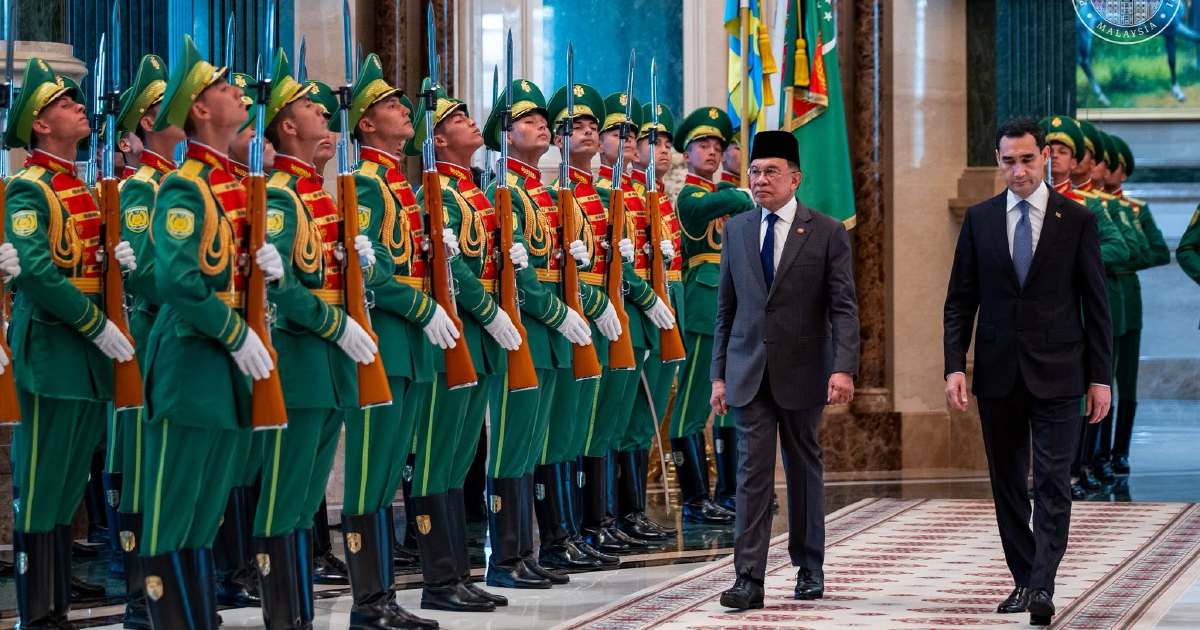
Prime Minister Datuk Seri Anwar Ibrahim was accorded full official honours at Turkmenistan's Presidential Palace in Ashgabat, underscoring the significance both nations place on their bilateral relationship. The ceremonial reception marks the first time Anwar has visited the Central Asian state since assuming office as Malaysia's Prime Minister, reflecting the growing diplomatic engagement between Kuala Lumpur and the region's energy-rich economies.
The formal welcome ceremony signals Turkmenistan's commitment to deepening ties with Malaysia amid shifting geopolitical dynamics across Asia. For Malaysia, the visit represents an opportunity to expand strategic partnerships beyond the immediate Southeast Asian neighbourhood and tap into emerging economic opportunities in Central Asia. This diplomatic move comes as countries throughout the region seek to strengthen connections with partners that can offer mutual benefit in trade, investment, and energy security.
Turkmenistan, Central Asia's largest gas exporter and holder of substantial hydrocarbon reserves, presents particular interest for Malaysian companies and investors exploring diversification opportunities. The nation's strategic location along historic trade routes and its role as a bridge between Europe and Asia make it an increasingly important player in regional stability and economic development. For Malaysian policymakers, establishing robust high-level contacts with Turkmenistan's leadership creates pathways for future commercial collaboration and knowledge exchange.
Anwar's visit underscores Malaysia's broader foreign policy orientation toward building meaningful relationships across diverse geographic and cultural contexts. The Prime Minister's participation in official state ceremonies demonstrates the ceremonial and substantive importance accorded to this engagement, suggesting both nations view the relationship as foundational rather than transactional. Such high-level visits typically precede concrete arrangements in areas ranging from trade protocols to educational scholarships and technical cooperation programmes.
For Malaysian observers of international affairs, the visit illustrates how the country continues to position itself as a bridge-builder in global diplomacy. Rather than limiting engagement to established Western partners or immediate regional neighbours, Malaysia actively cultivates relationships with lesser-known but strategically significant nations. This approach reflects the principles of balanced foreign policy that have guided Malaysian diplomacy for decades, emphasizing South-South cooperation and non-aligned positioning.
The timing of this inaugural visit carries implications for Malaysia's energy security considerations. As the country grapples with long-term sustainability of its domestic energy resources, exploring partnerships with major gas producers like Turkmenistan could inform future import strategies. Central Asian energy supplies have become increasingly relevant to Asian economies seeking to reduce dependence on Middle Eastern sources and diversify their energy portfolios.
Cultural and educational exchanges frequently accompany such official visits, though details of any specific agreements remained pending. Malaysian universities and research institutions may find opportunities to collaborate with Turkmenistan's academic sector, fostering people-to-people connections that extend beyond governmental relationships. These foundational contacts often yield unexpected innovations in scientific research, business partnerships, and professional networks.
The Presidential Palace ceremony also carries symbolic weight within Turkmenistan's domestic context. By extending full state protocol to Malaysia's Prime Minister, the Turkmen government signals to its own population and international observers the value it places on this bilateral relationship. Such ceremonies are carefully choreographed to communicate diplomatic messages both to immediate participants and broader audiences monitoring developments in Central Asian international relations.
From a Malaysian perspective, establishing credibility and presence in Central Asia requires consistent high-level engagement over time. Single visits, while important, constitute the foundation upon which sustained relationships are built. Anwar's presence in Ashgabat represents the beginning of what Malaysian diplomatic officials hope will be a productive long-term partnership spanning multiple sectors and involving various stakeholders beyond government.
Looking forward, the success of this visit will likely be measured not merely by ceremonial gestures but by concrete outcomes in bilateral cooperation. Trade statistics, investment flows, and institutional arrangements between Malaysian and Turkmen organisations will indicate whether this diplomatic engagement translates into tangible benefits for citizens and businesses in both nations. Malaysian companies eyeing expansion into Central Asia will watch closely for signals regarding the regulatory environment and openness to foreign participation in key sectors.
The visit also reflects broader patterns of Malaysian engagement with Central Asian states, suggesting a strategic recalibration of the country's international priorities. As Malaysia seeks to maintain its relevance in an increasingly multipolar world, cultivating partnerships with energy-rich, geopolitically important nations like Turkmenistan represents a pragmatic diversification of diplomatic assets. This approach acknowledges that Malaysia's prosperity depends not solely on traditional partners but on its ability to forge mutually beneficial relationships across the global stage.

