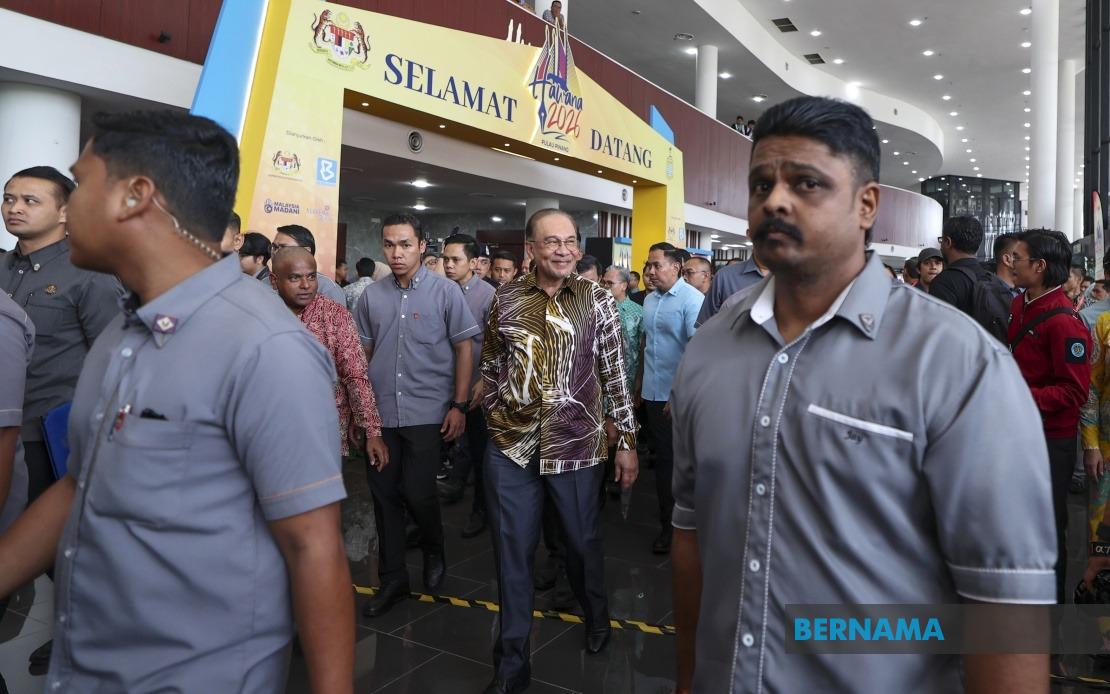
Prime Minister Datuk Seri Anwar Ibrahim has officiated the highlight of the National Journalists' Day (HAWANA) 2026 celebration at the PICCA Convention Centre @ Butterworth Arena, underscoring the government's commitment to recognizing the critical role of the media in sustaining democratic institutions and public discourse. The Prime Minister's attendance at this high-profile event signals the importance placed on media partnerships and press freedom within Malaysia's governance framework.
Anwar arrived at the venue on June 20 at 2.40 pm and received a formal welcome from Penang Chief Minister Chow Kon Yeow, Communications Minister Datuk Fahmi Fadzil, and Communications Ministry secretary-general Datuk Abdul Halim Hamzah. The senior-level reception reflected the significance of the occasion, which brought together prominent figures from Malaysia's media landscape and international delegations. Following his arrival, the Prime Minister toured the exhibition booths and the HAWANA 2026 Photo Gallery, engaging with the diverse displays that showcase journalism's evolving landscape in the digital age.
Among the Malaysian leadership present were Malaysian National News Agency (Bernama) chairman Datuk Seri Wong Chun Wai, Bernama chief executive officer and HAWANA 2026 Working Committee chairman Datin Paduka Nur-ul Afida Kamaludin, Bernama editor-in-chief and deputy chairman of the HAWANA 2026 Working Committee Arul Rajoo Durar Raj, and deputy editor-in-chief (News Service) and HAWANA 2026 project director Mohd Shukri Ishak. Their collective participation underlined the institutional commitment to advancing journalistic standards and fostering collaborative dialogue within the regional media ecosystem.
The event demonstrated ASEAN's growing emphasis on media cooperation and regional dialogue. Delegations from multiple ASEAN member states attended, including Timor-Leste Secretary of State for Social Communication Expedito Loro Dias Ximenes, Cambodia's Undersecretary of State at the Ministry of Information Prak Thaveak Amida, and Permanent Secretary of the Cabinet Office of Laos' Ministry of Technology and Communications Phuangpasert Keosouvanh. Additionally, representatives from Timor-Leste's news agency, Agencia Noticiosa de Timor-Leste (TATOLI)—including president Noemio Mateus Soares Falcao and deputy president Madalena DE JCP Carlos—participated in the gathering, reflecting the depth of regional media partnerships.
The international scope of HAWANA 2026 extended beyond ASEAN, with delegations from key global media organizations in attendance. Representatives from Indonesia's Antara News Agency, the Vietnam News Agency (VNA), and Xinhua News Agency were present, alongside professional bodies such as the Indonesian Journalists Association (PWI) and the Ikatan Setiakawan Wartawan Malaysia-Indonesia (ISWAMI). This international representation transformed the celebration into a multi-stakeholder platform for exchanging best practices and addressing contemporary challenges facing journalism across the region.
During the ceremonial proceedings, Anwar presented the HAWANA Award and the Special HAWANA Award to individuals recognized for their substantial contributions to journalism and the advancement of public thought. The Prime Minister also distributed contributions from the Kasih@HAWANA Fund to deserving media veterans, demonstrating governmental support for the welfare of journalists who have devoted their careers to the profession. These awards serve a dual purpose: recognizing excellence while setting benchmarks for journalistic integrity and professionalism within the industry.
Held under the thematic banner of 'Media Integrity Strengthens Credibility', the HAWANA 2026 main event convened approximately 1,000 media practitioners from Malaysia and abroad. This substantial gathering created a strategic platform for generating innovative ideas and establishing the trajectory of contemporary journalism in Southeast Asia. The emphasis on media integrity reflects growing concerns about misinformation, disinformation, and the erosion of public trust in news institutions—challenges that transcend national boundaries and require coordinated regional responses.
The event's organization by the Ministry of Communications, with Bernama as the implementing agency, reflects the institutional framework within which Malaysia manages its relationship with the press. HAWANA serves as a pivotal instrument for the government to recognize the dedication, professionalism, and essential societal role of media practitioners in delivering accurate, authentic, and credible information. For Malaysia, this recognition is particularly significant given the complexities of operating a media landscape that balances press freedom with national security and social cohesion considerations.
For Malaysian and Southeast Asian readers, HAWANA 2026 represents more than ceremonial recognition. It signals a regional commitment to strengthening journalism during a period of unprecedented technological disruption and information fragmentation. The participation of multiple ASEAN delegations suggests collaborative efforts to establish common standards for media integrity and to counter the spread of false information that threatens public discourse across the region. As digital platforms continue to reshape how news is produced and consumed, such platforms become increasingly vital for maintaining journalistic standards and fostering accountability within the industry.

