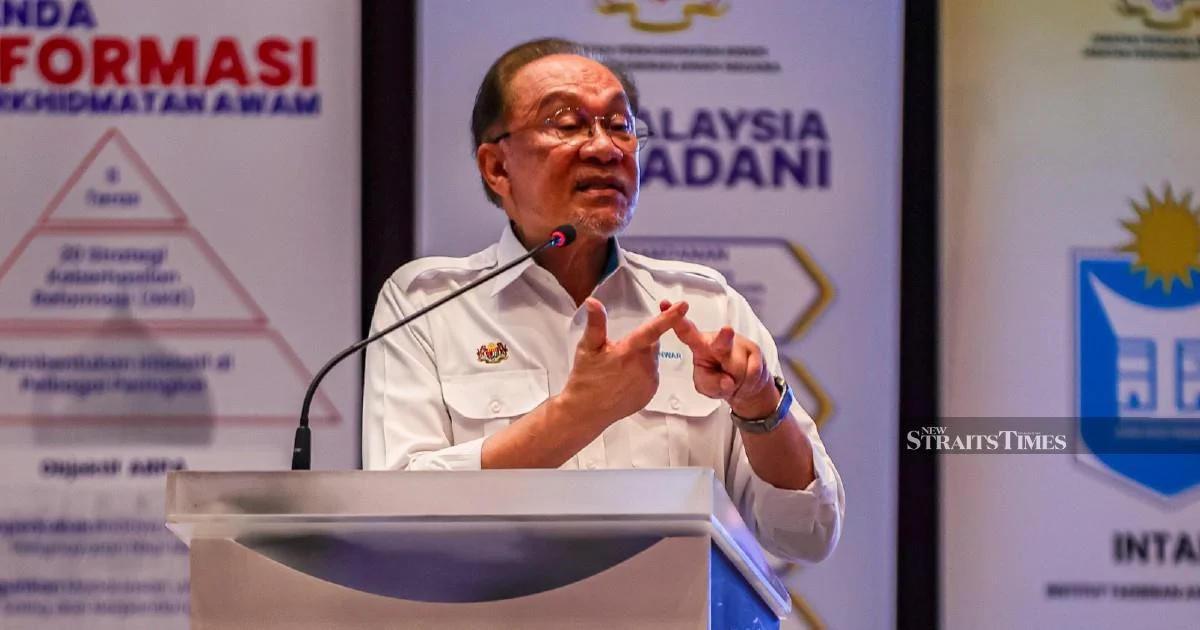
Prime Minister Datuk Seri Anwar Ibrahim sought to ease political tensions within the ruling coalition on Friday, clarifying that Parti Amanah Negara (Amanah) president Datuk Seri Mohamad Sabu had not intended to disparage any political party during his speech at the Pakatan Harapan (PH) candidate announcement ceremony in Tangkak. Speaking in Alor Gajah, Anwar's intervention appeared designed to prevent the remarks from escalating into a broader factional dispute within the four-party coalition that governs Malaysia.
The timing of Anwar's statement underscores the delicate balance the Prime Minister must maintain among PH's constituent parties—PKR, DAP, Amanah, and Parti Pribumi Bersatu Malaysia—as they navigate the complex terrain of federal politics. With general elections potentially on the horizon and the coalition striving to project unity to voters, any perception of internal discord risks undermining the government's stability and electoral prospects. Anwar's swift response to Mat Sabu's controversial remarks demonstrated his commitment to containing potential damage before it could metastasize into a public dispute that might be exploited by opposition figures.
Mat Sabu's speech at the Tangkak event had apparently generated concern among some coalition members, suggesting that his comments may have been perceived as critical commentary directed at one or more of his PH partners. The nature of such remarks in Malaysian political contexts often revolves around ideological differences, policy disagreements, or historical tensions between parties with distinct constituencies and electoral bases. Amanah, the party formed from defectors who left PKR in 2015, carries its own distinct political identity rooted in moderate Islamic principles and has sometimes occupied a middle ground between DAP's secular orientation and PKR's populist appeal.
The Tangkak candidate announcement itself represented an important moment for PH's campaign machinery, as the coalition prepares to field candidates in key constituencies. These announcements typically serve both as symbolic reaffirmations of party alliances and as practical steps toward electoral mobilization. Tensions at such events, however minor, can reverberate through party structures and media coverage, potentially distracting from the coalition's policy agenda or campaign messaging.
Anwar's intervention reflects broader patterns in Malaysian coalition politics, where the Prime Minister frequently assumes the role of mediator and consensus-builder. His position as head of PKR, the largest party in PH, alongside his role as Prime Minister, grants him significant authority to shape intra-coalition discussions and potentially to forestall disputes before they become public knowledge. However, this balancing act requires constant attention, as any perceived favoritism toward one party over another could provoke resentment among the others.
The statement also carries implications for DAP, PKR, and other coalition members who may have been concerned about Amanah's comments. By publicly endorsing Mat Sabu's explanation, Anwar signaled that he did not view the remarks as part of a broader pattern of inter-party friction. This reassurance may prove important for maintaining morale among coalition members, particularly in the context of the challenging political environment that has characterized Malaysian politics in recent years.
Mat Sabu's leadership of Amanah places him in a significant position within PH, and his public statements carry considerable weight among the party's base and broader coalition observers. The Amanah president has historically positioned himself as a voice for moderate Islam within Malaysian politics, a stance that sometimes creates distinct policy positions compared to other coalition partners. His speeches at major coalition events therefore tend to receive close scrutiny from both allies and opponents seeking to detect shifts in party or coalition positions.
The broader context for this incident includes ongoing discussions within PH about the coalition's direction, electoral strategy, and policy priorities heading into crucial upcoming contests. Internal harmony becomes increasingly important as parties compete for voter support while also maintaining their collective commitment to the coalition framework. Any perception that one party is attempting to distance itself from others or to establish a separate political identity risks weakening PH's overall electoral appeal and governing cohesion.
Anwar's public statement represents a deliberate choice to manage coalition politics through transparent communication and senior-level reassurance rather than allowing tensions to simmer beneath the surface. This approach has generally served the coalition well, though it also places significant demands on the Prime Minister's time and political capital. The willingness of coalition leaders to engage in such clarifications and mediation ultimately determines whether PH can maintain sufficient unity to govern effectively and compete credibly in elections.
Looking forward, the incident underscores the ongoing challenge facing Malaysian coalition governments: balancing the distinct interests and identities of multiple parties with the need for unified governance and electoral strategy. As PH continues its journey, managing such moments of potential tension will remain central to the coalition's sustainability and effectiveness. Anwar's proactive approach to this situation demonstrates an understanding that early intervention in potential disputes often proves more effective than allowing them to fester and potentially damage coalition relationships.

