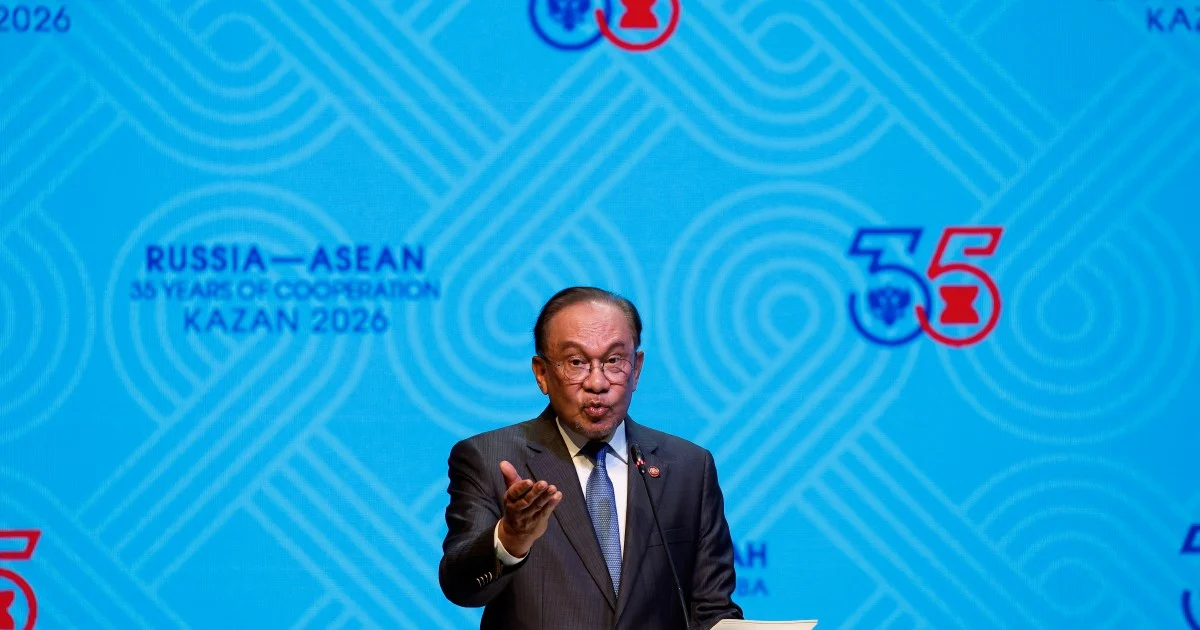
Prime Minister Datuk Seri Anwar Ibrahim has welcomed the completion of the Asean-Russia Strategic Programme on Trade and Investment Cooperation 2026-2035, viewing the agreement as a significant catalyst for expanding bilateral commerce across Southeast Asia. Speaking in Kazan, Anwar characterised the finalisation of this decade-long framework as a pivotal moment for the region's relationship with Moscow, signalling renewed commitment to deepening partnerships beyond traditional political dialogue.
The strategic programme represents a comprehensive blueprint for strengthening commercial, investment, and economic ties between the 10-member Association of Southeast Asian Nations and the Russian Federation. By establishing a structured pathway through 2035, the agreement provides both parties with measurable targets and collaborative mechanisms designed to unlock growth opportunities that have remained largely untapped due to geopolitical fragmentation and sanctions-related constraints in recent years.
Anwar's endorsement carries particular weight given Malaysia's role as a respected voice within Asean and its track record of balancing relationships across major powers. The Prime Minister's comments suggest that the bloc is signalling openness to diversifying its economic partnerships, particularly as it navigates shifting global trade dynamics and seeks to reduce dependence on traditional Western markets. This positioning aligns with Asean's central doctrine of strategic autonomy and non-alignment, even as the region contends with competing strategic interests from larger powers.
However, Anwar's caveat about the need for an enabling environment underscores a fundamental reality: successful trade frameworks depend on more than diplomatic goodwill. The Prime Minister appeared to reference the complex landscape of international sanctions, logistics infrastructure, regulatory harmonisation, and business confidence that continue to challenge Russia's economic integration with global markets, including Asean. Without tangible improvements in these enabling conditions, the strategic programme risks becoming another aspirational document rather than a catalyst for genuine commercial expansion.
The timing of this agreement reflects broader geopolitical recalibration. Asean has increasingly sought to maintain pragmatic engagement with Russia despite Western pressure, recognising that the bloc's prosperity depends on avoiding forced alignment in global conflicts. This approach has placed Asean in a delicate diplomatic position, requiring statements that acknowledge partnership possibilities while maintaining credible relationships with Western trading partners and allies. Malaysia, with its own history of balanced foreign policy, understands these sensitivities acutely.
From a practical standpoint, the 2026-2035 roadmap likely encompasses sectoral cooperation ranging from energy and natural resources to technology, agriculture, and manufacturing. For Malaysian businesses and investors, such a framework could open new avenues for trade corridors, joint ventures, and supply chain diversification. Southeast Asia's geographic position and manufacturing capacity make it a natural intermediary for Russian trade, potentially creating opportunities even where direct Russia-Western commerce faces obstacles.
The investment dimension of the programme is equally important. Russian capital and expertise in specific sectors—particularly energy, mining, and certain industrial technologies—could complement Asean's developmental ambitions. Conversely, Southeast Asian investors and companies could find opportunities in Russian markets, particularly in consumer goods, services, and technology adaptation. Such mutual investment flows strengthen economic interdependence and create constituencies within each region favouring expanded cooperation.
Nevertheless, significant challenges remain. Western sanctions regimes continue to complicate banking relationships, payment mechanisms, and technology transfer arrangements. Many multinational companies remain cautious about deepening Russian engagement due to reputational and compliance risks. These structural barriers cannot be legislated away through trade agreements alone; they require sustained diplomatic effort to create conditions where businesses can operate with reasonable certainty.
Anwar's measured optimism reflects realistic policymaking. Rather than overstating the immediate impact of the agreement, he has positioned it as a beginning—an important statement of intent that creates frameworks within which practical cooperation can develop. This framing suggests that the Malaysian government recognises both the potential and the limitations of such grand strategic programmes in the current global environment.
For Southeast Asian economies like Malaysia, closer Asean-Russia cooperation offers potential benefits in energy diversification, particularly natural gas imports, agricultural trade, and niche manufacturing sectors. The region's middle-income status and technological capabilities make it an attractive partner for Russia seeking to circumvent or work around sanctions constraints through selective partnerships and supply chain rearrangement.
Looking ahead, the success of the 2026-2035 roadmap will depend on mechanisms for implementation, dispute resolution, and regular review. Asean's consensus-based decision-making processes and Russia's preference for bilateral arrangements mean that translating the programme into concrete outcomes will require sustained diplomatic shepherding. Malaysia's ongoing chairmanship roles within various Asean forums position it to play a constructive mediating role in ensuring the agreement translates into tangible benefits for member states.
Ultimately, Anwar's endorsement signals that Asean intends to pursue diversified economic partnerships while maintaining strategic flexibility. The trade roadmap serves as one element of a broader effort to strengthen the region's economic resilience and reduce vulnerabilities to any single-power economic leverage. In advancing this objective, the finalised programme represents not a definitive breakthrough but rather a necessary foundation upon which sustained, pragmatic cooperation can be built.