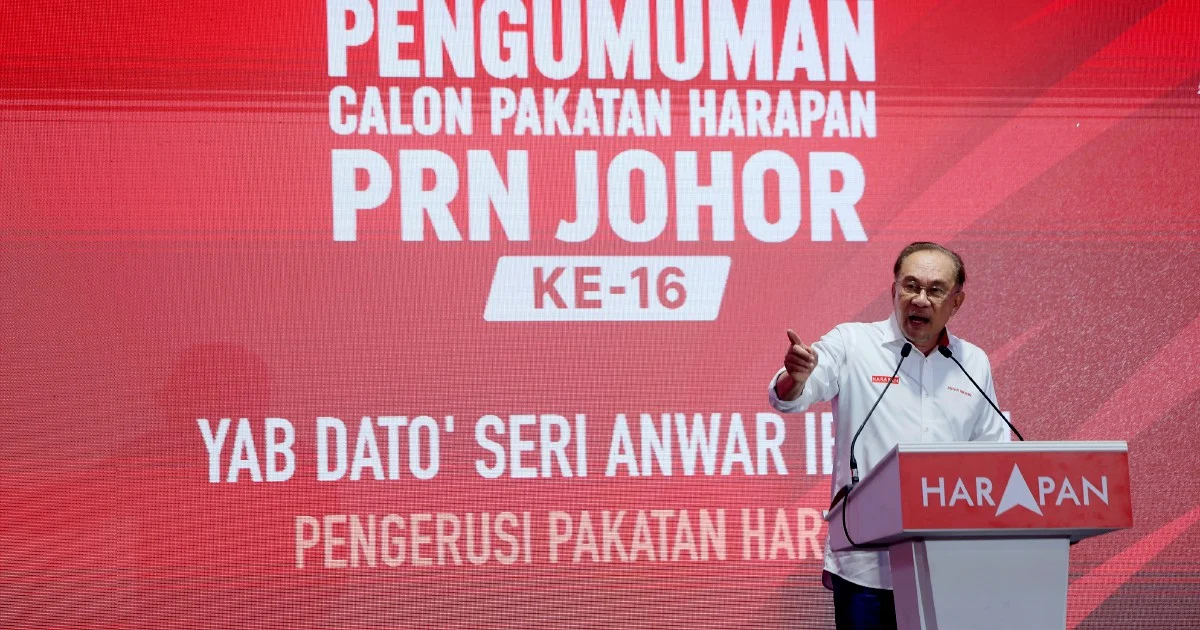
Prime Minister Datuk Seri Anwar Ibrahim has encouraged a Johor state executive councillor to press the previous Barisan Nasional and Perikatan Nasional federal governments for transparency regarding revenue distribution claims, reflecting ongoing tensions over fiscal federalism in Malaysia's richest state.
Speaking in Tangkak, Anwar highlighted the need for Johor's leadership to systematically review and challenge historical revenue-sharing arrangements, particularly the adequacy of federal transfers to the state. The remarks underscore the current administration's willingness to revisit financial allocations between Kuala Lumpur and the states, a sensitive issue that has periodically sparked tension between different tiers of government.
Johor, as Malaysia's fourth-largest state by population and a significant economic contributor, has long contended with questions about whether its resource wealth and fiscal contributions are adequately reflected in federal disbursements. The state generates substantial revenue through port operations, petroleum concessions, and manufacturing, yet historically received transfer allocations that various analysts and state officials have questioned. This imbalance has been a recurring friction point in Malaysian federalism, particularly when different coalitions control federal and state governments.
Anwar's intervention carries political weight coming from his position as Prime Minister and PKA's de facto leader. By explicitly encouraging scrutiny of both BN and PN administrations, he demonstrates the unity government's stance on reviewing governance practices from both its predecessors. The suggestion that Johor's executive council should formally challenge historical revenue claims reflects a strategy of holding prior governments accountable while potentially recalibrating relationships with key states.
The revenue-sharing dispute reflects deeper questions about Malaysia's federal structure. States contribute to federal coffers through various taxation mechanisms and resource wealth-sharing agreements, yet federal allocations back to states are determined through formulae that have remained largely opaque and resistant to reform. For a state like Johor, which hosts major port operations and petroleum interests, the gap between contributions and receipts has periodically generated calls for renegotiation.
Previous BN administrations managed these federal-state relationships through established mechanisms, while the PN government introduced different priorities and allocation criteria. The current unity government inherits these arrangements and faces pressure from constituent states to improve their respective positions. Johor's vocal questioning of its treatment under both predecessors suggests state-level frustration that transcends individual coalition preferences.
The timing of Anwar's remarks reflects the unity government's broader effort to reset the social contract between Putrajaya and the states. By encouraging documentary challenge to revenue claims, the government tacitly acknowledges that previous systems may have been inequitable. This approach allows the PM to appear reformist while avoiding immediate fiscal commitments, instead asking states to build cases for improved treatment based on historical evidence.
For Johor specifically, the opportunity to systematically review decades of revenue arrangements could yield significant financial benefits. A comprehensive audit examining whether federal transfers matched the state's economic contributions and population share might substantiate long-standing complaints. Such documentation could form the basis for renegotiating allocation formulae, though any substantial redistribution would require federal political will and acceptance from other states.
The broader Southeast Asian context matters here too. Malaysia competes with Singapore, Thailand, and Indonesia for regional economic prominence and investment. Johor's position as a gateway to Singapore and its status as a manufacturing hub mean that state-level fiscal health directly impacts regional competitiveness. Clearer, more equitable revenue-sharing could enhance Johor's capacity to invest in infrastructure and services, potentially strengthening Malaysia's economic position in the region.
However, Anwar's encouragement to question previous governments also carries risks. Reopening revenue disputes could unsettle federal-state relationships and create expectations across other states for similar reviews. Penang, Selangor, and Sabah might similarly demand audits of their respective allocations, creating a cascade of fiscal claims that the federal government must address. This could strain the unity coalition's coherence if member parties represent different states with competing interests.
The statement also suggests the current administration may be willing to use fiscal policy as a tool for consolidating political relationships. By supporting Johor's revenue claims, the government strengthens ties with the state government while demonstrating responsiveness to legitimate grievances. This approach could become a template for managing other states within the coalition, though it requires available fiscal space that may be constrained by Malaysia's debt situation.
Moving forward, Johor's executive council will likely commission detailed reviews of federal transfers under both BN and PN administrations. Such investigations could become pivotal in reshaping how Kuala Lumpur distributes revenue to states. The outcome will signal whether the unity government genuinely intends to reform federal-state fiscal relationships or whether Anwar's encouragement was primarily rhetorical positioning.

