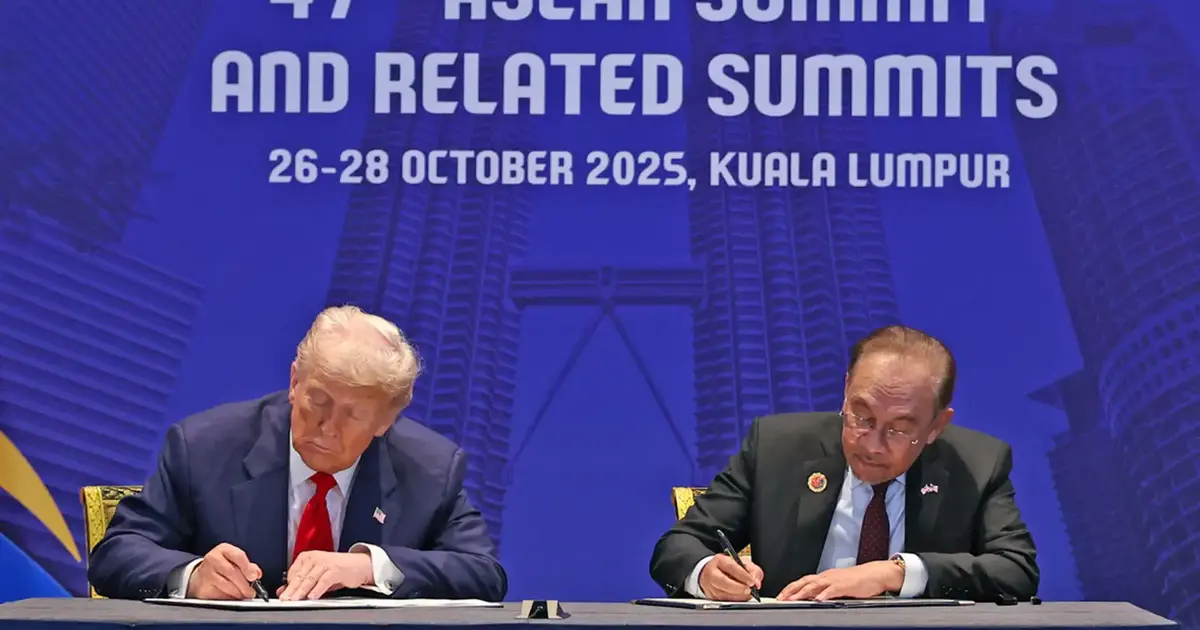
Prime Minister Anwar Ibrahim's government and the administration have jointly applied to have a legal challenge filed by opposition parliamentarians dismissed from court, marking an escalation in the constitutional dispute surrounding the recently negotiated reciprocal trade arrangement with the United States.
The move by the government comes as political tensions mount over the bilateral commerce agreement, which has attracted scrutiny from lawmakers across the political spectrum. The opposition MPs initiated the legal action to contest the validity and implementation of the trade deal, arguing that parliamentary procedures and constitutional requirements may not have been properly observed.
In a parallel maneuver, the same MPs have simultaneously lodged a separate application petitioning the Federal Court to examine fundamental constitutional questions arising from the trade pact. This dual-track legal strategy reflects the depth of concern among opposition benches regarding the agreement's constitutional standing and whether the government possessed appropriate authority to conclude such arrangements without fuller parliamentary deliberation.
The reciprocal trade agreement with the United States represents a significant commercial engagement for Malaysia, potentially reshaping bilateral economic ties and affecting various sectors of the domestic economy. Trade deals of this magnitude typically involve complex negotiations spanning months or years, touching on tariffs, market access, intellectual property protections, and regulatory harmonization across numerous industries.
The constitutional questions that the MPs wish to raise focus on the proper legal mechanisms through which Malaysia can enter international commercial agreements. Specifically, they appear concerned about whether executive action alone suffices or whether parliamentary oversight and approval constitute mandatory procedural requirements under the Federal Constitution. These inquiries carry implications extending far beyond this single transaction, potentially establishing precedent for how future international obligations are negotiated and implemented.
For Malaysia's regional standing and its role within ASEAN and the broader Indo-Pacific trade ecosystem, the outcome of this dispute carries weight. The country has positioned itself as a pragmatic participant in regional commerce, maintaining diversified trading relationships while attempting to navigate great power strategic competition. A robust domestic political debate about trade deal governance could either strengthen democratic accountability or create institutional uncertainty that complicates Malaysia's negotiating position internationally.
The government's decision to strike out the application suggests confidence in its legal position regarding both the substantive merits of the trade agreement and the procedural legitimacy of its conclusion. The administration's argument likely centers on the executive's traditional prerogative in foreign affairs and treaty-making, a doctrine deeply embedded in Commonwealth constitutional practice upon which Malaysia's system is founded.
Yet the MPs' insistence on raising constitutional questions indicates persistent skepticism about whether existing frameworks adequately protect parliamentary interests in an era of complex international economic arrangements. Southeast Asian democracies have grappled with balancing executive efficiency in foreign negotiations against legislative oversight, with different countries reaching different equilibriums between these competing values.
The Federal Court's eventual pronouncement on these matters could reshape how Malaysia approaches future trade negotiations, investment treaties, and other international agreements requiring domestic legal implementation. If the court sides with the MPs on constitutional grounds, it might necessitate enhanced parliamentary procedures for future major trade accords. Conversely, if it upholds the government's position, it affirms broad executive latitude in international commerce—a principle with both efficiency and accountability implications.
Businesses operating in Malaysia or considering the country as a regional hub have interests in this outcome as well. Clarity about the legal frameworks governing trade agreements affects investment confidence and the predictability of commercial relationships. Prolonged constitutional uncertainty, even if ultimately resolved in the government's favor, can create hesitation among international partners and investors evaluating Malaysia's stability and institutional reliability.
The dispute also reflects broader global trends in which parliaments increasingly demand voice in trade policymaking, challenging traditional executive dominance in foreign affairs. This phenomenon appears across advanced democracies and developing nations alike, driven by recognition that trade agreements have profound distributional consequences affecting employment, prices, and competitive dynamics across multiple sectors.
As the legal proceedings unfold, the government faces pressure to articulate clearly how it consulted stakeholders, evaluated impacts on domestic industries, and ensured alignment with Malaysia's long-term economic strategy. The opposition, meanwhile, must demonstrate not merely procedural objections but substantive concerns about the agreement's terms that warrant judicial intervention.
The coming months will likely see detailed arguments about both the constitutional law governing international agreements and the specific merits of the Malaysia-US arrangement. Whatever the courts ultimately decide, the case underscores that modern trade governance increasingly demands legitimacy grounded not merely in executive competence but in transparent democratic processes that can command broad political acceptance.

