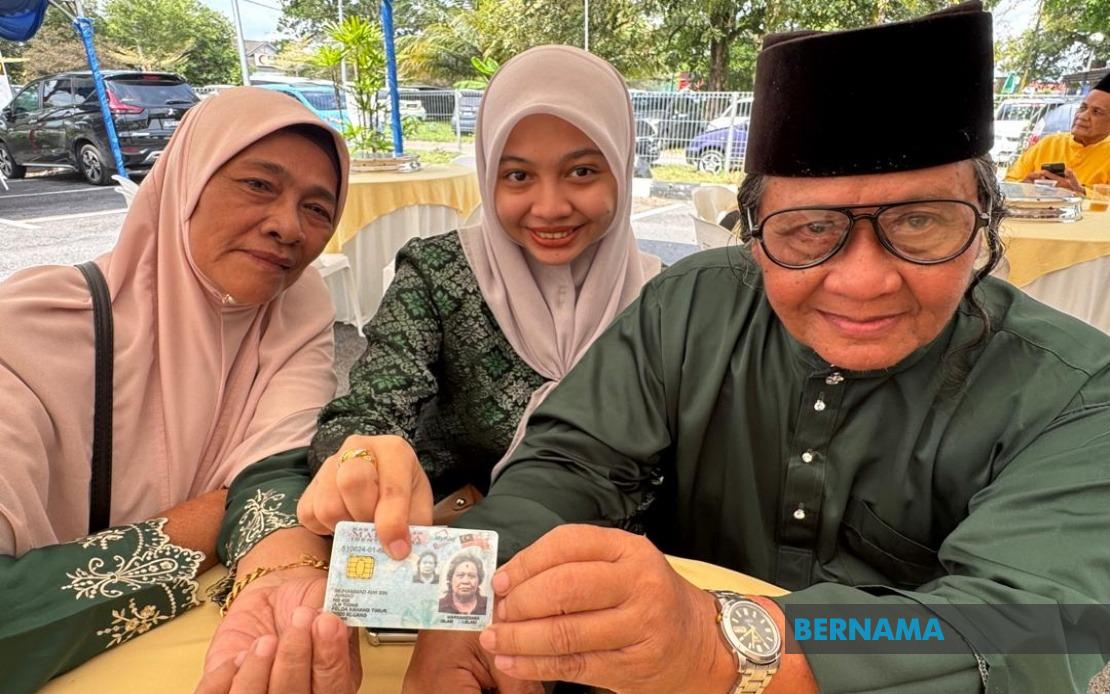
Muhammad Awi Ahmad marked his 75th birthday in Kluang with news that could not have arrived at a better moment: the official ownership title to his nearly 4.2-hectare plantation and home in Felda Kahang Timur. For this longtime settler, the document represented far more than a legal formality—it was the culmination of a personal quest spanning three decades and multiple rejected applications. His first two attempts to secure ownership, filed in 1990 and 2000 respectively, had ended in disappointment. Only this year, under the administration of Johor's Menteri Besar Datuk Onn Hafiz Ghazi, did his third application succeed within approximately twelve months.
Muhammad Awi's experience, while deeply personal, reflects a broader struggle that has defined the lives of Malaysia's Felda settlers for generations. These agricultural workers, who dedicated their working years to developing plantation land on behalf of the Federal Land Development Authority, found themselves in a peculiar legal limbo—cultivating land productively but without clear ownership rights. His relief at finally holding the title deed was palpable: "All the worry and uncertainty are over now. On my 75th birthday today, the land I have been working on for so long now belongs to me," he told news agency Bernama following a formal handover ceremony at Dewan Dato' Onn in Sembrong constituency.
The scale of the resolution becomes apparent when examining the reach of the initiative. A single ceremony held in Kluang encompassed 210 land title transfers across three districts—Kluang, Kota Tinggi, and Mersing. This represents not merely an administrative exercise but a systematic addressing of institutional backlog that had accumulated over multiple decades. The Johor state government's decision to process these applications represents a policy shift toward resolving what had become an entrenched grievance within the settler community. For many recipients, the approval marked the end of anxiety that had colored their entire adult lives.
The generational dimension of this issue carries particular weight for families like Muhammad Awi's. His daughter Norliyani, representing the second generation of Felda settlers at age 25, articulated a crucial reality that extends beyond her father's circumstance. The uncertainty surrounding land ownership did not merely affect those who had cleared and cultivated the plantations; it created perpetual insecurity for their children and grandchildren who viewed this land as their only home. "The first generation of Felda settlers can still go back to their villages, but for us as the second and third generation settlers, this is our home and we've got nowhere else to go," Norliyani explained, capturing the stark difference in perspective between settler cohorts.
Her concerns touch on inheritance and generational continuity. Without secure titles, settler families faced the nightmarish prospect that land they had nurtured for half a century could eventually transfer to others—potentially government agencies, private entities, or other claimants with stronger legal standing. For families with no alternative assets or fallback options, this represented an existential threat. Norliyani's articulation of the issue as one of fairness and intergenerational justice proved powerful: ensuring her parents retained ownership became synonymous with securing her own family's future stability and economic foundation.
The case of Mohd Farhan Mohamad, a 43-year-old resident of Felda Pasak in Kota Tinggi, demonstrates how these applications often took on emotional and familial dimensions beyond mere property claims. Farhan had initiated his application in 2006 with the explicit intention of honoring his father Mohamad Masek's wishes to secure formal ownership of land he had cultivated since the 1980s. The gap between application and approval—spanning nearly two decades—meant that Mohamad Masek could spend his final years with clarity about his legacy. When Farhan and his father submitted their latest application the previous year, they harbored little hope of success, having already endured multiple disappointments. The approval this year thus arrived as an unexpected vindication.
The aggregate numbers reveal the magnitude of what remained unresolved before this initiative. Across all of Johor, 27,639 Felda settlers out of 27,642 who had filed applications have now received ownership titles—a completion rate of 99.9 percent. This remarkable figure suggests that the backlog involved tens of thousands of individual cases, each representing a family's security and inheritance. The systematic clearing of virtually the entire queue indicates a coordinated bureaucratic effort rather than ad hoc case-by-case resolution. For a state government to process and approve applications from this many residents speaks to political will and institutional capacity being aligned toward resolving a historically contentious issue.
The context of Felda settlers' broader situation deserves consideration. These individuals and their families represent one of Malaysia's foundational agricultural programs, established with the intention of providing economic opportunity and land access to rural populations. Yet the disconnect between the promise of ownership and the legal reality created a governance failure that persisted across multiple administrations and decades. Settlers who had invested decades of labor, established communities, raised families, and contributed to Malaysia's agricultural output found themselves perpetually vulnerable because paperwork remained incomplete. This situation exemplified how bureaucratic inertia could undermine policy intentions and leave vulnerable populations in precarious circumstances.
The implications for Malaysian society extend beyond Felda communities specifically. Property rights constitute a fundamental pillar of economic security and personal autonomy. When government agencies fail to formalize ownership despite settlers fulfilling their obligations and investing years of work, it corrodes confidence in institutional reliability. Conversely, when long-delayed justice is finally delivered—as appears to have happened in Johor—it demonstrates the possibility of rectifying historical wrongs through sustained political commitment. For other settler populations in Malaysia facing similar uncertainty, and for administrators grappling with accumulated backlogs in various systems, the Johor experience offers both a cautionary tale and a potential model for resolution.
Moving forward, the question becomes whether this clearing of backlogs in Johor signals broader momentum toward similar reforms in other states. Felda settlers exist throughout Malaysia, and land title uncertainty likely affects populations beyond the organization's formal beneficiaries. The political will demonstrated by Menteri Besar Datuk Onn Hafiz Ghazi's administration suggests that resolving such historical injustices can become a governance priority when properly elevated. For Muhammad Awi, Norliyani, Mohd Farhan, and thousands of others finally holding formal ownership documents, the long wait has ended. But for Malaysia's other settler communities still navigating uncertainty, the question of when their own moment of resolution will arrive remains open.

